


China has warned Australia it could be slapped with an additional 55 per cent tariff on beef imports within days if it exceeds new shipment quotas.
Starting this year, Beijing introduced new quota and tariff arrangements for major beef import countries including Australia in a bid to protect local farms and beef producers.
Australia’s annual import quota was set at 205,000 tonnes of beef shipments, about one-third lower than its total imports into China from 2025.
Once that load is exceeded, a 55 per cent trade impost will soon come into effect.
Earlier this week China’s Ministry of Finance and Commerce issued an alert to Australia that it had reached about 90 per cent of its quota, just six months into the year.
China’s state media said the ministry’s alert notice was the fourth issued to Australia since the new quota system started.
“Previously, the ministry announced in March that imports of beef from Australia had reached 50 per cent of the annual quota under its safeguard measures, and reached 80 per cent in May,” said the Global Times, a major English state media site.
Australian beef is highly prized in China and is sought after in restaurants and high-end supermarkets for what is perceived as better taste and quality.
The Australian government has lobbied China to lift or expand the 2026 quota level, but Beijing has shown no indication of movement.
Tariffs ‘serious’ but not deadly for Aussie beef industry
Meat and Livestock Australia (MLA) general manager of international markets Andrew Cox said there would likely be a reduction in trade to China once the new tariffs are imposed.
“I don’t think it will totally stop, but certainly 55 per cent is a significant barrier to trade,” he said.
“There’s no doubt we’ll be sending significantly less beef in the second half of the year, but I can’t give you an exact figure.
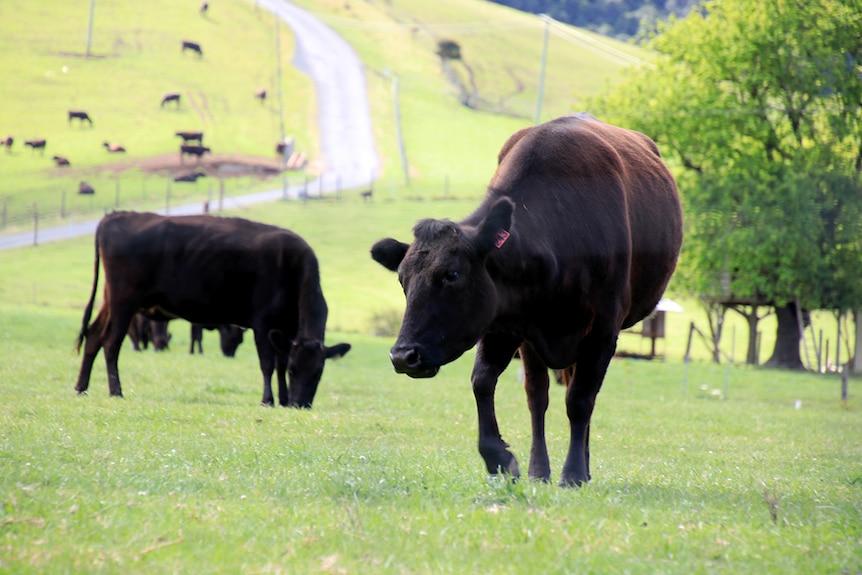
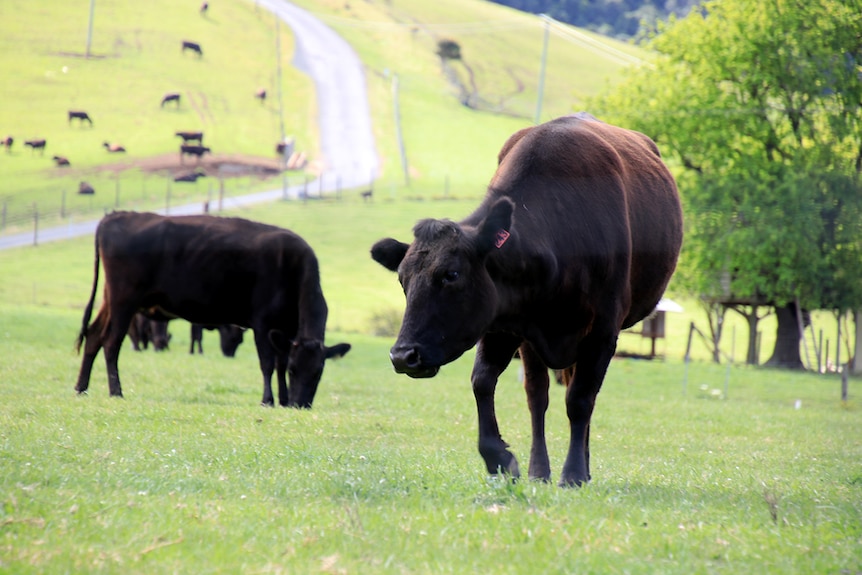
Australian beef imports used to be subject to low or even zero tariffs in China under a bilateral free-trade agreement, but that changed in January. (ABC Illawarra: Justin Huntsdale.)
“All I know is that there’s certainly a willingness from Chinese customers to stock Australian beef — a lot of steakhouse menus, a lot of retail shelves … stock a lot of Australian beef and have done for a long time.
“So they’re very keen to see how they can carry stock through and keep buying.”
Many Chinese customers had been incentivised to “buy big” in the first half of the year to try and beat the tariffs, contributing to Australia approaching the quota so soon, Mr Cox said.
“Cool rooms are full [of Australian beef] in China, is my understanding, and those buyers have been keen to get their hands on product in the first half of the year before any of the safeguard tariffs trigger,” he added.
Mr Cox said it’s too early to tell the financial impact of the tariffs, but said farmers were already looking to other South-East Asian markets to sell their produce.
“China was our second-biggest market last year, and whilst we’re a small part of imported beef [for China], we’re a large part of the chilled beef supply chain,” he said.
“So, certainly a 55 per cent tariff on your second largest market is serious, I won’t sugar-coat that.
“But the Australian beef industry is not overly reliant on one market, such as China.
“We’ve got good export markets like Japan, Korea, United States, and then emerging and developing markets that are showing great promise.”
China’s Ministry of Finance and Commerce was approached for comment.