





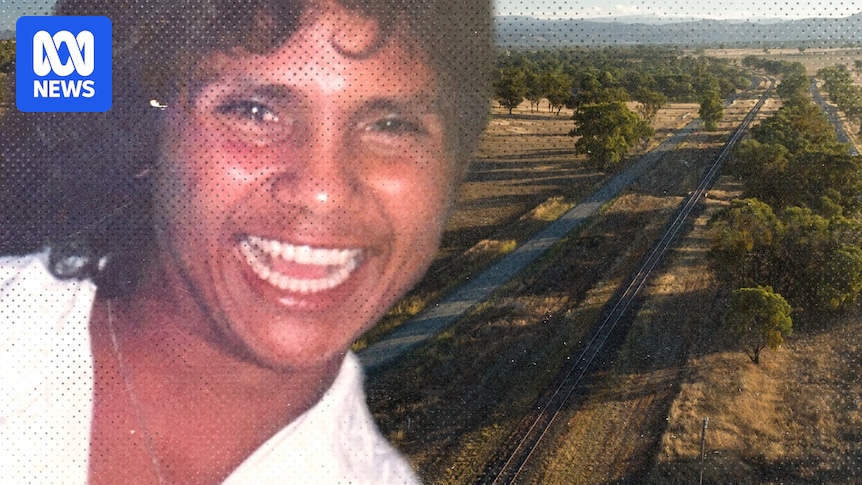
Mark Anthony Haines had a big smile, adored animals and had a soft spot for the musician Prince.
Warning: This story contains racist and offensive language. It also features photos of an Indigenous man who died.
He was loved by his friends, and would call his younger siblings for weekly chats over the phone.
Mark was 17 years old when he died on January 16, 1988.
His family still light candles for his birthday every year.
Thirty-eight years on from his death, the NSW Coroner’s Court has found the attitudes of the town he called home played a central role in the police investigation into his death.
Mark Haines loved animals, and grew up in an adoring family. (Supplied: Aboriginal Legal Service )
An uncomfortable truth
Mark’s body was discovered in mysterious circumstances on train tracks just south of Tamworth.
Since the beginning, his family have always rejected the police’s theory that he placed himself on the tracks.
Almost 40 years after his death, NSW Deputy State Coroner Harriet Grahame confirmed she can not confidently rule how Mark’s body came to be on the tracks.
One thing Coroner Grahame was certain of however, was that racism played a role in the police investigation.
Mark lived in Coledale, on the town’s southern fringe.
The inquest would hear it was common for Mark’s neighbourhood to be referred to as ‘vegemite village’ — a derogatory reference to its large Indigenous population.
Former Senior Constable Gordon Guyer had told the court the term was commonly used.
Mark’s family always believed racism played a role in the investigation into his death.
“I question how a police investigation could be quarantined from these widespread attitudes,” Deputy State Coroner Harriet Grahame said.
“I find it unlikely that such a superficial investigation would have taken place if it was a white boy on those train tracks.“
Mark’s uncle Don Craigie vividly recalls the rattle of the old police vans as they’d drive towards the mission he grew up on in northern NSW.
It left a scar on the Gomeroi man. His family was part of the Stolen Generations.
Mark Haines grew up close to his uncle Don Craigie, who has spent four decades fighting to understand how his nephew died. (Supplied: Aboriginal Legal Service)
“[Police] drove F100s in those days. People knew exactly who they were,” Mr Craigie told the inquest.
Soon after his nephew’s body was removed from the tracks on the morning he died, the train that had passed over him was allowed to continue its journey south.
“If [Mark] was a white boy I feel they would have flipped the train looking for blood, brain and tissue,” he would tell the inquest.
“They didn’t do that for Mark.“
With no faith in the police, Don and his family took it upon themselves to investigate Mark’s death.
It’s a distrust the Deputy State Coroner understood.
“I am surprised, given all the evidence, anyone would deny the pervasive existence of racism in Tamworth in the 1980s,” Coroner Grahame said.
“Their lack of confidence was well placed in those days.”
NSW Police were approached for comment following Coroner Grahame’s findings, however they declined to comment.
Mark’s parents were never the same after their eldest son died. (Supplied: Aboriginal Legal Service)
Superficial investigation
A stolen white Holden Torana was found near Mark’s body, with police initially concluding it must have been taken by Mark.
However, as the inquest heard, Mark didn’t know how to drive.
The court heard the stolen Torana was found near Mark’s body. (ABC News)
In 1988, police ruled the teenager’s death was a suicide, and because of that, critical evidence was not collected and leads were left unfollowed.
That includes a connection between the crashed White Torana and Mark’s best friend Glen Mannion.
Mr Mannion, who gave evidence to the inquest on two separate occasions, has always denied having any involvement in Mark’s death.
Judge Grahame drew particular attention to the evidence provided by Mr Mannion, saying there were aspects of his behaviour she found “unusual”.
“I doubt Glenn Mannion has been fully open with this court.
“Despite his emphatic denials, I remain unconvinced Mr Mannion has shared with this court all he knows.”
Coroner Grahame found that police at the time were influenced by a broader issue of bias.
“I am confident [racial bias] played a role and impacted the level of thoroughness … on early decisions,” she told the court.
Deputy State Coroner Harriet Grahame attended the smoking ceremony held by Mark’s family at the steps of the court. (ABC News: Max Tillman)
“Mark’s family rejected suicide from the start, and they were not listened to.”
Family’s pain
Mark’s sister Lorna remembers the moment her mother found out Mark had died, and dropped to the floor wailing.
Mark’s parents were never the same after their eldest son’s death, it changed all their lives forever.
Gathered on the steps of Tamworth Court after the findings had been delivered, Lorna and her younger brother Ron spoke of their enduring hope for an answer.
Siblings of Mark Haines, Ron and Lorna, attended each day of the five-week inquest. (ABC News: Max Tillman)
“Because he was black, [the police] didn’t care about him,” Lorna Haines said.
“What we went through, we are still going through … but we never lost hope.”
For Mark’s Uncle Don, living with the knowledge some answers were never found is difficult.
But the fight is not yet over.
“We feared our boy met with foul play,” he said.
“Does the journey end here, or is the journey going to continue?
“As I understand it, it will continue.“