



Even from the other side of the door, they could hear the television news report blaring: a man in custody, another on the run, four police dead.
Outside, the three senior officers stopped and listened.
Then Superintendent John Fitzpatrick knocked.
“[They] knew why we were there,” recalls Fitzpatrick, then the force’s divisional commander for Road Policing Operations and Investigation.
“But I still had to say … ‘I’ve got some horrible news for you’.”
At 5:35pm, on April 22, 2020, four Victoria Police officers had been at the scene of a traffic stop on Melbourne’s Eastern Freeway.
The car they had pulled over had been speeding, and the driver had tested positive for alcohol, cannabis and ecstasy at the scene.
But as the officers stood by their vehicles, a Volvo prime mover ran down the emergency lane and killed Constable Glen Humphris, Leading Senior Constable Lynette Taylor, Senior Constable Kevin King and Constable Josh Prestney.
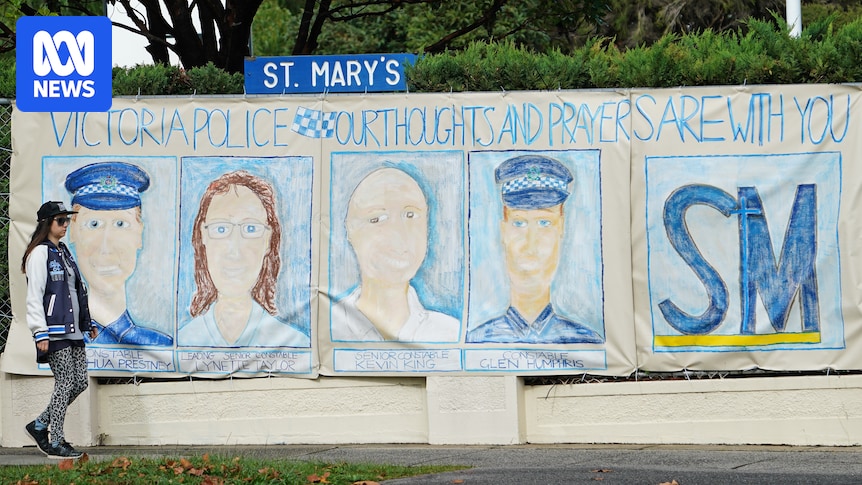
Constable Glen Humphris, Senior Constable Kevin King, Leading Senior Constable Lynette Taylor and Constable Joshua Prestney were killed in the April 22 crash. (Supplied: Victoria Police)
Now someone had the awful job of informing their families.
Their deaths marked the single deadliest moment in Victoria Police’s history and became a defining tragedy for the force.
It also set off years of protracted criminal prosecutions, the last of which was only finalised in a NSW court this month.
But six years on, the memory of the horror on the freeway continues to cling to the force like smoke, stinging the eyes of all involved.
John Fitzpatrick had the responsibility of notifying the next of kin on the night of the tragedy. (ABC News: Danielle Bonica)
For the first time, some of those officers have spoken to the ABC about what happened on the Eastern Freeway, and the bruising investigation that followed.
The day of the Eastern Freeway crash
It was at 4:48pm that day when a Porsche 911 Turbo S coupe hurtled down the Eastern Freeway at up to 149 kilometres an hour — a black blur on the major road connecting Melbourne’s eastern suburbs to the city.
The Porsche’s blistering speed caught the attention of Taylor and Humphris, who promptly pulled it over into the emergency lane near the Burke Road on-ramp at Kew East.
They called for backup and a short time later King and Prestney arrived on the scene, parking behind their colleagues.
Craig Pearson was one of the officers in charge of managing the crime scene on the Eastern Freeway. (ABC News: Danielle Bonica)
Not long after, Inspector Craig Pearson, who was the duty officer responsible for the eastern half of the state that night, received a call from the force’s media unit telling him there had been a fatal incident. They said the chief commissioner, Graham Ashton, wanted an update.
It was an unusual request because Victoria Police has an internal communications system which updates commanders when significant events happen.
A short time later, Pearson learned the four dead were police officers.
“It’s almost unreal,” he says.
“It’s that sick feeling in your stomach.”
Pearson raced to the scene to take on the role of incident commander, snaking down the Eastern Freeway’s internal emergency lane.
He tried to visualise what might be at the scene, but nothing was able to prepare him.
Craig Pearson says he will never forget what he saw on the Eastern Freeway in April 2020. (ABC News: Danielle Bonica)
He recalls the shock on the faces of the first responders confronted with a collective loss of their own, but no tears.
“I haven’t forgotten their faces, they’re just amazing people,” he says.
He returned to Doncaster police station in the early hours of the morning to find off-duty staff had come in to support their colleagues.
Victoria Police begins picking up the pieces
The freeway tragedy briefly pierced the panic and haze of the COVID-19 pandemic, which had plunged the state into its first lockdown and left Victorians with little to do but consume the news.
As they watched, appalled, that night, Victoria Police swung into action, trying to piece together how the tragedy could have happened. Dozens of officers, from the uniformed to the high-ranking, were called on to respond.
Police immediately began piecing together what had happened on the Eastern Freeway that night. (AAP: Scott Barbour)
At the centre of the destruction were two men: the Porsche driver, Richard Pusey, and the truck driver, Mohinder Singh.
Moments before the crash, Pusey had stepped over the freeway barrier onto an embankment to relieve himself, a decision which would ultimately save his life.
But it is what happened in the immediate moments after the crash that led a Victorian judge to suggest he was probably “the most hated man in Australia”.
Inexplicably, Pusey used his phone to film the police officers as they lay dying, providing a cruel, expletive-laden commentary. Then he fled.
By the time Detective Inspector Roger Schranz — then from Victoria Police’s Road Crime Investigations — arrived on the scene, Mohinder Singh had been taken to hospital and Richard Pusey had disappeared, having hitched a ride into the city.
Firefighters and investigators worked at the scene all through the night and into the next day. (ABC News: Kyle Harley)
A manhunt was underway, but the crash site was eerily quiet.
Before road policing, Schranz had worked in Professional Standards Command, the internal affairs wing of Victoria Police, and went to crime scenes where colleagues had been killed.
For more than a decade he was also the president of Victoria Police Legacy, which supports police families who have suffered the loss of a loved one. He was braced for the loss of police lives more than most. Still, the size of the tragedy that night chilled him.
“I’ve driven down there and intercepted cars — yeah, could have been me,” Schranz said.
“It’s just a stark reminder of how fragile life is and how it could happen to any one of us any day.“
Years later, many police officers remain shaken by the deaths of their four colleagues. (AAP: Joel Carrett)
The investigation into the crash was split into four crews, each with a distinct thread: Porsche driver Richard Pusey, truck driver Mohinder Singh, Singh’s trucking boss Simiona Tuteru, and the company Connect Logistics.
Fitzpatrick was asked to lead the taskforce with Inspector John Cormack.
The special group was named Paragon, meaning a model of excellence or perfection. It is a definition Fitzpatrick believes the teams lived up to, but one that came with a price: the strain of it eventually toppled some of the investigators who stepped up the task.
“Some of them didn’t come back to work again,” he said.
Floral tributes were placed at the gates of the Victoria Police Academy for the fallen officers in the days after the crash. (AAP: Daniel Pockett)
The ‘most hated man in Australia’ arrested
The morning after the crash, Richard Pusey arrived at the Melbourne West police station with his lawyer where he was interviewed and then arrested by Detective Senior Constables Aaron Price and Kallyn Gent.
Price, then a homicide squad detective, had been at home with his wife and children when the crash appeared on the news. His two boys were young but knew something awful had happened.
Aaron Price was one of the homicide detectives who arrested Richard Pusey. (ABC News: Danielle Bonica)
On the morning of Pusey’s interview, one of Price’s sons handed him a bandaid for his colleagues. He still keeps it in the top drawer of his desk.
“It’s probably the only thing in this job that got me,” says Price, apologising for his tears.
Pusey appeared at the Melbourne Magistrates’ Court on Friday, April 24. He faced 12 charges including failing to render assistance. It was standing room only inside the courtroom.
He would later also be charged with outraging public decency, an obscure and rarely-used law, which, until then had almost been exclusively used for indecent or public exposure. For months, lawyers would argue about that charge and whether it even existed.
Richard Pusey, the driver of the Porsche, being arrested at his Fitzroy home. (AAP: Michael Dodge)
In direct response to the tragedy, the Victorian government would ultimately make grossly offensive public conduct a crime with up to five years’ jail time.
In court, Price read out a police summary of Pusey’s actions on the Eastern Freeway, including the Porsche driver’s commentary of the wreckage, which reporters then conveyed to an appalled public.
“I got a bit emotional when I read it out,” Price says.
“I suppose it’s probably the first time I really thought, ‘Geez I’m a copper, they’re coppers too’.”
Aaron Price says the emotions were overwhelming when he spoke during the trial. (ABC News: Danielle Bonica)
The case wound its way through the court for months, but a trial was ultimately avoided after Pusey eventually struck a deal with prosecutors and pleaded guilty to just two charges: reckless conduct endangering persons and outraging public decency.
In the County Court, just days after the one-year anniversary of the crash, Pusey was sentenced to 10 months in prison.
The judge noted he was “probably the most hated man in Australia” but accepted he did not goad the dead and dying officers and instead engaged in a “running commentary”.
The drug-fuelled driver behind the tragedy
During the four days he spent at the Royal Melbourne Hospital, Mohinder Singh had been desperate to explain himself to his police guards, telling them all he was guilty of was a bad accident.
But by the time he sat across from Detective Acting Senior Sergeant Paul Lineham, the senior investigating officer on the Paragon Taskforce, he was less forthcoming. For half an hour he stonily refused to answer questions. Then, suddenly, something shifted.
“He looks up and he’s just got tears and I said, ‘what’s going on mate?'” Lineham recalls.
“He goes, ‘I did not want to drive. They made me drive’.”
Paul Lineham was the officer in charge of investigating truck driver Mohinder Singh. (ABC News: Danielle Bonica)
In the lead-up to the crash Singh had been on a drug-fuelled bender, smoking and injecting ice.
Mobile phone records later revealed he had, at most, just five hours’ sleep in three days — the same level of impairment of someone with a blood-alcohol reading of 0.3, according to a sleep expert in his Supreme Court trial.
The court heard ice use had also made Singh actively psychotic, and he was convinced he had been cursed by a witch.
On the day of the crash, Singh presented himself at the Connect Logistics depot at Lyndhurst, in Melbourne’s outer south-eastern suburbs, to speak with his boss Simiona Tuteru.
Mohinder Singh, pictured in a police car following the crash on the Eastern Freeway. (ABC News)
The night before, a shift supervisor found Singh trying to reverse his truck into the wrong bay and told Tuteru that he might not be fit to drive.
Singh and Tuteru prayed together at the depot before Tuteru, a lay Christian pastor, placed his hand on Singh’s head and said: “In Jesus’ name, I cast a spell out of you.”
Singh then signed a document declaring he was fit to drive and left the depot for Thomastown, stopping to sell ice on the way. Half an hour later, he had killed four police officers.
Investigators would later track down 25 people who had bought, sold or used drugs with Singh leading up to the crash and took their statements, painstakingly detailing Singh’s chronic, almost obsessive drug use. All but one agreed to speak to police.
Mohinder Singh pleaded guilty to culpable driving causing the death of the four police officers. (AAP: Luis Ascui)
Price, now an acting sergeant in uniform, was struck by how many people willingly gave evidence against Singh. He believes many felt sympathy for the investigators.
“Probably shows the common humanity, I suppose, between us and the public which is probably not the same in other jurisdictions around the world,” Price said.
Singh was ultimately jailed for 18 years and six months after getting his sentence reduced on appeal.
A trucking operation ‘rotten to the core’
Simiona Tuteru was originally charged with four counts of manslaughter and multiple breaches of Heavy Vehicle National Law, which sets strict limits on how many hours truck drivers can work in a 24-hour period so they are safe on the road.
Investigators alleged that was what made Tuteru “grossly negligent”.
Simiona Tuteru managed truck drivers in his role at Connect Logistics. (AAP: James Ross)
At the centre of the law is a concept called chain of responsibility, designed to keep everyone in the trucking industry accountable, including managers and executives, for the actions of their drivers.
On the surface, Connect Logistics was the picture of excellent work health and safety.
But when Lineham opened the company’s books, he found egregious breaches. He audited 1,951 shifts and found 1,626 fatigue-related offences.
Drivers who meet safety laws have their time-sheets ticked off and were paid. Lineham uncovered evidence of doctored time-sheets under the names of other employees.
He also found that Inghams, which gave the company millions in exchange for delivering their frozen chickens, had previously raised serious concerns about drivers breaking fatigue rules.
“It looked great on paper, but no, rotten to the core,” says Lineham, who came to the task-force from the major collision unit.
“They turned a blind eye to the offending, in fact in a lot of cases encouraged the offending by their processes.”
It was enough for investigators to charge not only Singh and Tuteru, but also Connect Logistics, its managing director Corey Matthews, executive Shane Chalmers and national operations manager Cris Large.
Connect Logistics, the trucking company Singh and Tuteru worked for, has since gone into liquidation. (AAP: David Crosling)
The company and all but one of the men were successfully prosecuted in New South Wales, with Matthews personally fined $22,500 and Chalmers fined $70,000. Large was found guilty of failing in his duties and jailed for three years but was acquitted on an appeal in late 2024.
After his appeal, Large pleaded guilty to a lesser charge and was last week (June 11) sentenced to a two-year conditional release order in the Paramatta Local Court.
He was ordered to pay legal costs of $16,842 but did not receive a conviction.
Connect Logistics was also fined $2.31 million, but will never pay its fine because it has gone into liquidation.
Lineham spoke to the ABC before Large was acquitted.
“Regardless of what happens, he spent one night in jail,” he says. “That’s all I’ll say on that.”
But the prosecution of Tuteru did not go to plan.
Contested charges lead to Supreme Court stoush
During a Supreme Court hearing in October 2022, the manslaughter charges were suddenly dropped, prompting an incensed exchange between Justice Lex Lasry and crown prosecutor Robyn Harper, who is now a County Court judge.
“I take it that … the Crown have finally worked out they don’t have a case, is that right?” Lasry said.
“I wouldn’t say that’s right, your honour, but I’m instructed to enter the discontinuance,” Harper said.
Simiona Tuteru was initially charged with manslaughter, but the charges were dropped. (ABC News)
Over the coming months, prosecutors would continue revising the charges against Tuteru and eventually whittled them down to a single count of breaching Heavy Vehicle National law.
But Lasry then put a permanent stay on the heavy vehicle charges, a rare and extraordinary step which represented the court refusing to exercise its jurisdiction.
“Continuing four charges of manslaughter against the accused for more than a year in circumstances where it must have been known there was no viable case to be made against the accused is, I consider, a glaring and oppressive misuse of the Court process,” Justice Lasry said.
But the decision was overturned in the Court of Appeal which found Justice Lasry’s reasoning was “problematic” and rested on “unsafe assumptions”.
“Having examined the entire history of these proceedings for ourselves, and with great respect to the primary judge, we are unable to see any basis on which a permanent stay could have been ordered in the present case,” his colleagues said.
“It is thus not necessary for us to consider whether his Honour’s decision was unreasonable or plainly unjust. Nevertheless, had it been necessary to do so, we would have so concluded.”
Lineham, who was the first detective sergeant for the force’s heavy vehicle unit, is well-versed in the extremely complex area of law. But he said everyone underestimated how convoluted applying the legislation would be.
He said they initially had no choice but to drop the manslaughter charges.
Paul Lineham was the first detective sergeant for the Victorian Police force’s heavy vehicle unit. (ABC News: Danielle Bonica)
By the time Tuteru had his day in court, he pleaded guilty to the remaining charge and was sentenced to a three-year community-based order. He was ordered to complete 200 hours of community work. He now runs a sliding door repair business in suburban Melbourne.
Meanwhile the exchange between Lasry and Harper would set off a chain of events which ultimately ended in Lasry’s resignation.
Victoria’s Director of Public Prosecutions filed a complaint against Lasry alleging his comments amounted to an attack on their professional integrity.
Nine days after learning of the complaint, Lasry announced his intention to resign during a pre-trial hearing, telling the court he “utterly rejected” the allegations against him.
The complaint against him was ultimately dismissed because he was no longer a judge.
In an interview earlier this year with a Melbourne legal podcast, William & Lonsdale, Lasry explained why he resigned.
He said that after the Court of Appeal reversed his permanent stay ruling, he believed the matter was closed, only to later learn of the complaint.
“I was in the middle of a quite complex, bikie murder trial, I’d been continuing to do criminal cases where the DPP was one of the parties, unaware that I was the subject of a complaint,” Lasry said.
“I wasn’t told by the DPP and for whatever reason the Judicial Commission kept it a secret from me as well.
“That, combined with the way in which the communication that the Judicial Commission sent me, led me to the view that I was a little bit behind the eight ball so far as getting a reasonable hearing.
“And I just decided I was not prepared to go through the process. I was 75, 76, I had enough, so the best way to resolve it, bring it to a head, was to quit, so that’s what I did.”
Reflecting back, six years on
Even now, memories of what happened on the Eastern Freeway send a jolt through those who responded.
Most of the Paragon investigators declined to participate in this story, not wanting to unearth a grief that continues to run deep. Those that did are proud of what they achieved.
A memorial service was held for the four officers in February 2022. (AAP: Joel Carrett)
After 44 years as a police officer, John Fitzpatrick retired in 2024. He joined when he was 19 and says even at that age, people looked to him and the force to solve their issues.
It was what Victorians expected on the night of April 22, 2020.
“In my view, we did a great job,” Fitzpatrick says.
“We didn’t do it because it was for police officers, we did it because it was four people who had families.”