






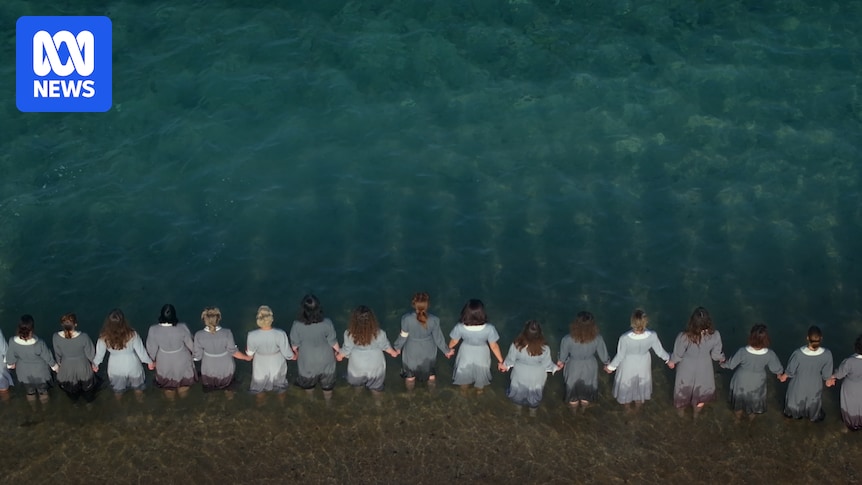
The beach is quiet, small waves lap the sand, a breeze rustles the trees that line the shore.
As the water ripples at their feet, a line of people step forward and make their way into the shallows.
With the sea gently splashing their knees, they cast flowers into the water, a poignant act of remembrance for a group of women who lined up on the same shore more than 80 years ago and were cut down in cold blood.
Relatives of the Bangka Island massacre victims cast flowers into the sea at the site of the killings on the beach. (Compass: Ivan Batara)
It was just before midday on Monday, February 16, 1942 on this remote beach on an Indonesian island that 21 Australian Army nurses were killed by Japanese soldiers.
The Bangka Island massacre, where more than 80 nurses and servicemen who survived the sinking of the steamship Vyner Brooke were murdered, was one of the worst atrocities committed against Australians by Japanese Imperial troops during World War II.
The Australian War Memorial describes it …
A party of Japanese troops arrived at Radji Beach … They shot and bayoneted the males and then forced the 22 Australian nurses, and the British civilian woman, to wade into the sea. The Japanese then shot them from behind.
Official histories, however, can leave much unsaid.
“If history uncovers that something is uncomfortable, we need to have the courage to engage with it and accept truth and facts and sit with that,” says Kath Stein, Group Captain Department of Defence.
What happened to those brave nurses before they were shot on a quiet tropical beach 84 years ago is confronting.
Rape was never mentioned in the official accounts.
Australian Army nurse Dorothy Elmes, known as Bud to her family, was killed in the Bangka Island massacre in 1942. (Supplied)
‘What really happened that day’
Georgina Banks has been on a quest to uncover the truth of what happened to her great aunt Dorothy “Bud” Elmes, an Australian army nurse from Cheshunt in Victoria, who was killed on Radji Beach that day.
“As a contemporary woman and a mother of daughters, there was no way that I was not going to turn over every stone I could to find out as much as I could about what really happened that day on the beach,” she tells Compass.
Georgina Banks has been on a quest to seek the truth about what happened that day on the beach. (Compass: Daniel Gallagher)
Her voice catches as she swallows a sob: “And for me, that’s justice for my great aunt.”
One nurse, Vivian Bullwinkel, survived the massacre.
Bleeding from a bullet wound, she pretended to be dead in the water before crawling into the trees where she was joined by a wounded soldier. They hid for 12 days but, driven by hunger, gave themselves up.
Sister Bullwinkel spent three years as a POW. She later gave evidence at the War Crimes tribunal in Tokyo, the only living witness to what happened on Radji Beach.
Vivian Bullwinkel giving evidence before the War Crimes Tribunal. (Australian War Memorial)
The lone survivor’s account
Her account echoed the official line: That the survivors of the sinking of the Vyner Brooke gathered on the beach and decided to then surrender.
Japanese troops separated the Allied soldiers from the women, marched the men to a quiet part of a beach out of sight, and came back without them, wiping blood from their bayonets.
The Japanese then motioned for the nurses to stand. They formed a line facing the sea and linked arms. They then walked towards the water with their eyes fixed on the horizon. And once the water was almost up to their knees the shooting started.
For some, Sister Bullwinkel’s evidence didn’t ring true.
“I thought this is very strange testimony,” says historian Yuki Tanaka.
Historian Yuki Tanaka says when Japanese troops separated male prisoners from women, they usually tried to rape the women. (Compass: Adam Perry)
“Because … she said they [the Japanese troops] separated nurses and British soldiers. Usually, when they separated the men and women, they tried to rape women.”
The troops who massacred the Australian nurses were from 229th Infantry Regiment, whom the British had identified as the same unit that had raped and murdered British and Chinese nurses in Hong Kong.
“I thought this is a strong possibility that she was not telling the truth, and she and her nurses were raped, and then they were massacred, and somehow Bullwinkel survived.“
Professor Tanaka wasn’t alone.
“This had been known for a very long time, I mean, no one’s ever talked about it,” says historian and author Lynette Silver, who’s looked into the massacre for many years.
“And unless you tell it like it was, you might as well not bother to tell it at all.“
Sister Bullwinkel had been prevented by the Australian government from mentioning torture or rape when she gave evidence.
Vivian Bullwinkel was prevented by the Australian government to mention torture or rape when she gave evidence at the Tokyo War Crimes Tribunal in 1947. (Supplied)
The secret affidavit
Lynette Silver scoured the Australians at War Film Archive and found an interview with Francis Hughes, who investigated war crimes after the Japanese surrender.
“We had an affidavit from Vivian Bullwinkel which was highly secretive,” Hughes says in the tape. “She was the only one except the Japanese that would’ve known of the mistreatment that those girls suffered.”
The affidavit was quite graphic.
“It was their maltreatment that was not to be revealed because it was so shocking that the government felt that their relatives shouldn’t be burdened by that knowledge and Vivian Bullwinkel stayed with that.”
“That is what haunted her all her life, not being able to speak out,” says Lynette Silver.
Historian Lynette Silver says there was knowledge of the treatment the nurses endured before they were shot but it was censored. (Compass: Joel Stillone)
But she did confide in at least two people.
One was journalist Tess Lawrence, who published an article in 2017 revealing Sister Bullwinkel told her in a conversation before her death that most of the nurses had been “violated” before they were gunned down.
The other was Patricia Hincks, an Army Captain who met Sister Bullwinkel at Leeuwin Officers’ Mess in Fremantle in 1991.
She asked about an upcoming biography and when it was to be published. Sister Bullwinkel told her: “Oh, I don’t know yet. I’m waiting for them to print the truth. They won’t print the truth.”
Captain Hincks asked: What is the truth?
“And she said, ‘We were tortured and raped before being walked out to sea and shot.’ And I think I was in such a shock that I didn’t ask anything else,” she says.
The cost of censoring the truth
No-one was ever held to account for the atrocities on Bangka Island. Most of the soldiers were most likely later killed in action. An officer, Captain Masaru Orita, committed suicide in his cell at Tokyo’s Sugamo prison in September 1948 before he could be interrogated.
Each year there is a ceremony on the beach where descendants of the Bangka Island massacre victims gather with locals to pay their respects.
Georgina Banks (left) took her daughters Scarlet and Freddie to the site of the massacre on Bangka Island for the first time this year. (Compass: Ivan Batara)
This year, Georgina Banks brought her daughters, Freddie and Scarlet, who are around the same age now as the nurses were when they died.
“It was kind of jarring being at a beach that was so beautiful, but knowing the history of the place,” says Scarlet.
That history is stained with blood but there is pride in the knowledge of what they did and what they stood for.
“It’s easy to forget that she [Bud Elmes] served and she nursed on that beach because we mainly talk about the end of her life as opposed to what she did,” says Freddie.
“So I think it is important to talk about the fact that until the final moment, she was a nurse.”
Acknowledging the truth is equally important.
“When you suppress a truth or kind of censor a truth, it just exacerbates the pain and spreads it across the generations,” says Freddie.
Georgina Banks on the beach where her great aunt Dorothy ‘Bud’ Elmes was killed along with 20 other Australian nurses by the Japanese in 1942. (Compass: Ivan Batara)
“I think we want our myths because they provide some solace, they’re probably a really healthy defence mechanism against what is so overwhelming,” Georgina says.
“We’re not wanting to take that beautiful image away from people.
“I think it’s absolutely fine to remember the nurses’ heads held high walking into the water, and it’s really important to also know what actually happened.”