






Tess Hassell says walking into a police station to report the physical and sexual abuse she allegedly suffered in childhood was both confronting and empowering.
“It felt like I was taking power over my life and what happened to me,” Ms Hassell said.
But in early 2024, less than six months after making a detailed statement to Queensland Police, the Sunshine Coast woman was told the investigation would not proceed because she had received eye movement desensitisation and reprocessing (EMDR) therapy.
“It was devastating, it was retraumatising,”
Ms Hassell said.
In EMDR therapy, a person is asked to recall a traumatic memory while engaging in another task, such as eye movement or tapping, with the aim of reducing distress.
It is performed by trained mental health professionals and listed among therapies recommended by the World Health Organization and the Australian National Health and Medical Research Counci (NHMRC) for adults with post-traumatic stress disorder (PTSD).
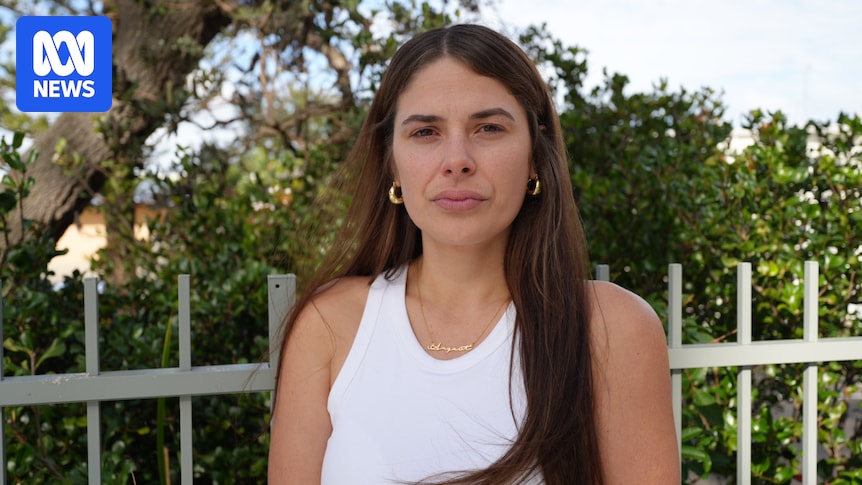
Ms Hassell says reporting the alleged abuse felt like “taking power over my life”. (ABC News: Madeline Grace)
However, the ABC has spoken with victim-survivors throughout Australia who have highlighted a tension between the therapy and seeking justice through the legal system.
Evidence obtained after EMDR ‘inadmissible’
The detective overseeing Ms Hassell’s matter told her the investigation would not proceed because of the Queensland Director of Public Prosecution’s (DPP) guidelines around EMDR.
“As police we understand the process and purpose of EMDR therapy however it is still viewed by the courts as a form of hypnosis therefore it is governed by the same laws and rules of evidence as hypnosis,” an email from the detective said.
“This has a direct impact on your matter as you have undertaken EMDR therapy prior to reporting the matter to police and prior to police obtaining your statement which means any evidence now obtained is inadmissible as it was obtained after the EMDR therapy was conducted.”
Ms Hassell, who credits EMDR with giving her the ability to speak with police about the alleged abuse in the first place, said she found the decision bewildering.
“I had all the evidence outside of EMDR, I processed a number of memories, not all my memories, I had these memories my entire life, and I didn’t process the memory itself; I processed the self-belief that stemmed from the abuse,” Ms Hassell said.
“The question is why is our justice system still not aligned with contemporary clinical understandings of EMDR and trauma?“
A Queensland Police spokesman said the service did not comment on individual investigations.
“All complaints made to police are subject to review of the available evidence, ensuring compliance with Queensland Police Service policy and DPP guidelines when determining the appropriate course of action,” the spokesperson said.
Ms Hassell had made a detailed statement to Queensland Police. (ABC News: Lucas Hill)
The Queensland DPP declined to comment, saying it had not considered Ms Hassell’s case.
Its guidelines refer to EMDR as a form of hypnosis or regression therapy and provide strict conditions in which it must be performed, such as having sessions recorded.
People holding off receiving EMDR
Ms Hassell is speaking out after the ABC shared the story of Katie Bird, a survivor of alleged childhood sexual abuse who was told by the Commonwealth Director of Public Prosecutions her case would not proceed because she had received EMDR.
People from across Australia contacted the ABC after Dr Bird’s story was published to say they had held off receiving EMDR, despite wanting the therapy, or having it recommended, after being told by local police or their therapist it may affect their chance at justice.
University of Sydney socio-legal scholar, Christopher Rudge, said the legal system’s approach to EMDR was based on a 1995 case in which the defence argued EMDR and hypnosis should be treated the same.
“But a lot has changed since then. The NHMRC endorses EMDR, it’s recommended for PTSD,” Dr Rudge said.
He said prosecution offices pre-emptively ruling out EMDR evidence was like “putting weights on the horse before you run it around the track”.
“[Prosecution offices have] got work to do I would suggest in revisiting that policy or assumption, and what that would involve is consulting the experts who are prepared to stand up for EMDR in court against a colleague who might detract from it,” he said.
Dr Rudge says a lot has changed since a 1995 case which formed the basis for the legal system’s approach to EMDR. (Supplied: University of Sydney)
Life on hold
Among people who contacted the ABC was a Tasmanian woman who has been waiting since 2023 to appear in court as a witness against a man she alleged sexually abused her in childhood.
She shared correspondence from her psychologist, who wrote she had been told by Tasmanian Director of Public Prosecutions staff that EMDR was “discouraged prior to giving evidence because the defence has used this as a reason to call witness testimony into account in some cases … interstate”.
The woman told the ABC she felt her life was on hold while she waited to receive EMDR, a therapy she hoped would help her better deal with distressing memories and flashbacks.
“My psychologist is at a loss of what to do — I’ve done CBT, I’ve done DBT, I’ve done everything,” she said.
She requested to pre-record her evidence so she could access the treatment, but has been waiting more than a year for confirmation on whether this will be allowed.
“It’s made me reconsider if it was the right thing to do to go to the police, whether it’s worth continuing with the prosecution,”
she said.
A spokeswoman for the Tasmanian Office of the Director of Public Prosecutions said the office was not able to comment on individual cases.
“The Director of Public Prosecutions cannot prevent any complainant from undergoing EDMR therapy,” the spokesperson said.
“The effect this may have on legal proceedings will be assessed in individual cases in accordance with the expert evidence.”
For Ms Hassell, EMDR provided “immediate relief” from traumatic memories.
She said she believed the judicial system needed to change its approach to witnesses who had received EMDR.
“EMDR is an evidence-based, Medicare-funded therapy, and on that I was essentially denied justice.”