






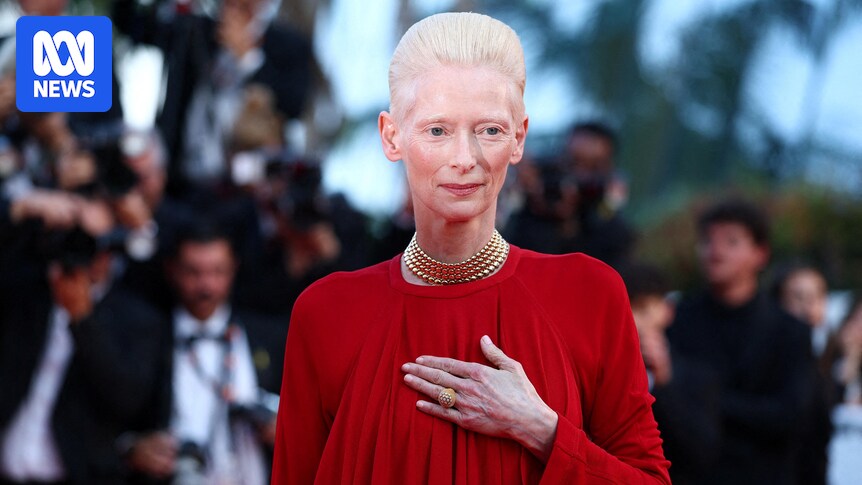
The most annoying thing about reheated internet pasta is that, like the real thing, it might taste great on the second go-round, but it can really stick to the pan.
If you don’t know it, “internet pasta” — originally known as “copypasta” — is a block of digital text that’s repeatedly copied and pasted across online forums, social media, and chat platforms. You know, the quotes that turn up again and again, attributed to a different famous person every time.
An example is an oft-shared meme of actor Tilda Swinton, exhorting us to seize the day:
“If you didn’t do it at 40, do it at 60. The timing doesn’t matter. What matters is that you actually do it. If your 20s were paralysed by self-doubt, make your 40s unapologetically bold. If your 40s weighed you down with heavy responsibilities, go out and dance at 60.”
And if you’re a mid-life woman like me, the message is irresistible.
The problem? Swinton never said it.
Nobody knows who first cooked this “pasta”, but it’s now baked into Swinton’s own story, whether she likes it or not, undoubtedly helped by the fact that she’s 65 and has a brilliant career.
No matter who wrote it, there is something undeniably seductive about the provocation: if you didn’t do it at 40, do it at 60.
It lands with a kind of shimmering defiance, an insistence that time is not a closing door but a second invitation. For many women, especially those who have spent decades in the service of others — children, partners, workplaces, institutions — it carries the electric charge of permission.
But permission from whom, and at what cost?
Because midlife, for a great many women, is not a clearing but a convergence. It is the point at which the scaffolding of work begins to shift — sometimes subtly, sometimes brutally.
Industries hollow out, roles are automated, experience is suddenly recast as obsolescence. The current wave of AI-driven transformation has only sharpened that edge, particularly in fields such as the law, media, administration and education, sectors where women have long built careers that are now being reconfigured in real time.
So, the idea of “starting again” at 60 doesn’t arrive in a vacuum. It arrives alongside superannuation anxiety, rising living costs, and the quiet, persistent recalculation of how many working years are left, whether they will be enough, and just how much time will be left over for… me?
What even is a dream?
The maxim is undeniably shaped by airy privilege. The unknown writer speaks from a position of creative autonomy, financial security and cultural capital that allows reinvention to feel like an artistic choice rather than an economic gamble. We have to name that.
But there is also something more universal tucked inside the remark, something less about a Hallmark card admonition to “Live Love Laugh” and more about resisting a particular kind of narrative closure. The idea that by midlife the story is already written, that ambition must narrow, that risk belongs to the young.
Miranda July’s novel All Fours became a global smash-hit, and smashed up marriages with it. (AFP: Ilya S. Savenok/Getty Images)
That idea is the reason Miranda July’s transgressive and exhilarating novel All Fours, about a woman who leaves her life to make another one, became an international smash hit, and smashed up marriages around the world along with it.
But for most women, especially those navigating the double bind of professional reinvention and financial precarity, the challenge is not whether to “chase a dream” at 60, but how to reframe what a dream even is.
It may not look like a dramatic career pivot or a late-life artistic flowering. It may be smaller, more pragmatic, but no less radical: carving out autonomy in a changing workforce, retraining in ways that preserve dignity, or simply refusing to disappear in systems that quietly expect it.
What might still be possible?
There’s also a psychological shift that the idea gestures towards, perhaps unintentionally. By 60, many women have acquired not just experience, but a sharper sense of what matters and what no longer does. The hunger for external validation softens; the tolerance for bullshit evaporates. That clarity can be a powerful asset in navigating change, even when the material conditions are far from ideal.
Still, we shouldn’t romanticise it. Reinvention at 60 is not equally available. It is structured by class, health, race, geography; by who has a financial buffer, who has caring responsibilities, who has the time and space to imagine alternatives. To pretend otherwise risks turning a compelling idea into a quiet form of pressure: if you haven’t remade yourself, perhaps you simply haven’t tried hard enough.
And yet, there is value in holding onto a version of “Swinton’s” provocation — if only as a counterweight to the more suffocating narratives of decline. Not as a command, but as a question: what might still be possible, even now?
For some women, the answer will be expansive. For others, it will be necessarily constrained. But in both cases, the act of asking — of refusing to accept that the most meaningful chapters are already behind them — might be its own kind of resistance.
And so, to my own resistance, as I decide, after 27 years with the ABC, to head off and pursue my own creative ideas, apart from the public broadcaster that I have been so proud to call home.
If not now, when?
Next week will be my last column here, and we can talk about all that then.
This weekend, if you’re an older mum like me, you can read the experience of the child of us parents, and also revel in the optimism of a new Ann Patchett novel.
Have a safe and happy weekend and remember that we are one night away from one of my favourite days of the year, the winter solstice: the day the earth turns the corner of our solar system and tilts our southern face closer and closer to the sun.
There’s a kind of mid-winter magic that goes with it, isn’t there? A night you can wish on a frozen, falling star? Here’s the appropriate music for this moment, play it at the stillest, greyest moment this Sunday afternoon and it will all make sense.
See you next week for my last ever column here. Go well.
Virginia Trioli is presenter of Creative Types and a former co-host of ABC News Breakfast and Mornings on ABC Radio Melbourne.