



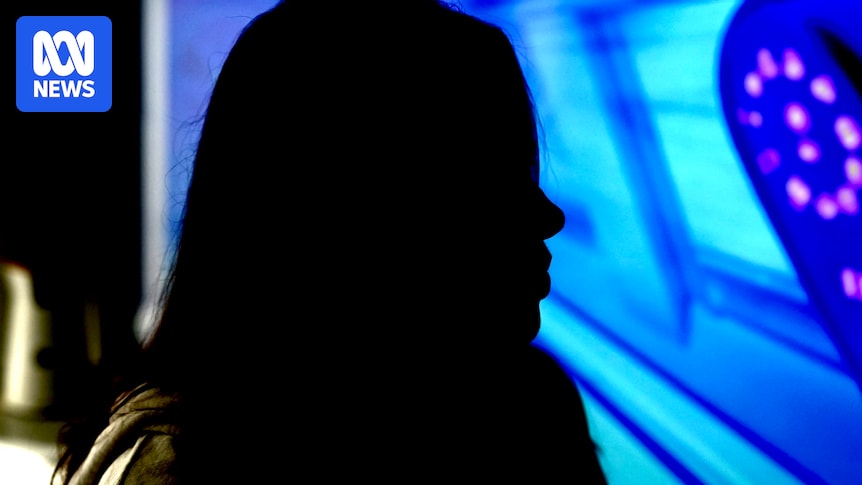
It is illegal to operate a commercial solarium across most of the country, but finding one online and booking a session takes only minutes.
Jess* has been using solariums through the underground market for about eight years.
“I spend a lot of time on my appearance, whether that’s at the gym, botox, all of those sorts of things to enhance my appearance, and to me I guess having tanned skin just became part of that package,” the Melbourne woman said.
She said she did not usually use solariums in summer, but when the sun disappeared and the weather got cooler, she typically booked a tanning session once a week.
Jess says she gets regular skin checks. (ABC News: Darryl Torpy)
A quick search on various social media platforms returns dozens of results, and booking a solarium session can be as easy as sending a private message before being given a booking link and location details.
“They’re extremely easy to find. They’re everywhere in this underground tanning world,” Jess said.
She said the operation could range from single machines secretly set up in suburban neighbourhood garages, to those hidden in the back of legitimate businesses.
“There’s definitely that model where it’s very private and you’re going to someone’s home and it’s very secretive,” she said.
“[Or] you’ll go into what might be a hair salon or it might be a smoothie shop or anything, it can be really bizarre places that you would never guess that a solarium is there, but you walk in and out the back the solarium’s there for people to use.”
Jess says she uses solariums around once a week, spending about 10 minutes per session. (ABC News: Darryl Torpy)
Melanoma survivor shocked by industry
Victoria banned solariums for commercial use in 2015 following the death of 26-year-old Clare Oliver in 2007.
All other states and territories, except the Northern Territory, have since adopted the ban.
During that time, Victoria has seized more than 40 tanning beds and successfully prosecuted 19 illegal solarium operators, mainly issuing fines.
After being diagnosed with melanoma, Clare Oliver campaigned to raise awareness about the risks of tanning and sun beds. (The 7.30 Report)
Some illegal operators are also placed on community correction orders or good behaviour bonds.
One person was ordered to pay $18,000, with more than $43,000 in costs awarded to the Victorian Department of Health.
Another was fined $2,000 plus $1,000 in costs.
In 2016, a company was ordered to pay $52,000 plus costs of $10,000 awarded to the department.
No-one has been charged for operating a commercial solarium in Victoria in two years, raising questions about enforcement.
“We have taken a strong stance on solariums since they were banned — seizing and destroying many beds across the state and we won’t hesitate to act where needed to protect the public health of Victorians,” a Victorian Department of Health spokesperson said.
A NSW Environment Protection Authority (EPA) spokesperson said the regulator had commenced two prosecutions for operators unlawfully offering commercial UV tanning services.
Between 2013 and 2025, the NSW EPA issued 24 penalty notices, including 10 for breaches under the Protection from Harmful Radiation Regulation, the spokesperson said.
“In August 2025, the NSW government strengthened the state’s radiation laws, increasing on-the-spot fines for commercially operating a tanning bed from $1,500 to $10,000 for a corporation and up to $5,000 for an individual,” they said.
Solariums emit much stronger UV radiation than the sun. (ABC News: Gus Goswell)
The spokesperson said advertising or promoting UV tanning services on social media is also illegal in the state.
The picture around the rest of the country showed a small number of prosecutions.
South Australia said it had prosecuted two operators.
The Tasmanian Department of Health said it did not hold data and was not aware of any prosecutions.
All other states and the ACT said there had been none recorded.
The prevalence of the underground industry shocked melanoma survivor Jay Allen.
“People are just killing themselves. They’re using these things unaware of the risk,” he said.
“Anyone that’s got a solarium in their backyard, that’s profiting off lives, they need to have a good look at themselves and just stop doing it.“
At 32, Mr Allen was diagnosed with the deadly type of cancer after finding a mole on his ankle.
“I was sitting in the doctor’s office and he’s telling you, ‘You’ve got melanoma and it’s spread from my ankle to my groin and it’s possibly gone to my liver, lungs or brain’. It’s so scary to hear those words,” he said.
The doctor told him that his use of solariums possibly contributed to his melanoma.
Jay Allen underwent multiple surgeries, chemotherapy and immunotherapy following his cancer diagnosis. (ABC News: Justin Hunstdale)
“I used to use them probably three to four times a week,” he said.
“It was madness. We used to go to the gym and think we were looking good and it was a good way to get the girls on the weekend, you know I was single at the time.
“I got my wife but I almost killed myself.”
Influencer culture playing a part, experts say
More than 2,000 people die from skin cancer every year, according to the Cancer Council Victoria’s head of prevention Craig Sinclair.
“Skin cancer is our most common cancer in Australia,” he said.
“Two out of every three Australians will develop a skin cancer at some stage in their life.”
Research suggests solarium use is directly linked to DNA damage and an increased risk of developing skin cancer including melanoma.
“A typical sun bed user … if they’re under the age of 35, their risk of melanoma increases by 60 per cent,”
Mr Sinclair said.
“There’s no question that the ban that we have in Australia has saved lives.
“[But] I’m really concerned that we’re seeing any sort of proliferation of sun bed use and people literally profiteering off the use of these sun beds by the harm that they’re causing to those who choose to use them.”
Influencer culture and the rise of social media was making it harder for education campaigns to get through to younger generations, according to Mr Sinclair.
Craig Sinclair says he’s concerned that many young people desire a tan. (ABC News: Billy Draper)
“We’ve certainly seen a real shift in the last few years around the amount of promotion on social media where people are desiring a tan or showing off a tan and we’re very concerned about that,” he said.
“We have learned that childhood exposure is particularly important, or those adolescent years have a big impact on your risk of melanoma later in life so it’s really important that we protect our children and our adolescence as much as we can.”
Grant McArthur, a medical oncologist at the Peter MacCallum Cancer Centre, agreed that almost an entire generation had missed out on vital messaging about the risks associated with tanning.
“Tanning is dangerous. Tanning means you’ve damaged the DNA in your skin cells,” Dr McArthur said.
“We need to look at social media carefully and counter these inappropriate claims and inappropriate promotion of use of sun seeking behaviour.”
Dr Grant McArthur says “no tan is worth dying for”. (ABC News: Matthew Holmes)
Dr McArthur, who was one of Clare Oliver’s treating doctors, said more needed to be done.
“Governments need to use the tools that they have in the law to prevent use of solariums but we also need to educate the public — solariums are dangerous ultraviolet light from the sun,” he said.
Survivor’s mission to spread awareness
Jess said she was aware of the risks, but like many who use the underground service, it hadn’t deterred her.
“I think there’s a lot of things I probably expose myself to that aren’t overly healthy and I would probably see the solarium … as a lower risk for me and my skin type,” she said.
“I also make sure that I’m getting my skin checked like every six months.
“The doctor says my skin does look great so while I’m in that position I don’t see as much of an issue with it.”
Dr McArthur said there was no safe way to use a solarium.
“Solariums are a very dangerous device because they deliver intense UV radiation well, well above the intensity of the midday sun to the skin” he said.
“No tan is worth dying for.“
Following his diagnosis, Jay Allen underwent surgery, resulting in 44 staples from his stomach to his thigh, as well as immunotherapy. He was also required to have tests and scans every three months for five years.
Mr Allen now travels to regional areas and provides free skin checks. (ABC News: Justin Hunstdale)
“I look back and I think ‘Why did you do that? Why would you put yourself under risk?’,” he said.
Years later, at the age of 45, he was diagnosed with throat cancer and underwent multiple rounds of chemotherapy and radiation.
Almost two decades after he was first diagnosed, he said he regretted using solariums.
“It’s just not worth it and to think that I put myself under that risk, and not only that, but my family could be without a dad one day,” he said.
“Life’s precious and it’s not until you go through a couple of cancer diagnosis or something big in life that makes you realise how precious life is.“
He has since founded the Australian Skin Cancer Foundation and now drives a truck across regional parts of the country conducting free skin checks.
“Maybe there needs to be stricter fines or bigger fines make it more punishable for the people that operate these machines,” he said.