






Old chemicals found inside two of Antarctica’s most significant historic huts could pose “potential explosive hazards”, a report has warned.
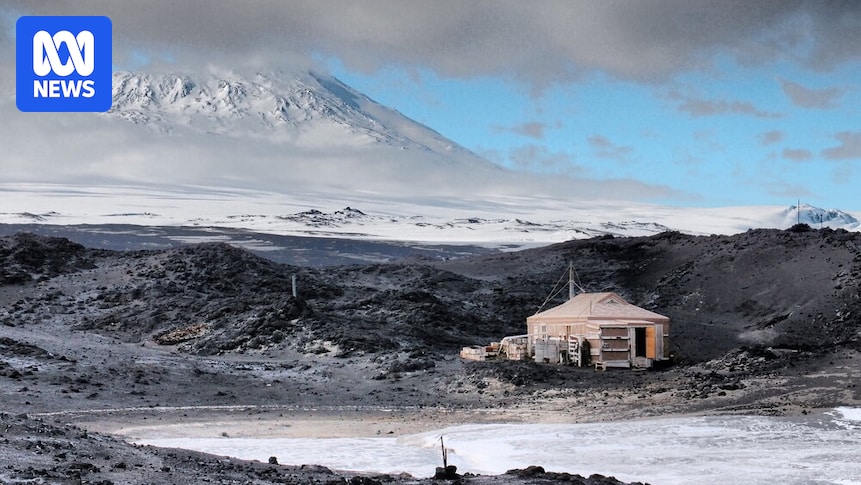
Ernest Shackleton’s Nimrod Hut at Cape Royds and Captain Robert Falcon Scott’s Terra Nova Hut at Cape Evans are considered time capsules of the Heroic Era of early exploration in Antarctica.
Shackleton’s Hut was built in 1908 as part of Anglo-Irish explorer Ernest Shackleton’s Nimrod expedition.
The cabin was used as the base for several missions, including getting to within 180 kilometres of the geographic South Pole in 1909 — the farthest south anyone had been at the time.
Inside Shackleton’s Nimrod Hut. (AHT/Sue Bassett)
Scott’s Hut was erected in 1911 and was the starting point for Scott’s ill-fated mission to the South Pole.
The British explorer’s party reached the landmark 34 days after Norwegian explorer Roald Amundsen’s team claimed the glory.
Scott and his four colleagues died on their return journey to Cape Evans.
The two huts, which are managed by New Zealand, have undergone restorations in recent decades.
Each year, they are visited by hundreds of tourists on cruise ships and expeditioners from nearby research stations.
Bottles and scientific equipment sit on the biology bench inside Scott’s Terra Nova Hut. (Supplied: AHT/Al Fastier)
But at last month’s annual meeting of Antarctic Treaty nations, New Zealand tabled a report to remind parties about safety risks first raised at last year’s meeting.
“In 2025, New Zealand reported that chemicals inside Scott’s hut, Cape Evans and Shackleton’s hut, Cape Royds, were assessed to be potential explosive hazards due to the possible presence of picric acid crystals, picric acid solution and peroxide crystals,” the report states.
The report does not detail the amount of chemicals in the huts, nor the types of containers they are in.
Chemicals only detonate under certain conditions
Nathan Kilah, an associate professor in chemistry at the University of Tasmania, was not involved in the assessment of the chemicals in the huts.
But Dr Kilah told the ABC that when those types of chemicals were found in laboratories in Australia, “often the bomb squad would be called out” to ensure their safe disposal.
As an example of the risk, he said picric acid had a “higher relative effectiveness factor as an explosive than TNT”.
If it were to detonate near a person, he said, it could cause significant injuries in the same way as other explosives could.
Biology equipment and other artefacts at Captain Robert Falcon Scott’s Terra Nova Hut. (Supplied: AHT)
“Scale is important, but a small firework or a cracker held in a closed hand could destroy someone’s hand,”
he said.
“And the black powder in that cracker has a TNT equivalent of about half of TNT.
“So, a small amount of picric acid could be very hazardous … if it was detonated.”
Captain Robert Falcon Scott’s Terra Nova Hut is located in Cape Evans. (Supplied: AHT/Stefanie White)
Dr Kilah said if the substances in the huts were proven to be picric acid crystals, picric acid solution and peroxide crystals, they would only detonate under certain conditions.
These included being exposed to fire, heat, friction or shock, such as being dropped or knocked.
“So, there is [an] explosion risk for all of these substances,” he said.
“But with the fact that they’ve been there for so long, it really highlights that [an explosion is] not necessarily inherent to it just sitting on the shelf.
“Something needs to happen to it, and that would then be the trigger typically for those things to explode.”
Risk mitigation measures in place
The huts and their surrounds are designated as Antarctic Specially Protected Areas (ASPA), meaning a permit is required to visit them.
Under Antarctic Treaty rules, up to 2,000 people are allowed at the sites each year.
But only 40 people can be in the area, and only eight inside the huts, at any one time, and they must be with a trained guide.
Antarctica New Zealand’s general manager of policy and environment, Ceisha Poirot, said mitigation measures had been put in place to reduce any risks to visitors.
A rope barrier installed in Captain Robert Falcon Scott’s hut is designed to prevent any interference with chemicals. (Supplied: ATCM)
These include warning signs and temporary barriers, such as furniture and ropes, to keep visitors away from the chemicals.
Ms Poirot said officials from New Zealand had hoped to assess and potentially remove the chemicals last summer, but sea ice conditions prevented vehicular access to the two sites.
She said another attempt would be made next summer.
“We’re all working hard to remedy any potential risk and deal with it and make sure that we communicate with everybody,” Ms Poirot said.