






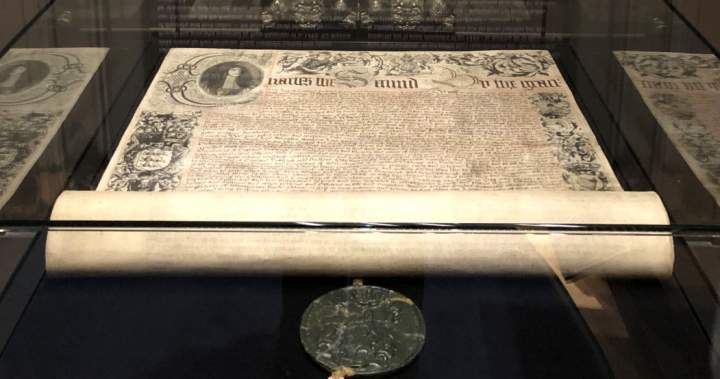
The founding document of the Hudson’s Bay Co. (HBC) was welcomed to the Manitoba Museum on Thursday, where it is being readied for visitors.

The royal charter for incorporating the Hudson’s Bay Co. was signed in 1670 with the blessing of then-king of England, Charles 11, and all England’s colonies.
In the charter, which is written in Old English, the king signs off on an “expedicion for Hudsons Bay in the North west part of America for the discovery of a new Passage into the South Sea” to find fur, minerals and other commodities.
King Charles II also granted “free liberty” to the company to “send either (ships) of war men or (ammunition)” onto the land if necessary for “security and defence.”
The company eventually became the now-defunct Canadian department store, The Bay.

“We are honoured to steward this document on behalf of all Canadians,” Dorota Blumczyńska, CEO at the Manitoba Museum, told the audience on Thursday.

Get daily National news
Get daily Canada news delivered to your inbox so you’ll never miss the day’s top stories.
She said bringing the document to the museum is a step towards reconciliation. The HBC arrived in Canada pre-Confederation, when it was a British colony.
“We cannot speak of the charter without speaking of what followed. In 1670, a king sitting across the ocean claimed authority over our lands that he had never seen and made a decision that impacted the people he never met,” said Ovide Mercredi, former national chief of the Assembly of First Nations.
“The charter did not discover us. Instead, through history, it ignored us. What became known as Rupert’s Land was never vacant territory. It was the homeland of countless First Nation people that covered the entire area claimed by king Charles II.”
He described the charter as having accelerated colonization.
The government of Canada purchased Rupert’s Land from the HBC without any Indigenous consultation two years after Confederation. The vast land now spans across Quebec, Ontario, Manitoba, Saskatchewan, Alberta and the Northwest Territories.
“The Hudson’s Bay royal charter should not be viewed merely as a treasured artifact or a relic of imperial history. It should also stand as a reminder of the consequences of believing that power creates ownership,” Mercredi said.
“Some may wish to celebrate this day without reflection, but true reconciliation does not ask us to forget. It asks us to remember. It asks us to learn. It asks us to do better.”
The HBC charter was among the assets sold after it shut down last June, and two Canadian billionaires successfully bid $18 million to donate it.
It will be shared among several Canadian recordkeepers, including two in Manitoba.
In addition to the Manitoba Museum, the Manitoba Archives, Toronto’s Royal Ontario Museum and the Canadian Museum of History in Gatineau, Que., will take turns displaying the royal charter.

© 2026 Global News, a division of Corus Entertainment Inc.