






Environmental authorities are investigating what caused the death of a popular Port River dolphin, the carcass of which was the latest among several to have been found on the Adelaide metropolitan coastline.
Warning: This story contains images that may be distressing to some readers.
A Department for Environment and Water spokesperson said park rangers were notified of a carcass, believed to be that of Zoom, found at Snowden Beach in the Adelaide Dolphin Sanctuary on Wednesday.
“Rangers did not detect any external injuries but the carcass was in a state of decomposition,” they said in a statement.
Whale and Dolphin Conservation volunteer Barb Saberton said they have been monitoring Zoom, aged 30 to 35 years old, for a sunburn injury.
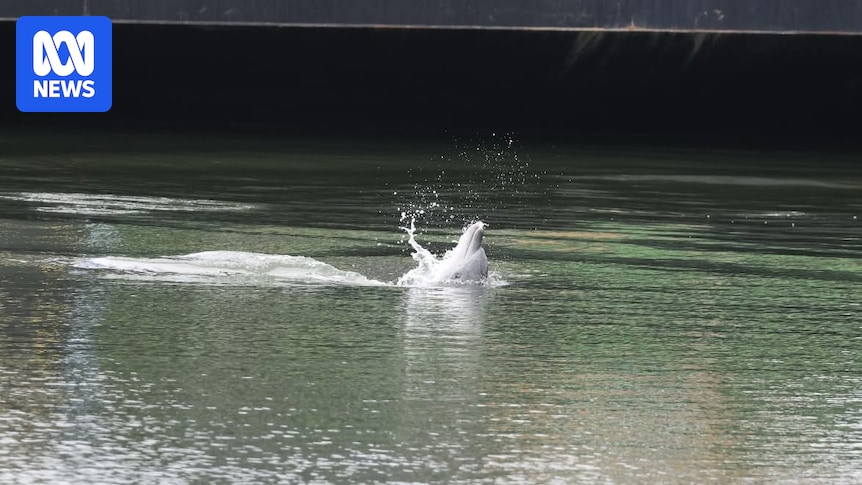
Zoom frequented various parts of Port River. (Supplied: Barb Saberton)
“I think the greater community is going to be grieving him for sure,” she said.
“He was quite the little stud muffin, he used to chase the girls around.“
Zoom is believed to be the Port River dolphin found dead on Wednesday. (Supplied: Marianna Boorman)
Ms Saberton said the dolphin, identifiable from a white mark on his left side, was frequently spotted swimming near a carrier ship in the sanctuary.
“It was nice to watch him come in on that and surfing his little heart out, because we don’t get the natural waves in the Port River that you do out in the ocean,” she said.
Dolphin carcasses washed up
The department spokesperson said two dead dolphins had been reported to have washed up at Hallett Cove on June 5 and 6 and the remains of a third found at Henley Beach on June 10.
All four carcasses have been taken to a pathology laboratory to undergo necropsies.
A dead female common dolphin washed up at Hallet Cove beach on June 6. (Supplied: Johanna Williams)
Citizen scientists Susan Belperio and Johanna Williams came across one of the dead dolphins, which they have named Naia, and showed photos to dolphin researcher and conservationist Mike Bossley.
“He looked at the photos that we took and decided, in view of his experience, she appeared emaciated,” Ms Belperio said.
“It feels very confronting and extremely tragic.”
Johanna Williams (left) and Susan Belperio have been documenting marine deaths since the start of the algal bloom. (ABC News)
Lisien Loan, director of conservation at the Department for Environment and Water, said the algal bloom may not have caused the dolphins’ deaths.
“We think it’s not directly related to the algal bloom at this time because there hasn’t been any sign of the algal bloom off the metropolitan coast over the last three months,” she said.
“There may well be an indirect impact from lack of food resources but that’s one of the things we’re investigating.”
Ms Loan said the necropsy results could take months to be delivered.
The department spokesperson said marine mammal death was not an uncommon occurrence.
“The number of reported dolphin deaths in South Australia has fluctuated over the past decade, with around 40 reported on average every year,” the spokesperson said.
“Causes of death include, but are not limited to, age, entanglement, boat strike and disease.”
Protected pod in Port River
In 2021, six dolphins — Doc, Twinkle, Tallula, Hunter, Squeak and another in nearby Semaphore — died within a few months of each other after becoming emaciated.
A further three dolphins — Hope, Ripple and Namor — died or disappeared in 2022 and 2023.
Last year, three-year-old dolphin calf Rocket died after a suspected boat strike.
Port River and its adjoining inlets are home to the world’s only city-based dolphin sanctuary, established in 2005 to protect a pod considered rare for living in an Adelaide estuary.