







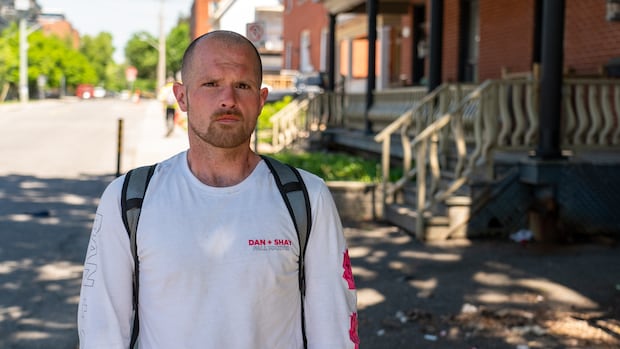
When Ottawa’s supervised drug consumption sites close for good this week, Barry Fyfe — one of hundreds of people who rely on their services — predicts that most everyone is going to regret it.
“People will be begging for the services to come back,” he said.
Fyfe goes to the Sandy Hill Community Health Centre consumption site to use drugs under medical supervision once or twice a day. He says staff have stepped in to save his life during an overdose on more than one occasion.
When the site is gone, Fyfe said, the drugs will still be there.
“They’ll find a way to use regardless,” he said. “It’ll be out in the open where everyone can see. And unfortunately, I think there’s gonna be a lot of used gear left out.”
Fyfe is just one of those bracing for the end of supervised consumption in Ottawa as provincial funding runs out on June 13, forcing Sandy Hill Community Health Centre and Ottawa Inner City Health to close the last two sites remaining in the city.
Dean Dewar, director of consumption and treatment services at Sandy Hill, said its site will close at 6 p.m. Friday. It will still offer outreach, primary care, a drop-in and a supply of safer drug use equipment like needles and pipes — but not supervised injection.
More than eight years after the site opened in 2018, Dewar said it’s with a “heavy” feeling that he awaits the end.
“It’s people that we care about in our community losing access to health care,” he said. “And like any population, any loss of health care to a vulnerable group is just devastating.”

Dewar said he’s worried for the safety of his clients. So are four doctors who work at Ottawa Inner City Health, which runs Ottawa’s other remaining supervised consumption site, known as The Trailer, at the Shepherds of Good Hope.
They put out a joint statement warning that the closure will shift drug use into alleyways, transit stations and public washrooms, where some people will use alone at a higher risk of overdose.
“We can expect to see more visible public drug use, more emergency calls and increased pressure on paramedic and police services in the [ByWard] Market and surrounding Lowertown neighbourhoods,” the statement said.
That’s similar to what Ottawa’s Medical Officer of Health Dr. Trevor Arnason said last month in a memo to city council. He noted that about 1,750 people rely on the sites, and he predicted that overdoses will increase, putting more pressure on paramedics, firefighters, police and hospitals.
Peter Tilley, CEO of The Ottawa Mission, has been among those pushing the province to reverse its decision to cut off funding for the sites. He now knows it’s almost certainly too late — and he’s preparing to live with the consequences.
“It’s going to be challenging times for this community, for certain,” he said.
Tilley said his staff are prepared to respond, with naloxone kits and training. But even so, he’s feeling “absolute anxiety” about what’s coming next.
“We have several clients here who stay under our roof, who go down to the supervised injection site that is at King Edward and Murray…” he said. “So where will those people be injecting? In a back parking lot here?”
John Heckbert, executive director of Operation Come Home, said he’s feeling a sense of “dread” over the impending closures. His organization works with street-involved youth, and he figures about 10 per cent of the 750 or so young people he serves have significant substance use issues.
“I think the majority of us in the sector are pretty apprehensive about what’s going to happen,” he said.

He also expects a higher risk of overdose and fears that, more and more, it will happen on his doorstep.
“There’s a feeling that people will shift their use to use in more public spaces, to use substances closer to organizations like ours, because there is a little bit of extra safety you can get from proximity,” he said. “And so we’re kind of bracing for that.”
But the dread isn’t universal. Supervised consumption has always been controversial, and Keith Nuthall of the Downtown Ottawa Condominium Alliance said the one at Sandy Hill Community Health Centre has made his neighbourhood less safe.
He said the community has seen more break-ins, more assaults and more open drug dealing since the site opened in 2018, causing “a good deal of fear and discomfort among residents in the community.”
Nuthall, whose organization represents about 4,200 condo owners and residents in several buildings in Lowertown and Sandy Hill, said it might not happen all at once — but he expects an eventual improvement after the site closes.
He said the site has become a magnet for people with complex problems who are preyed on by organized criminal networks.
“If those services are not there anymore, then there’s no reason for people to congregate in one particular area,” Nuthall said.
“So yes, we do think that, over time, this will improve the outlook of the neighborhood,” he added, “not just for the people that live and work and visit here, but also for the people who were targets of these services.”
Minister’s office defends funding cut
Lily Barnes, press secretary to Ontario Minister of Health Sylvia Jones, defended the decision to cut off funding for the sites.
“Instead of giving people tools to use harmful, illegal drugs, our government is helping people break the tragic cycle of drug addiction by making record investments in more mental health and wrap-around supports,” she said
She pointed to the $560 million the government is investing into Homeless and Addictions Recovery Treatment Hubs across the province, including two in Ottawa that will offer primary care, mental health services and supportive housing.
But Dewar said it can be a tall order for some of his clients to make the nearly hour-long walk from Sandy Hill to the closest HART Hub in the city at the Somerset West Community Health Centre.

He said his centre has been teaching its clients how to respond to overdoses and preparing them for the new reality.
“We’ve been really talking to our clients about how our response is going to be changing,” he said.
That includes an increased reliance on paramedics to respond in the case of an overdose.
Dewar said the lost funding will affect 40 positions, especially nursing staff. While some staff will find new positions in other programs, there will be 10 layoffs.
Fyfe said knowing those workers will soon be gone is tough on those who have come to rely on them.
“They’re caring people,” he said. “You get acquainted with them, so you feel for that as well.”