








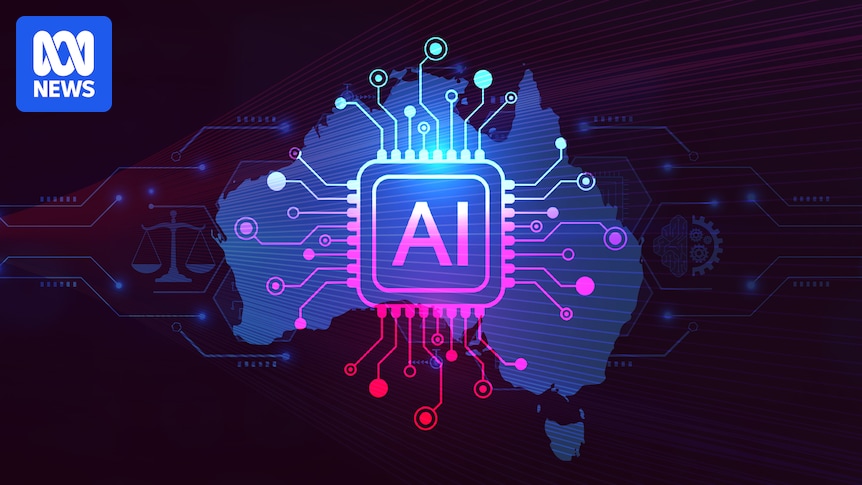
Tens of billions of dollars in investment, and Australia’s ambition to become a global AI power, could hinge on a law passed before humans walked on the moon, the Sydney Opera House opened, or Gough Whitlam became prime minister.
Australia’s copyright law was written in 1968 for an era of black-and-white television, film and radio.
More than half a century later, copyright has become an unlikely red line for AI companies looking to make Australia their second home.
These companies say the legal uncertainty over copyright and their technology is a major hurdle to them making significant investments on Australian soil.
At the same time, writers, musicians, artists and publishers say they want control of their own work and fair value for what has already been taken from them.
Australia in hot demand for investment
Tomorrow, Prime Minister Anthony Albanese is set to make a major speech about how the government is approaching AI and its rules for companies looking to expand to Australia.
Internal government documents obtained by the ABC under freedom of information laws show why Mr Albanese believes Australia has leverage.
Loading…
Ahead of a May meeting with the CEO of Anthropic, the maker of Claude AI, a Prime Minister & Cabinet briefing shows the company indicated Australia’s stability, renewable energy potential and close US ties placed it high on the list to become the first country outside the US to host its data centres.
Building these data centres could be worth tens of billions of dollars, according to The Australian Financial Review’s reporting of deals discussed with local companies.
Other companies are eyeing similar expansions here too.
In return, Anthropic has a number of asks, but according to the Treasury briefing obtained by FOI any major investment would be “contingent on clarity of copyright settings”.
Why is AI and copyright so complex?
Even before generative AI arrived, Australia’s copyright system was already “incredibly complex and complicated” and “basically dysfunctional”, UNSW copyright law professor Kathy Bowrey told the ABC.
She said there had been updates over the years with exceptions for new technologies.
Anthony Albanese is expected to give a major speech on artificial intelligence this week. (ABC News: Matt Roberts)
But the system was not designed for the onslaught of generative AI companies collecting millions of books, images, recordings and web pages to train machines to generate new material.
Public datasets, company disclosures and evidence filed in US lawsuits show major AI companies have absorbed enormous numbers of copyrighted books, songs, images and news reports to train AI models that power products such as ChatGPT and Claude.
It is not just a single copyright infringement, either.
In the act of training a model, a company may collect and organise material, make copies, test the resulting model and then use the material again.
Each stage might be considered an infringement, Professor Bowrey said.
Australian law also gives developers fewer potential defences for AI training than US law, where courts can consider whether a particular use is fair, Professor Bowrey said.
She said it was “probable” there had been copyright infringement in some stages of training AI, despite there being no known AI copyright case before an Australian court.
Professor Bowrey said that may flow from the existing challenges of copyright enforcement, with the expensive nature of litigation limiting cases to large companies, combined with the jurisdictional challenge that major tech companies trained their AI outside of Australia.
Australian creators already trained on
George Nicholas is a Grammy-nominated Australian mixing engineer and former member of the electronic group Seekae.
The ABC found 83 listings for Seekae tracks across four enormous song datasets published by US-based outlet The Atlantic as part of its investigation into songs being used to train AI models.
Nicholas suspected his music would be among the millions of songs used to train AI without permission, but having it confirmed had an impact on him.
“You knew that your IP was being trained on, but then to see it in the dataset … it really becomes real how much of your work exists within the training data of these models,”
he said.
George Nicholas is concerned about the use of his music being used to train AI models. (Supplied: Jordan Munns)
While creatives say AI companies have harvested culture and works worth billions without pay or permission, technology and business groups argue Australia’s laws are blocking investment without producing more income for creators.
Atlassian co-founder and Tech Council of Australia chair Scott Farquhar told the National Press Club last year that changing copyright law could unlock “billions of dollars of foreign investment”.
Both the tech and business councils of Australia have called for reform, and the Productivity Commission has also flagged it as an area for review.
Yet the choice is not necessarily binary, between unrestricted access to every copyrighted work and no Australian AI industry.
Maincode, an Australian AI company, chose to build its chatbot Matilda as a specialist model using only copyright-free material and data supplied by customers.
“You don’t need a model that’s hoovered up every single piece of data on the planet,”
CEO Dave Lemphers said.
Mr Lemphers said while that showed Australian companies could still develop AI models here, he acknowledged he did not know whether a general-purpose system such as ChatGPT or Claude, trained on a much broader range of material, could be.
Professor Bowrey said the current policy setting could lead developers to build early proofs of concept in Australia, then move offshore once they were big enough to get outside funding or were headed for great commercial success.
Supporters of reform point to the status quo as broken. They say training is legally risky in Australia due to the copyright issue, but Australians face no barriers using models that have been trained overseas.
This means jobs and businesses move offshore and Australian creatives receive nothing, they say.
Opponents argue changing the law would reward companies that built valuable products from other people’s work without permission.
What are the options from here?
Australia could leave the law unchanged, as rights-holder groups are urging.
According to the Treasury briefing Anthropic argued it could negotiate with major rights holders, but identifying and purchasing licences from a “long tail” of smaller owners was too difficult.
Rights-holder groups reject the argument that licensing is unworkable, pointing to deals already struck across music, news and other sectors.
Australia’s stability, renewable energy potential and close US ties placed it high on the list to host data centres. (ABC News: Rhiannon Stevens)
APRA AMCOS, which handles royalties for Australian and New Zealand artists, says no major AI platform has made a genuine attempt to negotiate with Australian rights holders.
Another option, though one the government has repeatedly ruled out, would be text-and-data-mining copyright exception, which would simply allow anyone to train AI on copyrighted material, no strings attached.
Collective licensing would let one or more organisations negotiate and distribute payments for a group of rights holders.
That could simplify negotiations, but would leave difficult questions about who was represented, whether it was compulsory, how usage was measured and whether payments reached individual creators.
The media union, MEAA, has separately proposed guaranteeing an ongoing share of licensing payments to creators, regardless of whether they transfer their copyright.
AI safety charity Good Ancestors has circulated a plan within government to create a permit, for companies to purchase, to train on copyrighted material.
A separate fund would support creatives, but its payments would not be tied to permit revenue.
Not just an issue for Australia
According to media reporting the prime minister is not expected to announce a decision tomorrow.
But copyright is the elephant in the room for discussion about AI in Australia, and whenever a decision is made it will ripple beyond Australia.
In a submission to an Australian inquiry last year, the US Copyright Alliance argued an Australian licensing deal could be cited in American courts as proof that it was possible to hash out an agreement.
Both AI companies and rights holders will view any Australian deal through the lens of a global tussle and not just a matter for AI and copyright in Australia.
And further to that, a deal on copyright would settle only one part of the debate over AI and training data.
Questions remain around whether Australians would have any protections over their likeness or the imitation of their voice, privacy, misinformation, Indigenous cultural rights, AI safety and more.
Professor Bowrey said the debate risked asking copyright law to solve problems far beyond its purpose that it would ultimately fail to address.
“Copyright has never been a cultural policy,” she said.