






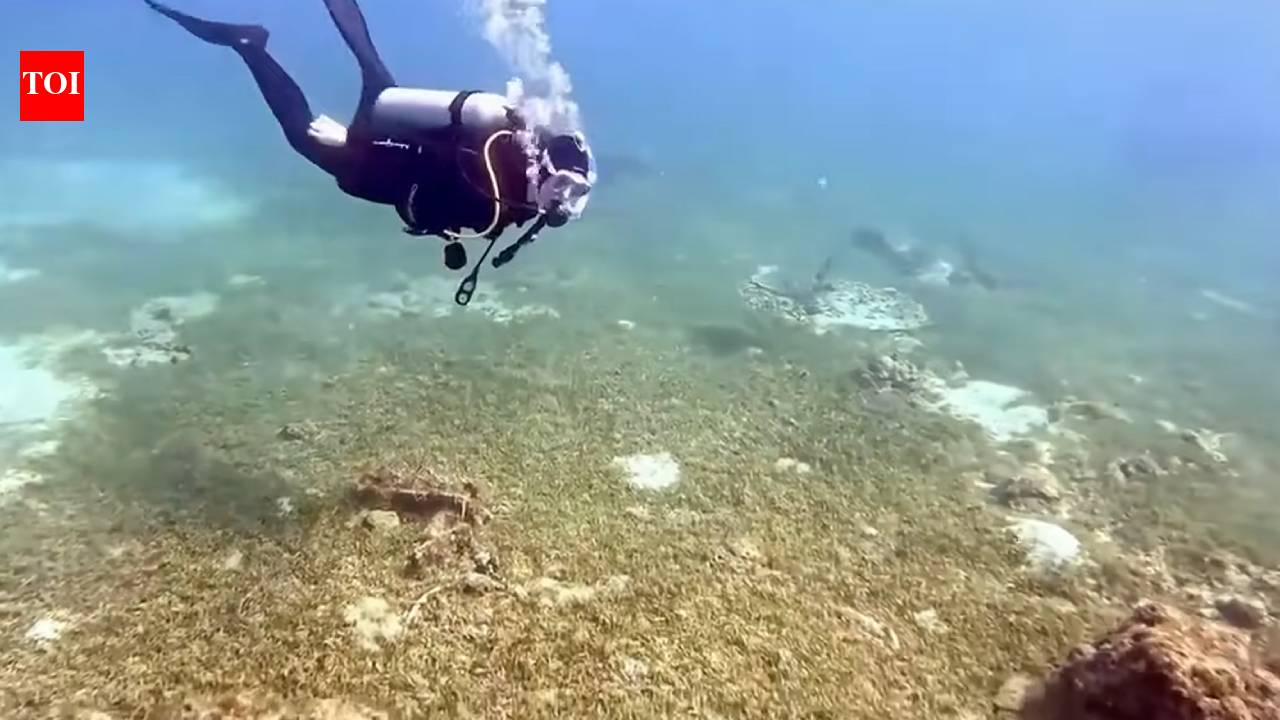
A registered nurse from Utah has shared the harrowing details of trying to save a woman who was fatally attacked by a shark while snorkeling in the Caribbean, revealing that he initially believed she was drowning before discovering the true horror unfolding in the water.Chris Carroll, 56, was relaxing with his wife on the balcony of their hotel in St. Croix after a day of scuba diving when he heard frantic screams coming from the beach below.
‘I thought someone was drowning’
Carroll, who is also a former lifeguard and director of surgical services at Holy Cross Hospital – Mountain Point in Lehi, Utah, said he heard people shouting, “Where are the lifeguards?”“It was just a typical rural Caribbean beach,” Carroll told People. “There are no lifeguards.”Believing someone was drowning, Carroll immediately sprinted toward the water. Unbeknownst to him, beachgoers were actually warning swimmers to get out of the sea after spotting a shark.
A routine snorkeling trip turns tragic
At the same time, 56-year-old Arlene Lillis and her husband Richard were snorkeling off Dorsch Beach, one of their favourite vacation spots in St. Croix.According to Carroll, the couple’s heads were underwater, preventing them from hearing the desperate warnings from people on the shore.While Richard continued swimming along the reef, Arlene stopped behind to take a closer look at something underwater. It was during those moments that she was attacked by a shark.
‘I saw the blood and immediately knew’
Carroll estimated that Arlene was around 50 to 75 yards from shore when he spotted her slapping the surface of the water.“I dove in and started swimming,” he recalled.“I asked, ‘Are you OK?’ and then I saw the blood and immediately had a shock of fear go through me, because I realized in that moment this isn’t a drowning. This is a shark attack.”Although he knew the predator could still be nearby, Carroll said leaving her behind never crossed his mind.“I knew in my heart and soul that I couldn’t leave her.”He stayed beside Arlene, reassuring her that help was coming while other beachgoers assisted in bringing her back to shore.
Tried to save her until the very end
As emergency responders arrived, Carroll briefed them on the severity of Arlene’s injuries and the urgent medical care she required to manage the massive blood loss.Despite their efforts, Arlene succumbed to her injuries. The Virgin Islands Police Department later confirmed her death.The tragedy deeply affected Carroll, who said he later learned that Richard was unaware of what had happened until he returned to the beach, where police informed him of his wife’s death.
Husband pays emotional tribute
Following the tragedy, Richard remembered Arlene as a loving wife, mother and grandmother.“She was so beautiful inside and out! She will be missed every second of the day,” he wrote in a heartfelt tribute.In a later social media post, he shared that the family had scattered her ashes in the ocean.
‘She wasn’t alone in the end’
The incident continued to haunt Carroll, who admitted he struggled with returning to the water even days later.“Ultimately, I knew that if I don’t get back in the water, I’m never going to get back in the water. So I chose to go,” he said of attending a scheduled scuba diving class after the attack.“But I’d be lying if I said I was warm and fuzzy the whole time. I was diving. I was looking over my shoulder a lot.”A few days after the attack, Carroll received an unexpected phone call from Arlene’s daughter.Instead of questioning his actions, she thanked him for staying with her mother during her final moments and apologised for the trauma he had endured while trying to save her.“I’ll never know Arlene, but the kind of people who loved her showed real character,” Carroll said.“She mentioned that her mom hated to be alone and that even though I couldn’t save her, she wasn’t alone in the end. There was somebody there holding onto her and comforting her.”Carroll said those words helped ease the guilt and “what ifs” that had weighed heavily on him since the tragedy.“I wish I could have done more, but that wasn’t the case,” he reflected. “I just want people to remember we’re all connected. You probably won’t ever be asked to swim out to someone attacked by a shark, but you can always reach out to people who are struggling.”