






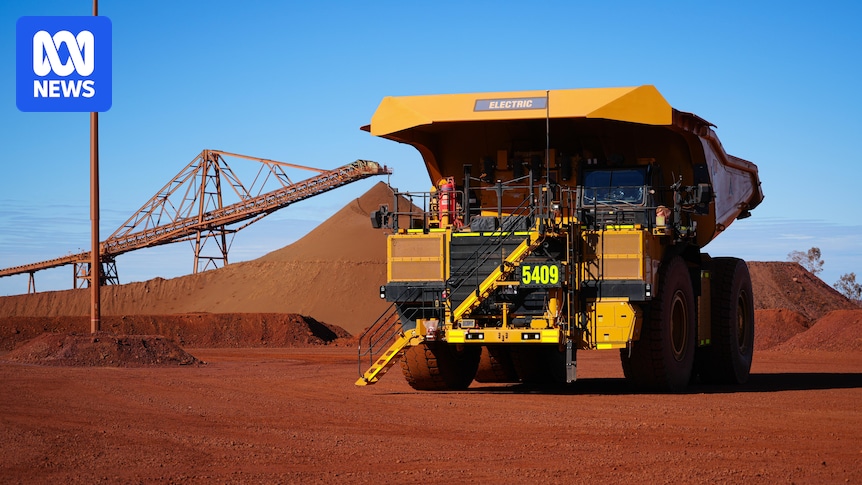
There is a dissonance to watching a hulking, 240-tonne piece of mining equipment trudge up a slope on the whisper of battery-electric power.
Where once there was huff and puff, and clouds of exhaust, all you hear are the sounds of a fizzing drone and red dirt crunching beneath monstrous tyres.
Yet, for the marvel of their 480-kilowatt motors, the two electrified haul trucks launched by BHP and Rio Tinto last week are also a reminder of how far Australia’s largest miners have to go to solve their self-described “diesel problem”.
One of the Caterpillar Early Learner trucks out for a test drive. (ABC Pilbara: Alistair Bates)
Two charter flights made the 1,200-kilometre journey north-east from Perth to Newman for what internal BHP documents, obtained by ABC’s Four Corners, envisioned as a “big moment to rally” in the corporate calendar.
One was loaded with journalists. The other carried politicians.
A pair of Caterpillar Early Learner vehicles had arrived at BHP’s flagship Jimblebar mine in Western Australia’s remote Pilbara in December.
Now, it was time to push the message that the Big Australian was advancing its “decarbonisation strategy”, according to the leaked memo.
Roger Cook with Geraldine Slattery and Matthew Holcz at the launch. (ABC Pilbara: Alistair Bates)
Flanked by WA Premier Roger Cook, Minister for Mines David Michael, and iron ore executives from both companies, BHP Australia president Geraldine Slattery told the fly-in fly-out press pack that the trucks had undergone vigorous on-site testing.
“There’s no better place than the Pilbara, in some of the harshest and most demanding mining environments globally, to put this technology and these machines through their paces,” she said.
The ceremony came as the planet’s biggest miner, BHP, continued to deadbat reports it had quietly shelved billions of dollars in green projects.
The ore-heavy Pilbara region, which contributes richly to the mining giants’ profits, is responsible for about 40 per cent of WA’s carbon emissions.
The “lion’s share”, as Ms Slattery put it, or roughly two-thirds of BHP’s direct Scope 1 emissions, are produced by the haulage trucks and locomotives that cart the ore from its mines in WA and around the world.
Nevertheless, BHP ordered another 62 diesel-powered trucks at the same time it pledged to turn electric, as revealed by Four Corners.
This locks in their use at Jimblebar until at least the late 2030s and potentially to 2041.
Ms Slattery said it was “too early to say” whether BHP would retire this about $500 million diesel fleet early, should the battery-electric trial prove successful.
“Decisions on fleet and infrastructure are something that we’ll consider as we de-risk and understand what’s needed in solving the technologies and the operation here,” she said.
Red dirt politics
A quarter of the WA government’s budget flows from iron ore royalties.
The closeness of this public-private relationship was on full display last week, with Mr Cook on hand to congratulate BHP and Rio for their investment.
Curtin University’s Institute for Energy Transition director, Peta Ashworth, said it was important for the government to uplift signs of progress, even if it sometimes appears like “hand-waving”.
“The transition is messy,”
Professor Ashworth said.
“If we’ve learned anything from the [Strait of] Hormuz and Iran, it’s that we’ve got to accelerate it,” she added. “But I think the more we can get big multinationals sharing data and collaborating, we’re only going to get much better outcomes from it.”
Two of the diesel trucks still very much in use at BHP’s Pilbara mines. (Four Corners: Ryan Sheridan)
Central to BHP and Rio Tinto’s reluctance to commit to a decarbonisation timeline beyond the broad-scale promise of net zero by 2050 is the challenge of scalability.
The currency of a Pilbara mine site is not ore. It is time: that is, the constant and efficient churn of the resource from pit to port for sale.
Unlike diesel-powered vehicles, which are quickly refuelled and redeployed, a battery-electric fleet that must return to the stable to recharge could throw off the economic rhythm of operations.
“It’s this 24/7 nature of things,” Professor Ashworth said.
“I could imagine these sorts of companies being a little bit cautious because they’re really wanting to see the data.”
Rio’s part in the trial is precisely that: neither of the trucks will be rolled at its mine sites, as it waits to gauge the results at Jimblebar.
BHP and Rio Tinto say there is still uncertainty around the “scalability” of battery-electric vehicles. (ABC Pilbara: Alistair Bates)
Charging on the go
One solution, outlined by Caterpillar vice-president Thad Litkenhus, could be generating a charge in motion, something that will be trialled at Jimblebar in the next few months.
Mining magnate Andrew Forrest and his company Fortescue appear to have few reservations about putting electric trucks to more immediate use.
The first of 360 trucks built by German-Swiss manufacturer Liebherr arrived at Fortescue’s Eliwana mine in 2023.
The company plans to remove many of its diesel drive-trains by October this year and replace them with battery-electric versions.
A further 400 zero-emission haulers are on order from Chinese state-owned manufacturer XCMG, with phased deliveries planned from 2028 to 2030.
Fortescue believes it can recharge them in about 30 minutes.
Dino Otranto at a mining conference in Karratha last week. (ABC Pilbara: Alistair Bates)
Chief executive Dino Otranto told the ABC he was happy to see other miners following suit.
“We’ve been standing here for a number of years now saying the technology is real, the economics are real, and it makes sense,” he said.
Professor Ashworth said Fortescue’s ambition mirrored the appetite of its billionaire founder and chairman’s competitive edge.
“We need people that can set direction, and go hard as part of this, and some, I guess, are more willing to take risks,” she said.
It is an approach to business nevertheless entangled in controversy after controversy.
Beyond the photo-op
There are unanswered questions around BHP’s capacity to charge the new trucks using green energy, having scrapped, among other initiatives, a 500-megawatt solar, wind, and battery project to power its mine sites.
Ms Slattery said this was an area the company was continuing to explore, adding that BHP was on track to reduce its emissions by 30 per cent from a 2020 baseline by the end of the decade.
Roger Cook pauses for a photo with executives from Rio Tinto and Caterpillar. (ABC Pilbara: Alistair Bates)
The premier, for his part, was quite congratulatory.
“This is big,” he said at the ceremony. “This is significant for the country in terms of our efforts to get to net zero by 2050.”
Big, sure. But significant?
The most important part of this picture sat outside the frame teed up for the media: the 62 diesel trucks set to operate at the same mine for more than a decade.
Incoming BHP chief executive Brandon Craig, who takes the reins today with a chance at generation-defining change, will also need to present shareholders with a new climate plan in the next two years.
Because if, by their own admission, the miners are not convinced, why should we be?