





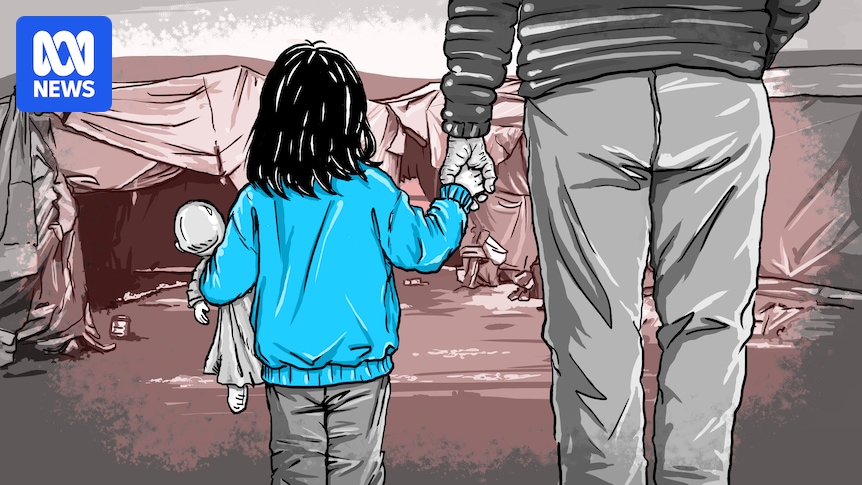
Jasmine* was five years old and so traumatised that when she woke up trying to scream, she couldn’t make a sound.
She told her grandparents of nightmares about black dogs trying to eat her.
Jasmine was safe in Australia, a long way from Syria, where she was born, and from the conflict that had claimed the lives of her parents and siblings.
But the comfort of grandparents did little to stop the daily hauntings, and she kept the vivid memories of watching starving dogs eat dead bodies.
“She’d just be frozen,” her grandfather, John*, told the ABC.
John and his wife have taken care of Jasmine for three years since she was rescued from an orphanage in Syria’s north in 2023.
It’s a remarkable survival story that almost never happened — a miracle, according to John.
“We spent a year and a half literally just nurturing her … making her feel safe, making her feel comfortable,” he said.
Jasmine’s case has not previously been reported by the media and is not related to the recent returns of so-called “ISIS brides” and their children to Australia.
But the attention on these groups has prompted John to share his family’s story.
In 2019, John’s daughter and her two remaining children, including Jasmine, were fighting for survival at a makeshift camp on the outskirts of Baghuz in Syria’s east. (ABC News: Paul Sellenger)
Amid public discussion about the potential risk returnees might pose, John said he wanted to appeal to politicians and the public to have compassion for the children.
“The trauma that they would be in is incredible,” he said.
“They need nurture. They need love.“
While he believes anyone alleged to have broken the law should face the justice system, he argues the tough tone from politicians and in the media had stoked “fear and division”.
“They’re using human suffering for political gain,” he said.
“The Australian government has been spineless in defending children.
“Children are innocent. Full stop.”
John’s story
John said his daughter, Jasmine’s mother, travelled to Syria more than a decade ago with her two older children, following the death of her Australian husband in Syria.
The husband had reported he was in Syria doing humanitarian work in the early stages of a brutal civil war that saw the emergence of militant factions, including the Islamic State group.
But John admits he does not know much about his son-in-law’s movements.
About 230 Australian men and women have travelled to Syria and Iraq to support or fight with extremist groups since 2012, according to the Department of Foreign Affairs and Trade.
John says he had no indication his son-in-law could be among this number before he died.
When John’s daughter left Australia, he said she did so without telling him.
It was a decision that left him gravely upset and worried, and one he still tries to comprehend today.
“She was grieving,” he said.
“She didn’t believe it. She wanted to go see where [her husband] was buried. I can’t begin to measure her hurt after losing a husband.”
In the years she was in Syria, John said he pleaded for his daughter to come home, but he said the war soon made leaving impossible.
His daughter remarried in Syria and had two more children, including Jasmine.
Communication is lost
Updates from John’s daughter were patchy, and months would often pass without any word as the family moved around amid the chaos and carnage of the Syrian war.
But as the years passed, John’s daughter provided him with news of tragedy after tragedy.
“It was agonising every day from the day she left,”
he said.
In the days before her birth in 2016, Jasmine’s father disappeared after leaving to go to a neighbouring town, John said.
He was later told his grandson died of natural causes and one granddaughter was killed during an air strike.
In 2019, John’s daughter and her two remaining children, including Jasmine, were fighting for survival at a makeshift camp on the outskirts of Baghuz in Syria’s east — one of the last strongholds of Islamic State.
The daughter reported the group of civilians she was among was being bombarded, John said.
“The women are out there just trying to survive,” he said.
“We know she tried to escape on three occasions. On one occasion she was almost abducted by ISIS.”
Displaced Syrian children at a refugee camp near the Syrian-Turkish border in 2018. (Reuters: Osman Orsal, file)
Communication then stopped.
Months later, John received a message from Syria that his daughter and her remaining children had been killed.
Despite the news coming from an anonymous source, he had no reason to doubt it was true.
“We had a wake for her,” he recalled.
For more than two years, John grieved the loss of his daughter and grandchildren.
Then, in 2022, he got the remarkable news that one granddaughter, Jasmine, was still alive.
John was told an unrelated woman had taken Jasmine after her mother and sister were killed and slowly made her way towards the Turkish border.
Children at a makeshift camp in Syria in 2020. (Reuters: Khalil Ashawi, file)
That woman contacted Australians living in a separate refugee camp, telling them Jasmine was about to be moved to a Turkish-run orphanage in northern Syria, John said, kickstarting a drawn-out diplomatic effort to bring the young orphan to Australia.
“It’s a miracle she was found and picked up,” John said.
“We welcomed the Australian government’s support, and we thank them for it. They were awesome.”
Return of families sparks intense debate
There has been intense public and political debate about the potential risk the IS-linked families might pose and whether Australia had an obligation to support the return of the young children in particular.
The federal government repatriated four Australian women and 21 children, including eight orphans, under prime ministers Scott Morrison and Anthony Albanese in 2019 and 2022.
But the Albanese government has since refused to assist others, with all bar one woman and her child making their own way home last month.
Australian Federal Police officers at Sydney Airport awaiting the arrival of IS-linked families. (ABC News: Berge Breiland)
That woman was issued a Temporary Exclusion Order blocking her return on national security grounds.
In February, Mr Albanese argued “if you make your bed, you lie in it”, saying that while he felt “sorry” for the children involved, it was their mothers who were “responsible” for their plight.
The opposition had pushed for the families to be blocked from entering Australia, with Nationals senator Bridget McKenzie claiming the children were “already radicalised”.
As well as stirring intense community debate, members of the Yazidi community persecuted by IS said the return of the families had been traumatic.
Australian Federal Police have charged four of the women: two with terrorism offences and two over slavery allegations.
Investigations into the women who hadn’t been charged are continuing, with security agencies also monitoring the families.
The children — who the ABC understands are mostly of primary school age — will be asked to undergo community integration, therapeutic support and countering violent extremism programs, the AFP said.
‘Putting them with positive influences’
Those programs largely focus on intervention and treating health issues, with poor dental hygiene and malnutrition common among those returning from Syrian refugee camps.
They will work to integrate the families into the community, schools and sporting clubs, as well as provide ongoing mental and wellbeing support.
Deakin University professor of Islamic politics Greg Barton said management of any potential threat to community safety would also form part of their ongoing care.
“They’ve suffered poor physical health, they’ve been through trauma,” he said.
“It’s more about working with their health and rehabilitation and taking them away from any influences that are extreme and putting them with positive influences.“
Children hold their toys during a security operation in al-Roj camp last year. (Reuters: Orhan Qereman, file)
The programs are also designed to prevent isolation, which experts argue can lead to poor outcomes.
Peta Lowe, a countering violent extremism expert with Phronesis Consulting and Training, provides risk assessments for those that have been exposed to radicalisation, including interviewing some of the IS-linked Australians who have returned from Syria.
She said feeling isolated or alienated from society could put a child on any number of destructive paths — dropping out of school, finding it difficult to get a job or requiring social security support, she said.
“Those sorts of things are much more likely than the ultimate outcome that they want to become a terrorist,” she said.
In 2022, she assessed the family of Mariam Raad, another Australian repatriated and later charged with entering a region controlled by a terrorist organisation.
Raad pleaded guilty but received no conviction, with the magistrate accepting her husband had a “level of control and influence” over her and cited good prospects of rehabilitation.
Children who lived through Islamic State in Syria suffered poor physical health and trauma. (Reuters: Issam Abdallah, file)
Ms Lowe said she believed the harshness of the Syrian camps — where violence and housing, food and health insecurity was common — could increase the risk of those “susceptible” to radicalisation.
In a risk assessment presented during Raad’s bail application, Ms Lowe noted she had been the primary source of love, security, and education for her children in the camp.
That care could reduce a child’s risk of radicalisation and enhance their rehabilitation, Ms Lowe said.
But she said any assessment of whether the women or children held or still hold extremist beliefs could only be done accurately from Australia.
Whether the women hold extremist beliefs has been discussed in recent court hearings, with lawyers for Rayann El Houli stating she had “renounced” support for Islamic State.
In a separate case, federal police argued Zeinab Ahmad had not.
Ms Lowe worked with the Iraqi government and United Nations from early 2023 until late last year as part of a program to repatriate some 10,000 people affiliated with Islamic State from Syrian refugee camps.
She said many who had supported the so-called caliphate had changed their views, after experiencing the brutal reality of Islamic State.
A rebel fighter takes away a flag that belonged to Islamic State militants. (Reuters: Khalil Ashawi)
“There wasn’t necessarily a correlation between what beliefs you held going into the camp and what beliefs you hold coming out,” she said.
“They’ve lost countless friends and relatives. They just want peace. They want to grow vegetables. They want their children to be happy.”
Prospects for recovery
The not-for-profit STARTTS, based in New South Wales, provided therapy for some 2,800 children last financial year, including refugees and former child soldiers.
It has not engaged with the Australian families repatriated from Syria.
For a young child, therapy can involve art, working with sand or re-enacting experiences with figurines to process trauma.
Clinical social worker and psychotherapist Shaun Nemorin said says children can and do recover. (Reuters: Bassam Khabieh)
Returned teenagers may struggle to “reconcile their experiences in a conflict zone and their new identity as Australians,” STARTTS clinical social worker and psychotherapist Shaun Nemorin said.
“Rehabilitation cannot begin until a child feels physically and legally safe,” he said.
“Children do not choose to be in these conflict zones and they are victims themselves.“
Importantly, Mr Nemorin added, children do and can recover.
“I’ve seen some great, some great outcomes,” he added.
A family member of previous Syrian returnees praised the services the children received in Australia, telling the ABC their family was doing well.
“The services were intensive, they had the best interest of the child, and it was much more about integrating kids back into normal life,” the relative said.
“That’s what was required.”
Jamal Rifi says children who have arrived from Syria in previous years have integrated well. (ABC News: Liam Patrick)
Sydney-based doctor and community leader Jamal Rifi, who has worked to help repatriate families from Syria, said children who arrived in years prior offered hope for the latest arrivals.
“They’ve integrated very well,” he said.
Following last year’s Bondi terror attack, Dr Rifi acknowledged there was “palpable” community fear about the families’ return to Australia.
“We can’t mitigate that fear by leaving those kids out of sight, out of mind,” he said.
Jasmine is brought to Australia
A video from Jasmine’s final days in Syria show her handing out toy kangaroos as she says goodbye to children at the orphanage.
Another captures her first time meeting her grandfather John, the pair sharing a warm, loving embrace.
But once home, Jasmine’s trauma was clear.
Beyond the vicious nightmares, she couldn’t cope with school and was home taught.
Then, last year, there was a turning point.
Jasmine’s grandfather says while Jasmine still has some nightmares, she is generally “thriving”. (ABC News: Paul Sellenger)
Jasmine started talking about wanting more activity and engagement. It was agreed she was ready for traditional schooling.
Now, she is “thriving”, John said.
She’s fluent in English, enjoys swimming, cycling and dancing.
The nightmares are still there but not as frequent. Much of her recollections are now about the orphanage, rather than the perilous years prior.
“We talk about things she loves, we try to bring all pleasant memories,”
he said.
“[Kids] need love and attention.”
John attributes his granddaughter’s recovery to excellent professional care she received in Melbourne.
But also, his wife, the girl’s grandmother, who worked tirelessly to comfort the girl.
“My wife is an incredible woman, and without her I couldn’t have done this on my own,” he stated.
To this day he is plagued with questions about his daughter’s decision to go to Syria, and the events that took place there.
John wishes he’d asked more questions about his daughter’s decision to go to Syria, and what happened there. (Reuters: Khalil Ashawi, file)
“I have a thousand questions I wish I’d asked,” he said.
“What I felt was frustration and powerlessness. I couldn’t meaningfully change a situation that was dangerous, unlawful, and far beyond my reach.
“I can’t undo anything.”
He now hopes the children of the latest arrivals receive the same level of care his granddaughter received.
“These children need stability, love, care.”