









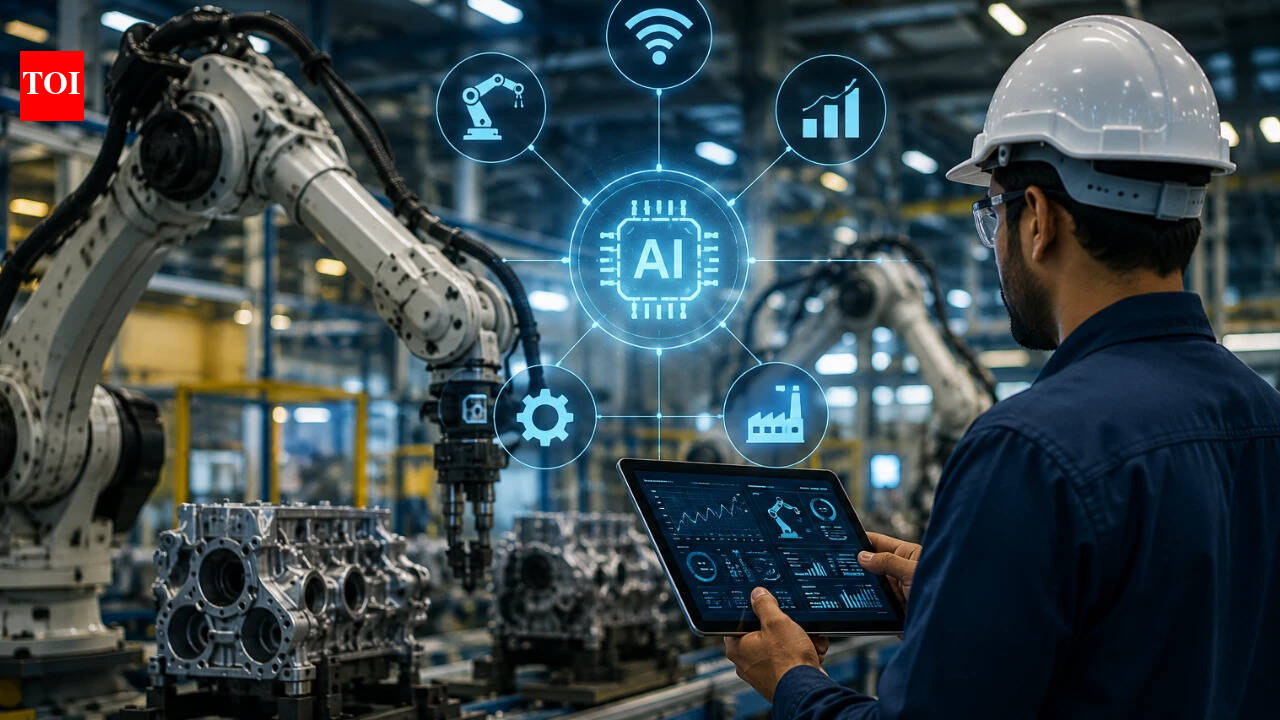
MUMBAI: Artificial intelligence is rapidly transforming India’s factory floors, with manufacturers moving beyond conventional automation to build intelligent production systems that can predict machine failures, detect product defects, optimise energy consumption and even make real-time operational decisions with minimal human intervention.The shift, industry leaders say, marks the beginning of a new phase in Indian manufacturing—one where intelligence, rather than automation alone, will determine competitiveness in global markets.From automotive and engineering to electronics and industrial machinery, companies are increasingly investing in AI-powered predictive maintenance, machine vision-based quality inspection, digital twins and production planning tools as they seek to improve productivity, reduce downtime and build resilient supply chains.A practical example of this transformation can be seen in India’s automotive component sector.Several Tier-1 suppliers have integrated AI-powered machine vision systems, predictive maintenance platforms and digital production dashboards across their manufacturing lines.One leading auto component manufacturer in Tamil Nadu, for instance, deployed AI-based visual inspection to detect microscopic defects in precision-machined parts while using predictive analytics to monitor the health of critical CNC machines.Within a year, the company reported a significant reduction in quality rejections, lower unplanned machine downtime and improved overall equipment effectiveness (OEE), enabling faster deliveries to global OEM customers.The initiative also reduced maintenance costs by shifting from reactive repairs to condition-based maintenance, demonstrating how AI investments are delivering measurable returns rather than remaining experimental projects.Bosch Limited has integrated AI-powered machine vision systems for automated quality inspection and predictive maintenance across its manufacturing operations.By analysing real-time data from production equipment, the company can identify potential machine failures before they occur and detect product defects with greater accuracy than manual inspection.This has helped improve production quality, reduce unplanned downtime, lower maintenance costs and enhance overall operational efficiency.The transition comes at a crucial time for Indian industry.As global manufacturers diversify supply chains under the “China+1” strategy and India pushes to establish itself as a global manufacturing hub through the Make in India initiative, companies face mounting pressure to deliver world-class quality, shorter production cycles and greater operational efficiency.Unlike traditional automated factories that rely on fixed programming, AI-enabled manufacturing systems continuously analyse data generated by sensors, connected machines and production lines, allowing factories to learn, adapt and optimise operations in real time.For manufacturers, the benefits extend beyond faster production.Predictive maintenance helps prevent costly equipment failures before they occur, AI-powered vision systems detect defects that may escape manual inspection, while digital twins—virtual replicas of manufacturing systems—allow engineers to simulate production changes before implementing them, reducing operational risks and improving decision-making.Industry experts say these technologies are becoming increasingly important as manufacturers contend with rising labour costs, supply-chain disruptions, growing customer expectations and stricter sustainability goals.Adithya Jayakar, Deputy Managing Director of UCAL Ltd, said digital transformation has evolved from being merely a technology initiative to becoming a strategic business necessity.“The future factory will not be defined merely by automation, but by intelligence. AI enables manufacturers to make faster, more accurate decisions by converting vast amounts of production data into actionable insights. That is where the real competitive advantage lies,” Jayakar said.According to a senior manufacturing industry expert, who requested anonymity, AI adoption has already moved beyond pilot projects in many Indian factories.“The conversation today is no longer about whether companies should invest in AI, but how quickly they can scale it across their operations. Manufacturers that fail to embrace intelligent production risk losing competitiveness in global supply chains,” the expert said.Industry observers believe India enjoys a distinct advantage because many manufacturers can modernise existing factories by integrating AI into current production systems instead of building entirely new facilities.This allows companies to improve productivity while keeping capital expenditure under control.Jayakar said Indian manufacturers have consistently demonstrated their ability to embrace emerging technologies.“Indian manufacturers have demonstrated remarkable agility in adopting new technologies. By combining AI, connected machines and skilled human talent, we can build factories that are not only more productive but also more flexible and resilient,” he said.Experts expect the next wave of industrial transformation to see wider adoption of collaborative robots (cobots), autonomous production cells, automated material handling systems and AI-assisted quality inspection, particularly in automotive component manufacturing, where precision, traceability and consistency are critical for meeting global customer requirements.For consumers, the shift could eventually translate into products with fewer defects, improved quality and more reliable delivery schedules.Manufacturers also expect lower wastage, reduced energy consumption and better utilisation of machinery, helping improve profitability while supporting sustainability goals.However, industry leaders caution that the race towards autonomous manufacturing is not without challenges.While the technology is becoming increasingly accessible, successful implementation depends on high-quality production data, robust cybersecurity, reliable industrial connectivity and a workforce equipped to work alongside AI-enabled systems.“Many companies have digitised parts of their operations, but building a truly autonomous factory requires clean data, robust cybersecurity and a workforce capable of working with AI-enabled systems. Technology is available; the real challenge is change management,” another senior industry expert said, requesting anonymity.The rapid deployment of AI has also sparked concerns over its impact on employment.Industry leaders, however, argue that intelligent factories are more likely to redefine jobs than eliminate them, with routine manual activities increasingly giving way to higher-value roles involving data analysis, machine supervision, maintenance and digital operations.Jayakar echoed that view.“Autonomous factories are not about eliminating human involvement. They are about empowering people with better tools, better information and better decision-making capabilities. The companies that invest equally in technology and talent will define the next era of manufacturing,” he said.Industry experts believe the coming decade will determine whether India can leverage AI to emerge as a preferred global manufacturing destination.While automation laid the foundation for modern factories, they say the next competitive advantage will belong to companies capable of combining intelligent technologies with skilled human talent, secure digital infrastructure and continuous innovation.For India’s manufacturers, the journey towards autonomous factories has already begun.The challenge now is not whether AI will reshape industrial production, but how quickly companies can adapt to a future where data-driven intelligence becomes as important as machines on the shop floor.