





When the Cronulla riots erupted in 2005, artist Abdul Abdullah was 19 years old and living in Perth.
On the morning of December 11, more than 5,000 mostly Anglo-Australians converged on North Cronulla Beach.
They were there to protest an uptick in antisocial behaviour in the area they claimed was “un-Australian”, after a fight had broken out on the beach a week earlier between three lifesavers and a group of young Middle Eastern men.
On the day the riot broke out, the angry crowd quickly degenerated into a mob, egged on by inflammatory media coverage. Twenty-six people were injured and 104 arrested over several days of unrest.
Although the incident took place on the other side of the country, it left a strong impression on Abdullah, a Muslim with Malay/Indonesian and Australian heritage.
“It was frightening,” he says.
Abdullah remembers feeling shocked by the size of the mob, the violence that ensued and the anti-Muslim signs and slogans brandished by the rioters.
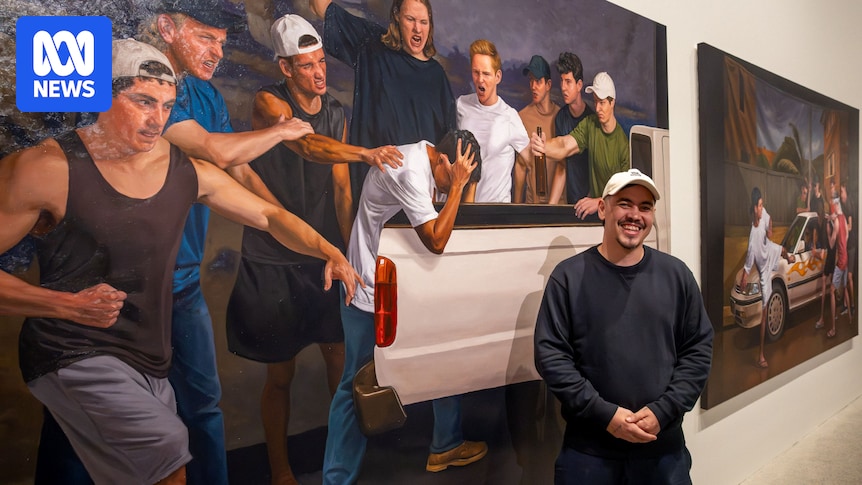
“I’ve been thinking about the Cronulla riots since they happened,” Abdullah says. (Suplied: AGNSW/Felicity Jenkins)
Twenty years on, he has returned to the episode in his work, producing a triptych of “contemporary historical paintings” depicting scenes from the riots for the 25th Biennale of Sydney, which closes this weekend.
“For me, the Cronulla riots are a key moment in recent Australian history,” Abdullah says.
“It was a moment of revelation for many people who didn’t understand that these currents existed.“
Racial profiling
The groups targeted by the Cronulla rioters — people from Lebanese, Arab and Muslim backgrounds more broadly — had already endured years of negative public sentiment.
“It was a community that was already under siege post 9/11,” Abdullah says.
“I remember at the time, it seemed like 9/11 was ages ago, but like if you look back on it, [the two events] are in quite close proximity.”
The Cronulla riots still occupy a contested space in recent Australian history.
“If you look at the old YouTube clips of the news footage, people still defend the riots as if they were justifiable,” Abdullah says.
“But to me, it seemed quite an obvious injustice regardless of the dysfunction that was happening at Cronulla Beach in the lead-up.”
The victims, including a Bangladeshi man and a Lebanese couple had nothing to do with the reported antisocial behaviour on the beach, were bystanders targeted for their skin colour.
“The people that were attacked on the day were only attacked because … they were racialised; they had a perceived similar racial identity to other people who had allegedly done crimes,” he says.
“To me, that’s a perfect example of racism and … what would be described in another century as an attempted lynching.“
Neoclassical inspiration
When it came to depicting this pivotal historical moment, Abdullah found inspiration in a neoclassical painting held by the National Gallery of Victoria in Melbourne.
The Banquet of Cleopatra, painted by Giambattista Tiepolo in 1744, shows Cleopatra and Marc Antony seated at a table, surrounded by courtiers, in a scene described in Pliny the Elder’s first century literary work, Natural History.
The famous painting belongs to a neoclassical tradition of depicting key moments from mythology and history.
The Banquet of Cleopatra by Giambattista Tiepolo depicts a legendary banquet between the Egyptian queen and Mark Antony. (Supplied: National Gallery Victoria)
Abdullah was fascinated by the way the artist used “contrivances” within the artwork to signal to the viewer that they were looking at “a story of a story”.
“It’s a historical scene, but all the subjects in the painting were actors dressed not in costumes from the era the painting depicted, but rather the era that the painting was painted in,” he says. “They were wearing contemporary clothes from the 18th century.”
In a nod to Tiepolo, Abdullah sought to present the Cronulla riots in the same way by re-enacting moments drawn from contemporary news footage.
“I re-staged the scenes in my studio with models around cardboard cutouts,” he explains.
“In the painting, you can see a backdrop behind them; they’re working with props.”
Abdullah says his aim “is to stoke people’s memory as opposed to just tell them what happened”. (AGNSW: Felicity Jenkins)
Abdullah, who splits his time between Melbourne and Bangkok, sourced actors to restage the scenes from a Bangkok talent agency.
“By chance, they all happened to be Russian, and they all knew each other, which was a really interesting dynamic in the room,” he says.
The actors, who were aged between 19 and 22, obviously had no idea about the Cronulla riots, so Abdullah showed them photos and videos to bring them up to speed.
He also made sure they were happy to be depicted as the aggressors in the scenes.
In the end, he says, everyone enjoyed getting into character. “It was a fun game.”
Meditating on the past
Abdullah wants the paintings to serve as a reminder or a warning of what can happen when anti-immigration discourse runs unchecked.
The triptych — “clearly a restaging” — doesn’t show anything that isn’t already accessible online.
“My paintings can’t make any more impact than the actual photos and videos and news stories and documentation of the day,” he says.
But he hopes the work triggers “a slower, more meditative engagement with the topic” by creating a sense of distance from the events of the past.
“The focus is on the perpetrators,” he says. “All the victims in each of the paintings have been anonymised; their faces are covered or they’re wearing glasses.
“Although their story is important, it’s not the centre of this story that I’m telling. [The centre is] the faces of those people that are doing the attacking.”
To add to the sense of historical remove, Abdullah scrubbed the scenes of signifying text and symbols, such as placards displaying slogans and the Australian flag, both common sights on the day.
“I took that all away,” he says.
“I found it interesting that when I’ve done artist talks about the work, a lot of people have said, ‘Oh, that looks like my neighbour.’
“And that’s kind of the point: it can be anyone.”
History repeating
So, what, if anything, has changed two decades on?
“I’d like to say it’s gotten better but I don’t think it has,” Abdullah says.
After 2005, he says, there was a “lull” in anti-immigration sentiment, but the views espoused by politicians such as Pauline Hanson are once again gaining traction in some parts of the community.
Abdullah says there was a time when the students who attended his high school workshops only knew Hanson as a contestant on Dancing with the Stars, not as a politician.
“She’d slipped off the radar,” he says.
“And now she’s front and centre again and [leading] potentially Australia’s most popular political party. These things are rearing their head again.
“I don’t think they ever went away.”
Abdul Abdullah’s triptych is at the Art Gallery of New South Wales until June 14.