






Like so many Australians, author Fiona Wright can’t resist snooping in an open home.
“You get these glimpses into people’s lives that are strangely intimate,” she says.
“There’s always these little clues that are left about the people who were there and what their lives were like and what they did with their time and what they valued.”
It’s a pastime that helped Wright pen her first novel, Kill Your Boomers, about 30-something Sydneysider Keira, who is similarly obsessed with real estate.
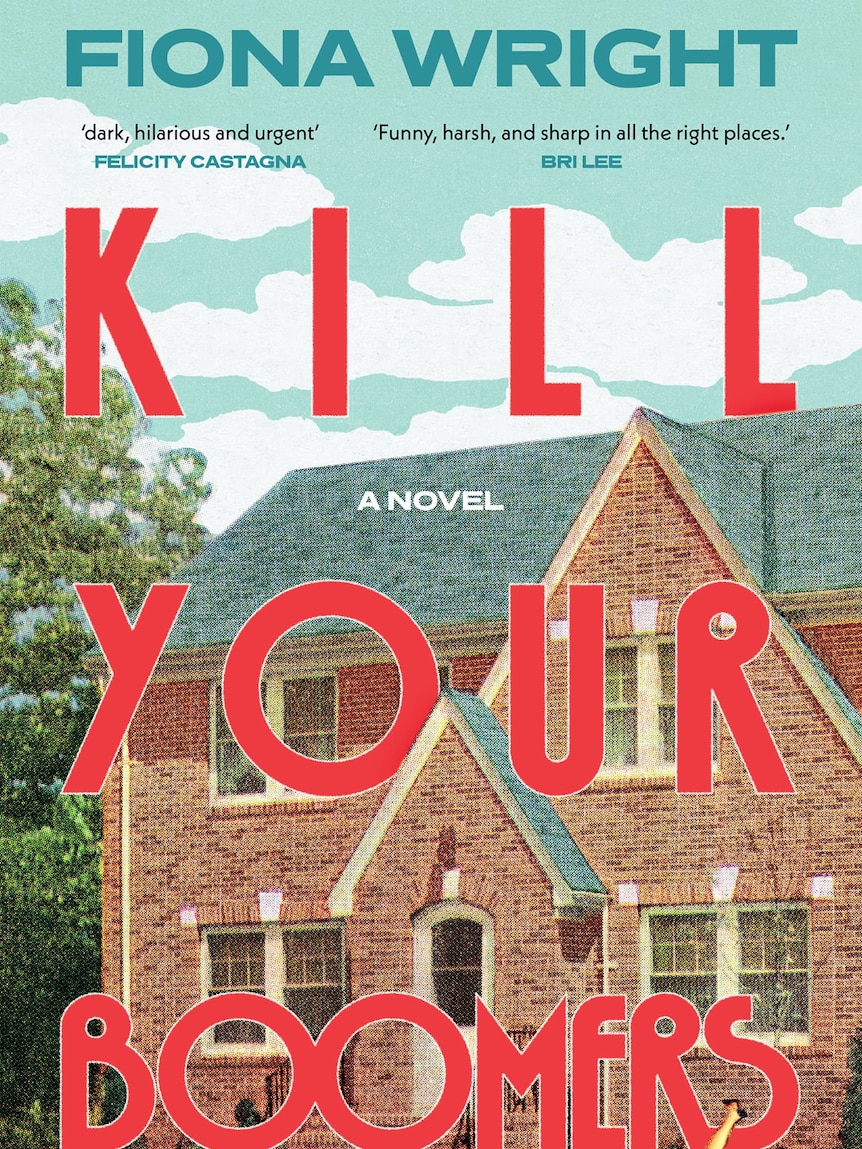
Kill Your Boomers is littered with vivid descriptions of Sydney, where the housing crisis is “particularly obscene”, Wright says. (Supplied: Ultimo Press)
She spends hours scrolling through Domain listings and visiting open homes. But, balancing freelance writing with casual babysitting to scrape together rent each week, owning her own modest home feels totally out of reach.
Over a short period, as research, Wright would visit as many open homes as she could, as long as they were within walking distance of her home in Sydney’s inner west.
“I do think it does something to your head though,” she says.
“I could feel it making me angrier, but also I started feeling grabby.
“I started feeling a lot more envious and feeling my want more acutely, purely by seeing how many houses and apartments were shifting and moving around me all the time.
“It was mind-blowing that that much commerce was happening so constantly in a sphere from which I was entirely locked out.”
Last month’s federal budget promised to ease that feeling of being locked out, by making it easier for young people to buy their own home. The federal government announced it intended to do that by reining in negative gearing and capital gains tax breaks, policies that have seen national median house values increase by more than 400 per cent since 1999.
Yet the changes haven’t been roundly praised by younger generations. While some bemoan the taxing of their shares, others, like Wright and filmmaker Zoe Pepper, whose movie Birthright is in cinemas now, are tackling the housing crisis through their art.
The indignities of renting
Wright was a long-term renter when she started writing Kill Your Boomers in 2018, almost as a joke.
“The driving force really was the indignities of renting,” she says, describing things like spending more than 12 weeks looking for a place to live and the physical exertion of needing to move house regularly.
“I kept thinking about the weirdness of home ownership being so culturally ingrained in this country. And the flip side is there’s no protections for renters.
“There’s so many places in the world where renting all of your life is the norm. There are three- or five-year leases; you can change a place [by painting or putting a nail into a wall]; you can’t get kicked out for no reason.”
While some of those conditions for renters have changed in recent years — for example the NSW government has ended no-grounds evictions — what most surprised Wright while writing the book was how the cultural conversation around both renting and home ownership changed.
“2018 was before we were talking about a ‘housing crisis’, but I certainly felt like I’d been living for years under the conditions that are now suddenly part of the conversation, and so had many of my friends,” she says.
Since the start of the pandemic, house values nationally rose by about 38.4 per cent while wages increased by less than half that amount. By March last year, rents had also risen to $177 a week higher than in March 2020.
“People like me were in the news for the first time,” Wright says.
Now, Wright does own a home with her partner who works in tech. But her experience of precarity — working as a poet, essayist and academic — fed into the novel.
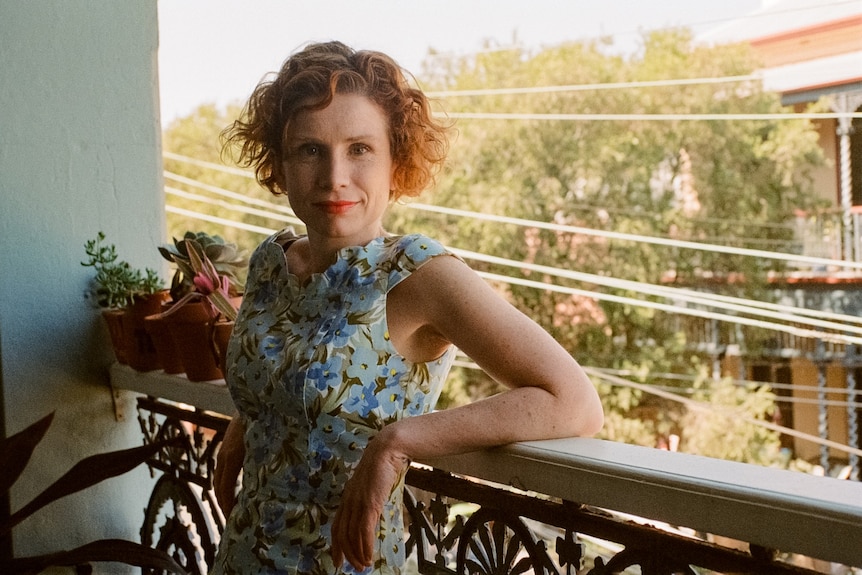
Wright is the author of the essay collections Small Acts of Disappearance and The World Was Whole, and two collections of poetry. (Supplied: Ultimo/Jonno Revanche)
She knew it needed to be fiction rather than an essay, so she could push the idea of “pitting landlords and renters against each other” to its “natural”, absurd conclusion, rather than approaching it from a political or economic lens.
“It’s much easier if you can make it a fight between individual people,” Wright says.
Throughout Kill Your Boomers, Keira and her flatmates talk about how they’ll only be able to afford their own home after someone they love dies. It gives Keira an ugly idea.
“It’s a silly revenge fantasy,” Wright says.
And one that was a lot of fun to write, with the author letting go of the self-aware style of her personal essays.
“There’s so much work you have to do to position your speaker as a good but not impeccable person [in essay writing],” she says.
“To be able to just let all of that go and have Keira be horrible, think horrible thoughts and do horrible things and also think she’s worse off than everybody around her was delightful.”
A pressure cooker
As in Kill Your Boomers, Zoe Pepper’s Birthright sets up a clash between generations.
Recently evicted 30-something couple Cory (Travis Jeffery; Kingdom of the Planet of the Apes) and heavily pregnant Jasmine (Maria Angelico; Strife) move in with Cory’s parents, Richard (Michael Hurst; Hercules: The Legendary Journeys) and Lyn (Linda Cropper; Offspring) — without notice.
Pepper was inspired to make Birthright after seeing a number of friends move back in with their parents during the pandemic.
“It was always for a short time, and then that stay would extend,” she says.
“I was really curious about the power dynamics playing out underneath the one roof.”
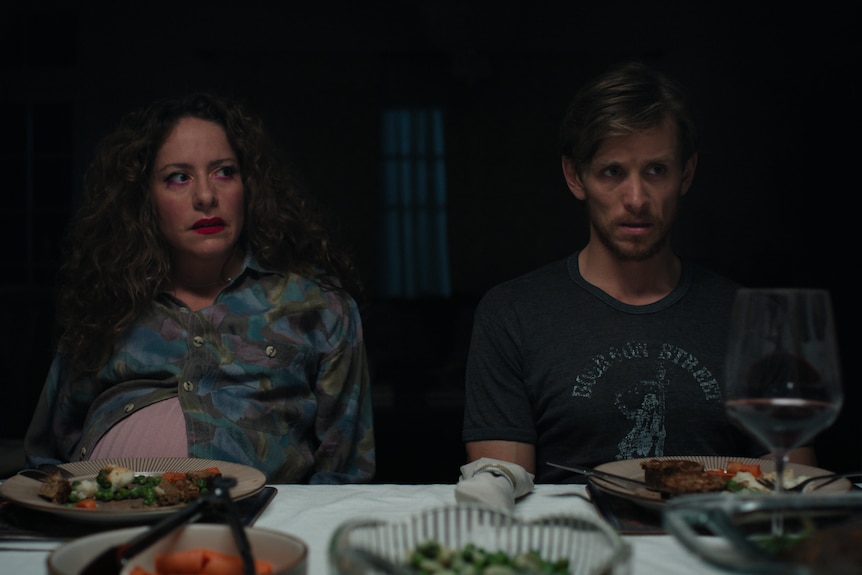
Making Birthright, Pepper was inspired by both Jordan Peele’s Get Out and Mike Nichols’s 1966 movie adaptation of Who’s Afraid of Virginia Woolf? (Supplied: Madman)
She started to realise the story of people in their 30s moving back home was a “microcosm for the warring between generations, the beef between millennials and baby boomers that presents itself in housing and then seeps into all facets of life”.
In 2022, the Australian Bureau of Statistics found home ownership has fallen for every successive generation, with only 55 per cent of millennials owning their own home, compared to 62 per cent of gen X and 66 per cent of baby boomers at the same age.
At the same time, real weekly wages have stagnated, going up by a couple hundred dollars a week, while the cost of a house has gone up by more than half a million dollars.
That’s despite millennials being the most qualified generation, with 79 per cent pursuing further education after school, compared to just 48 per cent of baby boomers.
In Birthright, both couples are frustrated by the other’s attitudes. Watching the movie, the audience’s sympathies shift rapidly as both parents and children behave in increasingly entitled and over-the-top ways, enraged by the others’ inability to see things through their perspective.
“It was definitely a conscious choice to make it keep shifting, so your allegiances don’t really settle,” Pepper says. “It’s the worst of everyone.”
While 15 years directing for theatre helped Pepper refine her sense of tone — walking the thin line between comedy and tragedy — she knew she wanted to make Birthright a movie rather than a play.
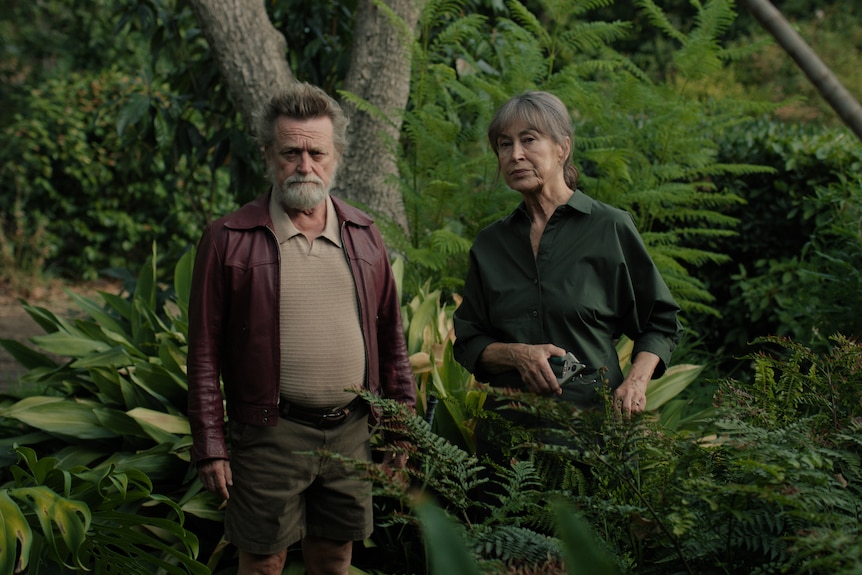
“When I was writing it, ‘avocado on toast’ articles were still around,” Pepper says. “Whereas I feel like they just don’t fly any more.” (Supplied: Madman)
Mostly set in Richard and Lyn’s home, the confined space adds to the kind of “pressure cooker” tension of Birthright.
“To make it work, there needs to be that isolation so these characters descend into their own flavour of madness,” Pepper says.
The containment of the setting also made it easier to get the movie made — as did its exploration of the housing crisis, which has become even more a part of the Zeitgeist since Pepper started writing it in 2021.
“That was when things started to go insane: Average time on the market for a house was like five days,” Pepper recalled to ABC Radio National’s The Screen Show.
“You’d spend more time buying jeans than buying a house.
“I was paranoid when I was writing it that, oh, the bubble’s going to burst and the film’s not going to be relevant anymore, but really the opposite happened and it doubled down and got exponentially worse.”
She hopes other millennials will bring their parents with them to the cinema to see Birthright. Since the movie premiered at Tribeca Film Festival in New York in 2025, before touring to film festivals around the world over the last year, she’s found generational — and regional — differences in how audiences react.
“I find the worse the housing crisis in the city, the harder the laughs,” she says.
“And if there’s a balance of generations, the tragedy lands in a different way. It carries more weight. If it’s predominantly millennials [in the audience], it lands as more of a straight-up comedy.”
Why are millennials making art about the housing crisis?
Wright and Pepper are not the only millennials seemingly coming to grips with the housing crisis through their art. There’s also Ellena Savage’s debut novel The Ruiners, which sees Pip use the inheritance from her estranged father to buy a run-down house on a Greek island.
At the same time, Perth-born, New York-based artist Ian Strange seems fixated by the idea of home, with his photographs of and site-specific interventions in suburban homes around the world, while Sydney-based visual artist Alana Hunt tackled the housing crisis directly in her 2025 exhibition A Deceptively Simple Need at the Perth Institute of Contemporary Art.
As part of the exhibition, a stack of letters rested on a pile of red bricks, addressed To the Owner (of multiple properties). She continues to deliver those letters to the most expensive houses in Sydney and Perth, with each making a simple request: “I am seeking a patron to provide me with a house to live in free of charge for a decade.”
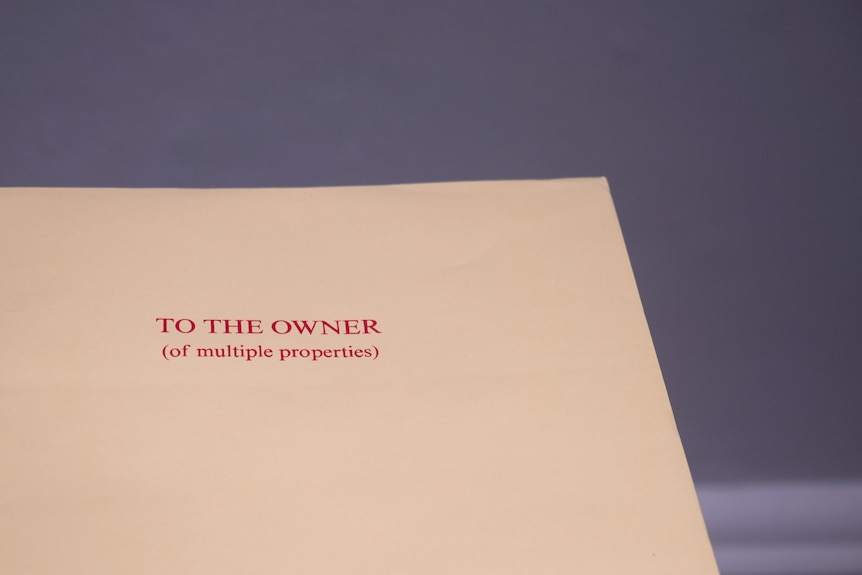
“You will in turn play a central role in an evolving art work of profound social importance, while supporting an artist’s career,” Hunt writes. (ABC News: Emma Wynne)
Wright suggests millennial artists might be thinking more about the housing crisis as they’re not getting any younger.
“There are so many narratives or expectations about what we expected to have achieved or earned or to own by this time in our lives and instead we’re watching those things become increasingly more impossible,” she says.
“It really does feel like: What are any of us supposed to do?
“You see this [ideal of home ownership] retreat into the distance at the very time when you’re becoming aware of the fact that you are actually aging and going to continue to age.”
Pepper says artists’ preoccupation with the crisis is “so much bigger than housing”.
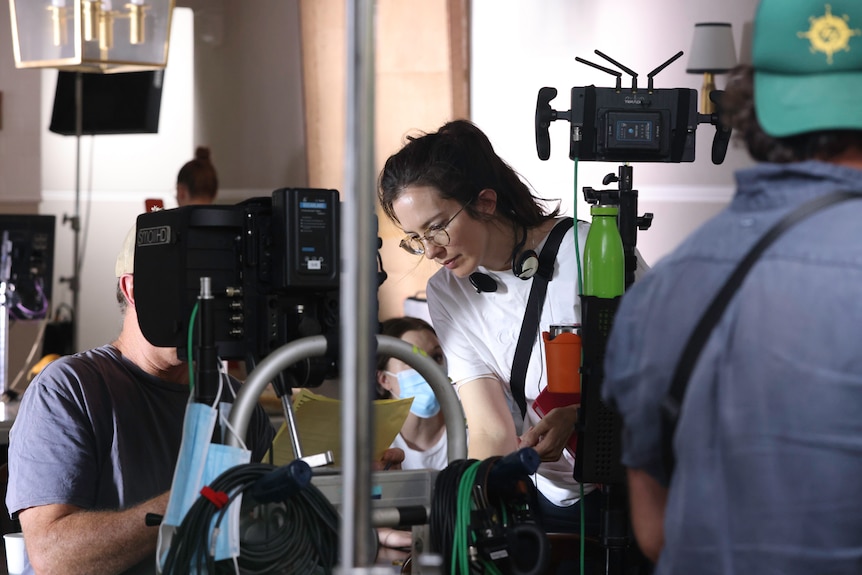
The tone of Birthright reflects a description by banker Satyajit Das about the crisis as like the Goya painting Saturn Devouring His Son. (Supplied: Madman)
“[It’s about] the impact this predicament is having on our psyches,” she says.
“We internalised this worldview from our baby boomer parents [of meritocracy and hard work] and we came of age and realised that worldview doesn’t stack up anymore.”
That impact is more than just disappointment, but shame, she explains.
“That’s where the art comes from.”
Birthright is in cinemas now.
Kill Your Boomers is published by Ultimo Press.