









It’s a warm evening in a small Australian town.
A man dressed in a shirt and tie prepares to record a statement he believes will be used in court.
In his bedroom, he presses record, bows to the camera as a sign of respect and addresses the judge who will decide his fate.

Justin was told that the allegations would prevent him from entering and exiting China. (ABC News: RIchard Sydenham)
Everything he has been accused of is “fabricated, unfounded and unrealistic”, he tells the camera.
He ends with a final plea.
“I earnestly request the wise presiding judge to clarify the facts on my behalf and confirm my innocence. I sincerely ask for your assistance.“
Justin (whose full name has been withheld to protect his identity) was born in China and believed he had been accused of international money laundering and was being investigated by Chinese authorities.
He was trying to prove his innocence but would soon discover there was no police investigation, and the people he was talking with were sophisticated criminals impersonating Chinese law enforcement and were about to rob him of nearly all his life savings.
Millions stolen in authority scams
In 2025, more than $12 million was lost to Chinese authority scams in Australia, according to the Australian Consumer and Competition Commission (ACCC), which received 1,294 reports of the scam through Scamwatch.
ACCC deputy chair Catriona Lowe said of all the scams targeting multicultural communities in Australia, authority scams targeting the Chinese community had the highest losses.
The median loss reported to Scamwatch for culturally and linguistically diverse (CALD) consumers was $750, Ms Lowe said.
But the median loss for Chinese authority scams was $55,000.

Catriona Lowe says the sophistication of authority scams has increased. (ABC News: Patrick Stone)
Ms Lowe said the ACCC had been receiving reports about the scam for a number of years and had seen “a rise in its sophistication”.
“We are seeing scammers utilising both technology and psychology incredibly effectively to trap their victims in this crime,”
she said.
Victims had reported that documentation presented and methods used by the scammers was “highly convincing”, Ms Lowe said.
“We hear reports of credible transfers between police departments, for example, that just mimic what in fact these institutions [do], how they operate,” she said.

Stephanie Tonkin says the Scam Prevention Framework is “sitting on a shelf”. (ABC News: Simon Tucci)
Consumer Action Law Centre chief executive Stephanie Tonkin said scams were now “industrialised”.
She said scammers were investing time and money in grooming their victims and in some cases were using fear of deportation or reprisal to defraud victims of huge sums of money.
“[It’s] a really complicated psychological scam that is putting people in situations of deep panic and despair where they may not think clearly,” she said.
How it starts
The scam began when Justin received a phone call from someone claiming to be from the Australian Consulate-General’s legal department in Hong Kong.
He checked the number and it matched the consulate’s registered number.

The scam started when Justin received a call from someone claiming to be from the Australian Consulate-General in Hong Kong. (ABC News: Richard Sydenham)
The man on the other end of the line spoke in Mandarin and told Justin that a phone number registered under his name was being used to send fraudulent messages to Hong Kong residents about job opportunities and immigration to Australia.
He told Justin that lots of people were impacted and that it had been reported to the Chinese police and consulate-general.
“They claimed that this may impact my exit and entry into China and it may impact my passport,”
he said.
He was sceptical but the caller seemed convincing.
The fake police
Justin was transferred to what he believed was the Shanghai Police and the voice on the other end told him to hang up, google the phone number of the Shanghai police department and write it down.
The policeman called back and the numbers matched.
Justin was told he needed to make a statement via Microsoft Teams but during the call the policeman claimed that his name had been flagged as being linked to another crime needing investigation.

The fake police knew details of Justin’s life including what his parents did for work. (ABC News: Richard Sydenham)
The police knew details of Justin’s life in China such as where his parents used to work, where he used to live and transactions from his Chinese bank.
“The way that they talk to you is very controlling, very authoritarian,”
he said.
He was shown legal documents including a warrant with his face on it.
The warrant cited a number of Australian agencies including ASIO and the AFP, saying that both would cooperate with the Shanghai police in arrest action and would share all evidence.
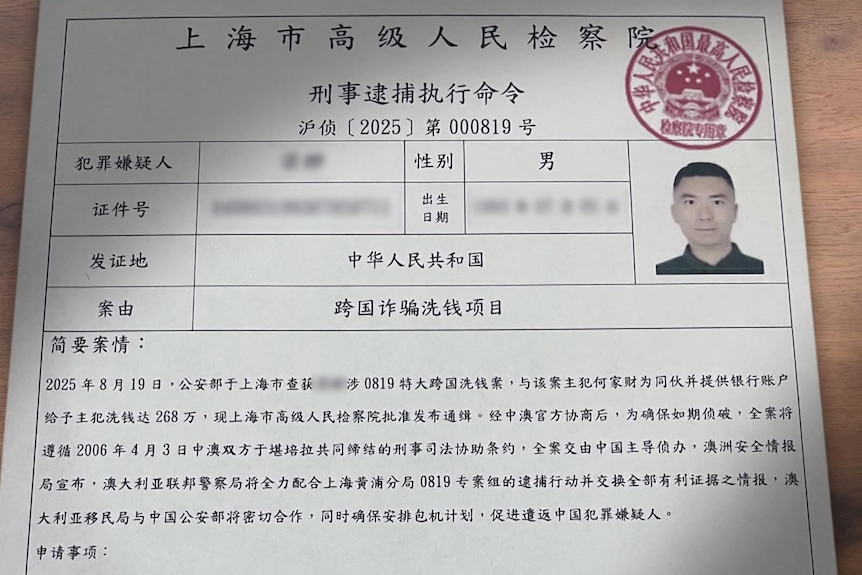
The scammers sent Justin a warrant with his face on it. (Supplied)
It also said that Australia’s Department of Home Affairs and China’s Ministry of Public Security would work together to repatriate Chinese criminal suspects.
“It was a mixed feeling of fear, shock and also confused and sceptical because I was wondering how this kind of thing could happen,”
he said.
Justin was also told that his identity had been used to open a Chinese bank account used for money laundering.
“They couldn’t prove whether I did it or not but they were still going to investigate me,” he said.
Scammers in uniform
While not in the majority, Ms Lowe said there had been reports of victims being visited in person by people in uniform and others having to travel overseas to deposit funds or gold bullion.
“Some of the reports do include a suggestion that part of the scam gang has appeared in person in a uniform,” she said.
Last year, police arrested and extradited a 24-year-old Chinese national from Sydney to Queensland following reports of authority scams targeting international students.

A Chinese national was arrested and extradited to Queensland for allegedly conducting a law enforcement scam. (Supplied: New South Wales Police)
Police allege a victim was contacted and told they were linked to serious offences before being transferred to a person purporting to be a Chinese police officer.
The victim was allegedly threatened with deportation and coerced into handing over money and setting up bank accounts.
The case remains before the Queensland courts.
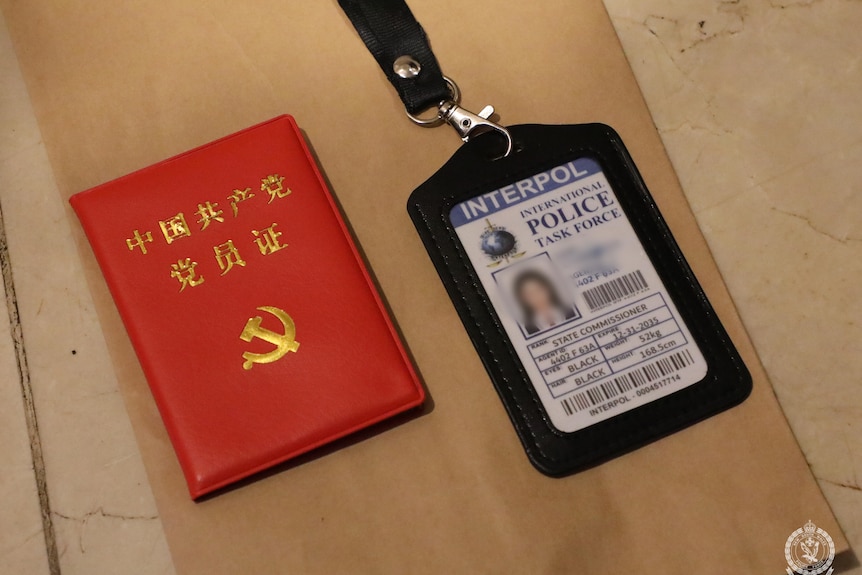
Documents seized by detectives in the New South Wales operation. (Supplied: New South Wales Police)
24-hour surveillance
The scammers told Justin he would be monitored as part of the police investigation.
“They asked me to stay on Microsoft Teams and you literally have to turn on your cameras all day, even [when] you’re sleeping because they need me to report to them every three hours,” he said.
“And before going to bed every day I have to send my schedule for the next day.
“If I’m leaving the house, I have to send them a notice.”
When he left the house, he was made to transfer the Teams call to his phone, and every three hours send a selfie showing them what he was doing.
He said he had never been that stressed before and his colleagues started to notice.
“That impacted my judgement,” he said.

Justin was told he would face extra charges if he spoke to anyone. (ABC News: Richard Sydenham)
The scammers told Justin to stay silent, saying if he told other people, extra charges would be laid.
“It just made you feel that there is nowhere to ask for help,”
he said.
The scammers told Justin there was an agreement between Australia and China to bring people back over criminal matters, even though Australia pulled its extradition treaty with China over concerns about the country’s legal system in 2017.
Life savings lost
Justin was told that police needed to investigate whether his funds were coming from a legitimate source.
He was asked to open a new bank account with Westpac and then told to transfer his money to an HSBC account that the scammers said was held by someone working for the Interpol China National Central bureau.

Being monitored 24 hours a day took a mental toll on Justin and impacted his judgement. (ABC News: Richard Sydenham)
Over seven days he made multiple transactions from Westpac to the HSBC account totalling nearly $140,000.
He was told to record a statement of innocence to be used in court proceedings.
Days after he made the final transaction, he realised it didn’t feel right and reported the scam to police and the bank.
“I just feel very horrible because I have transferred all my money to them and I lost all the money,”
he said.
Westpac was able to retrieve $30,000 and Justin was considering other options to get the rest back.
The ABC has seen correspondence between Justin and Westpac as part of his internal dispute resolution process.
In it, Westpac said after “a thorough investigation”, it had not found “any bank error or failure to act with due care and skill that directly contributed to your loss”.
“We are therefore unable to agree that Westpac breached its obligations under the ASIC Act or the Corporations Act in this matter,” the letter read.

Justin realised it was a scam days after he made the final transaction. (ABC News: Richard Sydenham)
A Westpac spokesperson said stopping scams was “one of our highest priorities” and that the bank was investing in scam prevention.
“Unfortunately, we have seen instances where criminals impersonate trusted organisations, including law enforcement, and use threats of arrest or deportation to pressure people into transferring money or sharing personal information,” the spokesperson said.
The spokesperson said the bank provided customer warnings when transferring money to new recipients.
“If a customer proceeds and transfers money to a scammer, we do everything we can to recover their funds but this is not always possible.”
A spokesperson for HSBC said the bank had “robust policies, procedures and systems” for detecting fraud and was continuing to invest in “scam prevention measures”.
“Banks play an important role in detecting and disrupting this activity, but no single institution has visibility of every element of a criminal scheme,” the spokesperson said.
Justin said he contacted one of the Chinese consulates in Australia and was told they had received a number of reports of the scam.
He was told that the Chinese government would use official ways to contact individuals and would not use digital platforms.
A Chinese embassy spokesperson said it had issued official warnings on its website in response to authority scams.
“Such crimes seriously undermine citizens’ financial security and legitimate rights, disrupt normal social order, and must be severely punished in accordance with the law,” the spokesperson said.
Victims ‘desperate’ to prove innocence
Sylvia Chou from the Scam Victims Alliance, who lost more than $2 million to a different type of scam then became an advocate for scam victims, said she had seen a number of Chinese authority scams.

Sylvia Chou says victims come under pressure to prove their innocence. (ABC News: Shauna Foley)
In one case, a woman in Australia was contacted by a fake ambassador who presented fake documents purportedly signed by Foreign Minister Penny Wong.
Ms Chou said overseas Chinese communities might not be able to see through the scam because they were used to policing systems that had little transparency.
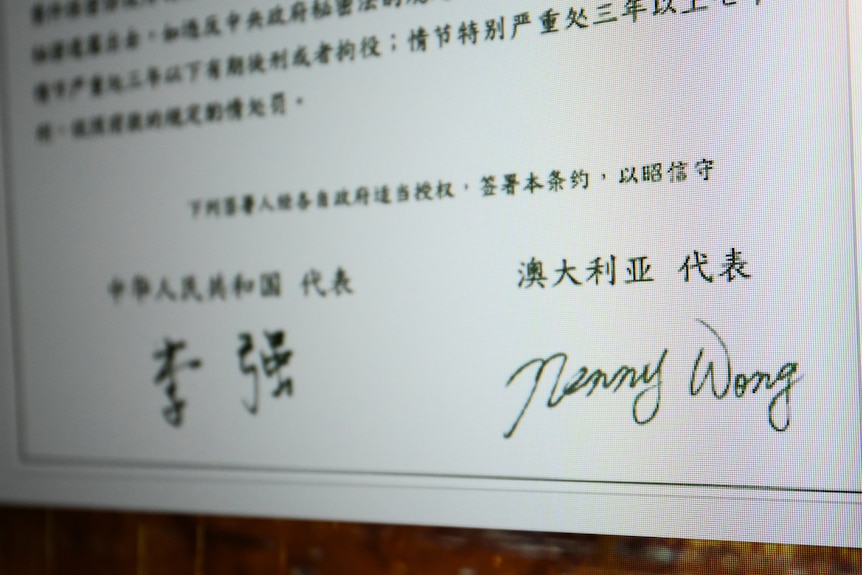
Sylvia Chou says one victim was presented with fraudulent documents “signed” by Foreign Minister Penny Wong. (ABC News: Shauna Foley)
“Communist [systems] are different to our democracy,” she said.
“Their government, their authority is the law and the entire process is not transparent.
“There, if the government says you are criminal, then you are a criminal. End of story.
“In all the victims’ minds, they thought they are in trouble straightaway.”
Ms Chou said these types of crimes could lead to the death penalty in China.
“No one wants to be associated with this type of activity, so they’re just very keen or desperate to prove they’re innocent,” she said.
A ‘honey pot’ for criminals
Ms Tonkin said it was worrying that international criminals were accessing the Australian banking system.
“This is why we are such a honey pot,” she said.
“We are a soft target for international criminals because we have lax security.“
She said there needed to be “much more friction in the system” so that money was not “whisked out of the jurisdiction” and that there should be “a human intercepting and calling Justin and verifying that he wants to make the transaction”.

Stephanie Tonkin says protections are not keeping up with the methods and innovation used by scammers. (ABC News: Patrick Stone)
“Justin’s case is a really good example of where the protections just aren’t keeping up with the innovation of the scammers,” she said.
In 2025, Australia set up the Scam Prevention Framework, which was to compel business, telecommunications companies and digital platforms to prevent, disrupt and respond to scams.
But Australian consumers were still waiting for those laws to come into force, Ms Tonkin said.
“What that means is all of those aspirations, all of those promises that Australians have been given around having a world-leading prevention framework and businesses doing all they can to protect their customers — that’s sitting on the shelf,” she said.
Last week, the government announced that victims with losses up to $3,000 would automatically be reimbursed.
Assistant Treasurer and Minister for Financial Services Daniel Mulino said the government was working to make sure Australia was not seen as a “soft target”.

Justin urges other scam victims to talk about their experiences. (ABC News: Richard Sydenham)
“We only get one chance to get it right,” he said.
“Scams are an evolving and increasingly sophisticated threat, so it’s critical that the protections we put in place are strong and effective from day one.”
Justin said he would keep on fighting to get his money and urged other victims to come forward with their stories.
“The more we talk about it, the less likely that we’ll be in the scam because we know what could happen,” he said.
Additional reporting by Sunny Wang and Kai Feng
Loading…