






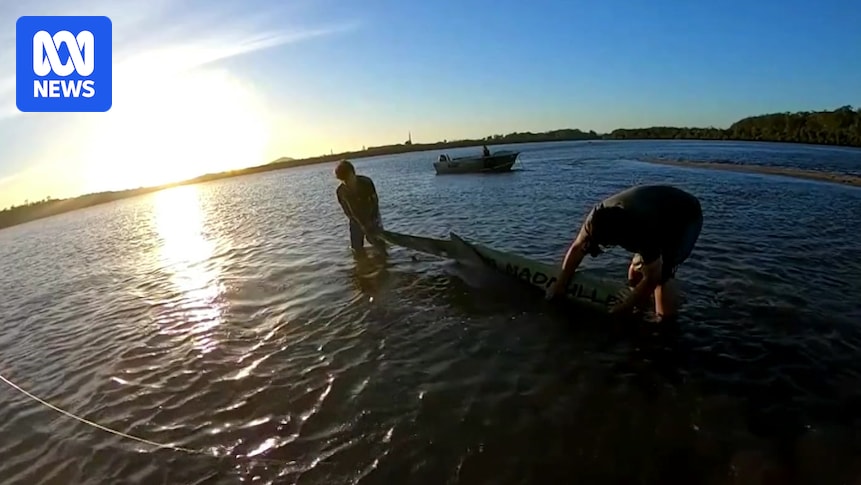
A male voice off-screen can be heard saying “2.9” as a pair of mates shake hands.
Sharks like this one live in Queensland waters. (Supplied: Mad Mullet Productions)
The amateur fishermen have just caught and released a large bull shark.
“Your shark. You release her … push her out.”
They have returned the shark to the river because they are abiding by Queensland law that dictates the shark is too big to be captured.
Some fishers, along with recreational users of the state’s waterways, want those laws relaxed so they can catch more, and larger, sharks.
Others are more cautious.
On the banks of the Brisbane River, Richard Smith sets up for an afternoon of fishing.
It is something he has done for decades.
Richard Smith has been fishing the Brisbane River for decades. (ABC News: Lottie Twyford)
One of the many species he is often on the hunt for are bull sharks. After all, there are plenty of them in the river.
“They’re fast and powerful fish. They move very quickly through the water so they’re a great fight,” he explained.
Many amateur fishers target bull sharks. (Supplied: Mad Mullet Productions)
Over the years, Mr Smith has had close encounters with bull sharks from his kayak.
He estimates the largest one he has ever seen was about three metres in length.
On one occasion he battled a two-metre shark near Fig Tree Pocket on the Brisbane River, before finally setting it free.
He has also seen a shark snap up a fish he had just thrown back in the water, and has seen issues with depredation – when sharks eat hooked fish before they can be pulled in.
David Frisina rides his jet ski around coastal waters near Brisbane. (ABC News: Nickoles Coleman)
Angler and avid jet ski rider David Frisina has growing increasingly concerned about their numbers.
“I love getting out on the water – it’s my freedom. But [I’m] actually scared to fall off,”
he said.
Loading…
Once upon a time (in the late 1970s and early 1980s), Mr Frisina would water ski on the Brisbane River around the Long Pocket area.
“I wouldn’t do that anymore,” he laughs.
“And I’d tell my kids and grandkids not to do it.”
These days, Mr Frisina – now in his 60s – rides his jet ski in coastal waters, often departing Cleveland, south of Brisbane, towards the Bay Island, or in the Gold Coast’s creeks and rivers.
Over time, Mr Frisina has become increasingly aware of the numbers of bull sharks in inland waterways.
Mr Frisina’s concerned increasing numbers of bull sharks will make the waterways he loves increasingly unsafe. (ABC News: Nickoles Coleman)
Like many recreational fishers, he believes believe bull sharks are growing in both number and size.
He is so concerned that he’s lodged a petition with the Queensland government, urging it to review and relax existing fishing restrictions and population control measures – like culls.
Mr Frisina said he was coming from the point of view of someone who hopes his grandchildren will be able to grow up in and alongside the state’s waterways.
He is worried that without intervention, bull shark numbers will continue to grow, and potentially make creeks and rivers entirely unswimmable.
“I want them to have the lifestyle I had.“
Anecdotal claims about increasing bull shark numbers can be difficult to stack up.
Loading…
Dr Daryl McPhee from Bond University said they were a difficult species to count accurately, and social media was also making it easier for people to re-share videos.
“The anecdotal information is that the population of bull sharks is increasing” he agreed.
“In terms of getting scientific information, they’re large animals, they’re mobile animals, they’re animals that can roam around a large area and that makes it very difficult to get a population assessment.”
That is something the state government says it is working on.
Current guidelines for fishing bull sharks in Queensland. (Supplied: Queensland government)
The rules
Currently, Queensland anglers are limited to catching one bull shark per day and the fish must be smaller than 1.5 metres in size.
As a comparison, New South Wales fishers can catch up to five sharks a day, and there are no legislated size limits.
Experts warn there’s a reason the 1.5-metre limit is in place for recreational fishing.
Daryl McPhee is an associate professor in environmental science at Bond University. (Supplied: Bond University)
Dr McPhee said people are advised against consuming larger sharks because the mercury content of the fish increases to potentially unsafe levels.
“A very large shark to eat is simply as tough as an old boot,” he said.
Bull sharks – a species which spends a lot of time in polluted waterways like the Brisbane River – also become exposed to toxins, making them even less desirable to eat.
Dr McPhee doubts that relaxing fishing limits would have any impact on shark numbers, as he is not convinced many recreational fishers would necessarily want them.
Mr Smith’s not convinced he’d be keen to catch sharks any larger than 1.5m in length. (ABC News: Lottie Twyford)
Mr Smith, who throws back every shark he catches, said he is in favour of a “sanity check”.
“They’re big, angry, biting fish and I don’t know if there’s any sane reason you’d want to catch a three-metre bull shark,” he said.
He also does not support culls.
Dr Leonardo Guida is the shark campaign manager at the Australian Marine Conservation Society. (Supplied: AMCS)
Dr Leonardo Guida, of the Australian Marine Conservation Society (AMCS), believes getting rid of that 1.5-metre limit would effectively allow a cull – “one way or another”.
That concerns the shark expert.
“Bull sharks, like most large sharks, are typically at the top of food webs,” he said.
“If we remove too many species or too many apex predators from that position, food webs can potentially become unstable and possibly collapse.”
Dr Guida’s calling for an “evidence-based approach” and supports measures like drone surveillance at beaches, as well as tagging and tracking sharks for more accurate population assessments.
A shark net in the water off the Sunshine Coast is one of many along the Queensland coast. (Stephen Stockwell)
Two opposing calls
Dr McPhee does not believe there is widespread community appetite for expanding the coastal shark control program, which uses mesh nets and drumlines to capture and kill, to inland waterways like rivers.
Loading…
That program has been criticised for its indiscriminate killing – species like whales and dugongs can become ensnared and die in nets – and because of the growing number of sharks it kills.
Last year, the government was petitioned to put an end to those practices. Instead, they were recently expanded.
Bob Katter called for a shark cull following a recent fatal bite in Far North Queensland. (ABC News: Meghan Dansie)
After a recent fatal shark bite in the Far North, MP Bob Katter added his voice to calls for shark culls in north Queensland waters.
Dr Guida cautioned against an emotional response to tragedies or negative interactions with sharks.
“People tend to remember the bad situations or the negative experiences more,” he said.