






In the past few years, Australia has unintentionally shown the world two great examples of how not to organise a major global sporting event.
Brisbane winning the bid for the Olympics and Paralympics was met with some joy in 2021, but raised plenty of eyebrows with people in the midst of a pandemic with a cost-of-living crisis coming down the pike.
Then came the stadium mess.
A renovation? A tear-down? An opening ceremony at Lang Park? Years of bickering and a whole state election, ultimately ending up with a hugely controversial new build at Victoria Park.
In a world where it’s no longer possible to live in blissful ignorance, all we know about the work and cost that goes into hosting major events can make them hard to root for.
It seems the Victorian government recognised this when the cost of hosting the Commonwealth Games in the regions blew out and ultimately pulled the ripcord and the rug out from organisers along with it.
In the end, 2014 host Glasgow was left to cram seven years of planning into 12 months, resulting in a truncated Games at largely existing venues.
We’ve seen similar complaints about everything from construction costs to ticket prices to traffic jams when any major sporting event comes to town.
The uncomfortable truth is these events, no matter the joy they bring while we’re watching, are expensive undertakings that can feel frivolous in the grand scheme of things.
And if that’s the case for global showpieces like the Olympics or FIFA World Cups, how can the Commonwealth Games survive?
‘It’s not this year that counts’
Ask 10 different athletes from 10 different sports in 10 different periods of their career about the Commonwealth Games and you may get 10 different answers.
At the Australian Swimming Trials in June with spots in the Glasgow team up for grabs, already the best of the best were looking two years down the track at the Los Angeles Olympics.
“We go back to the drawing board and see where I can make improvements and at the end of the day it’s a learning curve for the [2028] Olympics,” Mollie O’Callaghan said during a meet where she seemed to be testing out different race plans across all her sprint events.
For seasoned champions, the Commonwealth Games represent something different than they do for younger athletes. (Getty Images: Andy Cheung)
It later emerged O’Callaghan has been recovering from stress fractures in her spine and dealing with a shoulder issue throughout the season.
Kaylee McKeown, who has since pulled out of the Games with glandular fever that she was struggling with at the trials, couldn’t have been more clear after coasting to victory in the 100m backstroke.
“It’s not my best,” she told AAP.
“But at the end of the day, it’s not this year that counts, it’s LA.“
Without the US, Italian, French, Russian or Chinese competitors (and even Canadian superstar Summer McIntosh skipping the Games to focus on the Pan Pacs starting two weeks after the swim program finishes in Glasgow) dominance in the pool could not be more expected for Australia.
Both under 25 and already senior members of the Dolphins with 10 Olympic gold medals, 23 world championship wins, and seven current world records between them, you can see why it doesn’t get O’Callaghan and McKeown’s competitive juices flowing.
Of the 21 abled-bodied women’s and mixed events at Birmingham 2022, Australia took gold in 14, swept the podium four times and had double medallists in five finals.
Even without the likes of McKeown, Ariarne Titmus and Emma McKeon, the Dolphins are always anticipating dominance in the pool against the Commonwealth, even bringing the top three men’s and women’s 1,500m finishers at the trials in the hopes of podium sweeps.
For the Games’ other marquee event, the Australian team vibes are slightly different and this year very much “counts”.
A testing and proving ground in Scotstoun
A lot has been said and read about the so-called Golden Era of Australian athletics, but we’re still finding out exactly what that looks like.
Paris 2024 marked the country’s most prolific Olympic Games for track and field medals in almost 70 years, but was followed by a less historic world championships in 2025.
The Americans won’t be in Glasgow, but Jamaica, Kenya, Canada, England and Nigeria boast some of the best athletes in the world.
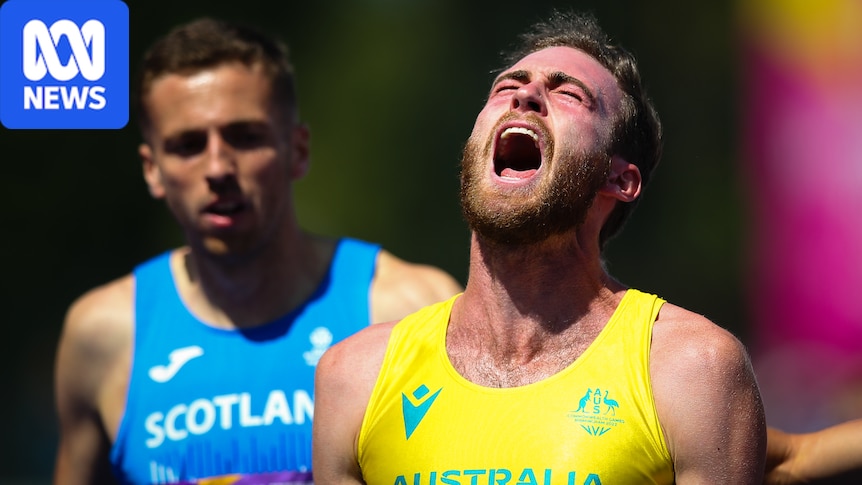
Even without the supernova-bright Gout Gout sucking up the oxygen, the energy is high around the 86-strong team set to perform over six jam-packed days in Scotstoun Stadium.
Jess Hull, Cam Myers, Abbey Caldwell, Nicola Olyslagers, Nina Kennedy, Kurtis Marschall … unlike years gone by there is no shortage of Olympic medallists, world champions and even recent Diamond League stars to grab Australian attention out of the pool.
And, even with all this talent across the board, it’s the promise of making an impact in the blue-riband event that has Aussie fans salivating.
Lachlan Kennedy twice dipped under the famous 10-second mark legally at the nationals in Sydney in April, while Eddie Nketia (four times) and Rohan Browning (once) have done it with illegal tailwinds in 2026.
Rohan Browning and Lachlan Kennedy will team up with Eddie Nketia in the men’s 100m. (Getty Images: Cameron Spencer)
Since records began, the Glasgow-bound trio are in a group of just five Australians to run nine-point-anything in the 100m, regardless of any gales at their backs.
Browning and Josh Azzopardi, who was unlucky to miss out on a spot in the individual 100m, failed to get out of the heats at the Paris Olympics and last year’s world championships in Tokyo.
The Commonwealth Games offer another chance for this generation of athletes to come together as a team in a global meet and compete against some of the world’s best.
“[Winning Commonwealth gold would] mean everything to me. It’s definitely not the end goal of my whole track career but it’s the things you dream about, it’s the things kids get posters on their walls,” he said.
“Winning gold medals against the best in the Commonwealth, [it’s] history, I don’t even know how to describe it. It’s what you do all this for to have those moments, be in those races, win those medals and run against those people, it’s everything.
“It’s my dream, it’s what I wanna do, it’s where I belong and hopefully we can make it happen.”
The Australian flag flies next to athletes’ names at every Diamond League event through the year, but Glasgow, perhaps most importantly, gives them a chance to compete in front of Australian eyeballs.
“[There’s] something about the Commonwealth Games, the history behind it, especially for Australia, it’s a big event,” Kennedy told ABC Sport.
“The rest of the track and field world I don’t think values Commonwealth Games as much as Australians. It’s a big event for us and I would love to be the first Australian to win gold in the men’s 100m. I think I can and that’s what I’ve been striving for all year.
“It’s always an honour to wear the green and gold, so every chance I get to put that uniform on and represent my country I’m giving it my all.”
While the likes of Kennedy, Gout and Nketia have enjoyed the spotlight that comes with performing in the glamour event of the athletics program, for other Aussie athletes, the profile of the Commonwealth Games could be the launch pad to national recognition.
Middle-distance runner Seth O’Donnell, who will run the 5,000m on the final day of the athletics program in Glasgow, said that was particularly important in the lead-up to the 2032 Olympic Games in Brisbane.
Seth O’Donnell is taking some time away from his physiotherapy business to compete in Glasgow. (Getty Images: Quinn Rooney)
And carving out a public profile can mean more than just a bit of fame in a sport that doesn’t always come with immense financial remuneration, leaving many like physio O’Donnell to juggle full- or part-time work with their consuming training regimes.
“We’re entering a golden era of Australian athletics and with the 2032 Queensland Olympics coming up I think it’s really important for people to throw support around us because we’re finding it quite challenging to make ends meet and also represent my country,” he said.
“The future is bright for Australian athletics and the support going forward needs to improve if we’re going to represent Australia at the highest level which I’ve got absolutely no doubt that there’s so many athletes capable of doing.”
Nine-time Olympic swimming medallist Kyle Chalmers spoke at this year’s national trials about the difficulty of making ends meet without the sort of annual salaries bestowed upon our similarly hard-working national footy or cricket stars.
He said he had never profited off and barely ever seen footage of his famous 100m freestyle victory at the 2016 Olympic Games due to incredibly strict rights restrictions that prevent sharing and posting vision by non-broadcasters.
Refresh, reset and remain relevant
The athletes are competing for more than just these medals. (Getty Images: Aaron Chown/WPA Pool)
In a small move that will help athletes self promote and have at least a small stake in their name, image and likeness rights, they will be allowed to post vision of their events on their social media.
It’s one of the moves the Commonwealth Games are making to try and stay relevant in the digital age, with the effects of climate change and cost of living pressures paramount.
Donald Rukare was officially elected as the president of Commonwealth Sport late last year and is pushing a “refresh and reset agenda” where the organisers and hosts will co-create a unique program every four years.
“We are now co-creating the program. We do not insist there must be brand new builds of any facilities,” he said.
“We look at how do we integrate seamlessly with the ongoing plans of the city or country and not come in with a prescriptive model.”
After Birmingham 2022 boasted a massive slate of more than 20 sports and Glasgow was compressed down to 10, the 2030 Games in India will be the first of a new era.
Cricket is set to return to the Commonwealth Games when India hosts in 2030. (Getty Images: Ryan Pierse)
Seventeen sports are set to be contested at the Ahmedabad Games, as Commonwealth Sport moves to a slimmed-down approach of 15 to 17 sports.
Athletics and swimming will be the only compulsory events, with everything else up for grabs, including the potential for hosts to add more if there is enough local interest or importance.
“We’d like to see a very robust and responsive sport program to ensure we’re responding to the athletes of the future and fans and members of our territories,” Rukare said, championing an athlete-first approach.
“Looking at how we can broaden our value in terms of the brand of Commonwealth Sport globally to truly entrench the Games as one of the major sporting events on the calendar globally.
“We’re looking at what is the sweet spot for an optimum sport program to ensure we have a sport program that is fit for purpose.
“After that we’ll review. We are very optimistic that the Games remain one of the go-to events on the calendar.”