






Installation rates for household batteries plunged by more than 70 per cent in the wake of changes to tighten a multi-billion-dollar taxpayer-funded subsidy scheme.
Figures from the Clean Energy Regulator show the number of small-scale consumers installing a battery at their property fell dramatically in May compared with the previous month.
The sharp decline came after the federal government revamped the Cheaper Home Batteries Program by scaling back the rebates on offer for bigger systems.
According to data from the regulator, more than 20,000 battery systems were installed in May, when the new rules came into effect.
A similar number was recorded in June.
By comparison, more than 80,000 batteries were put into people’s homes in April during the final month of the original, more generous terms.
‘Strap yourself in’
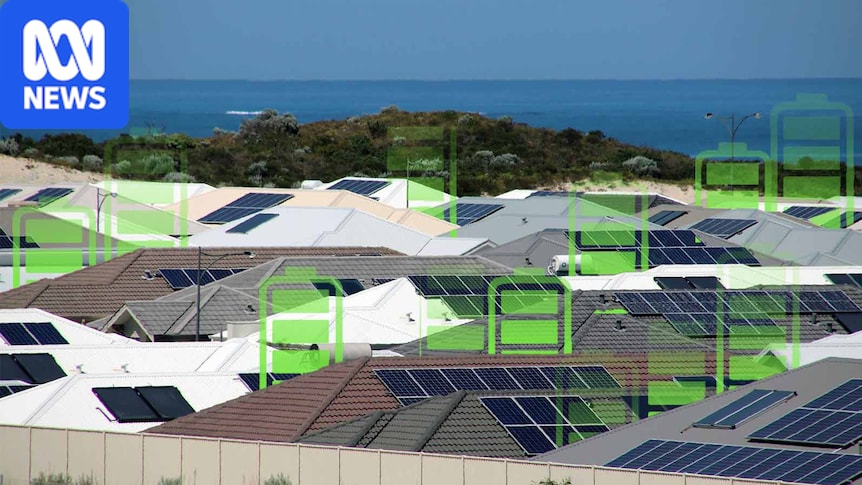
One in four Australian homes now has rooftop solar. (ABC News: Daniel Mercer)
Warwick Johnston, the managing director of solar consultancy SunWiz, said much of the extra demand leading up to the end of April was artificial.
Mr Johnston said it was demand that had been brought forward by the government’s own deadline for changes to the scheme.
In any case, he said it was symptomatic of an industry that had been characterised by wild swings in demand depending on government incentives.
“This often happens in solar industries when subsidies shift,” Mr Johnston said.
“You’ve brought forward a lot of customers that might otherwise have bought in an orderly fashion. They have all rushed to buy before that deadline.
“So you’re actually going to have a quiet period afterwards.
“That’s why it’s called a solar-coaster.“
Batteries allow householders to store and later use excess power from their solar panels. (ABC News: Rhiannon Shine)
Announced in the run-up to the 2025 federal election, Labor’s battery subsidy scheme has been hugely popular.
According to the regulator, almost 450,000 batteries have so far been installed, while the federal government is targeting two million installations by 2030.
Under the scheme, households, small businesses and community facilities can claim a subsidy that’s worth about 30 per cent of the up-front cost of a system.
At the time it was framed, the policy was supposed to slash the cost of a typical, 10-kilowatt-hour battery by about $4,000.
But the original design meant customers could in reality attract far greater subsidies for much larger systems while paying little more out of their own pocket.
A system with 50 kilowatt hours of storage, for example, was collecting about $18,000 in taxpayer subsidies.
The Australian Energy Regulator says a typical home uses between 15 and 20 kilowatt hours (kWh) of electricity a day.
“The industry had figured out that the economies of scale that apply to these batteries meant that once you got past a certain point, certain size, then the subsidy was funding a very large portion of the subsequent capacity of the battery,” Mr Johnston said.
Subsidy rules tighten
In a bid to clamp down on the over-selling of large batteries, in December the federal government said it would taper subsidies from May.
While the full subsidy would be available for every kilowatt hour up to the first 14kWh, it would be scaled subsequently up to a maximum of 50kWh.
At the same time, the government tipped a further $5 billion into the scheme, taking its overall cost to $7.2 billion.
Mr Johnston said there was arguably a case that some, if not many, people had bought systems that were simply too big for their needs under the original design.
Warwick Johnston says personal reasons are the primary ones for battery buyers. (Supplied: SunWiz)
But Mr Johnston said there was also an argument that householders would need bigger batteries as they met more and more of their energy needs from electricity.
“What we know is that households are on an electrification journey,” he said.
“As soon as you go and add an electric vehicle, you can very easily double your household consumption.
“It makes sense to plan for the future and what you’re going to need in the future, not just what you need now.
“But yeah, there’s probably plenty of examples of people whose batteries aren’t getting fully utilised yet.”
Despite the drop in installations, the industry said demand was expected to remain steady in the coming months and years as consumers sought greater independence from the grid.
It was also helping to sustain rooftop solar installation rates, given customers could only be eligible for a battery subsidy provided it was connected to a photovoltaic system.
There are now more than 4 million small-scale solar installations across Australian rooftops.
Critically, Mr Johnston said people were tending to install bigger systems or upgrade existing systems to increase their size and make better use of their storage.
Finn Peacock, the founder of comparison website SolarQuotes, said the battery subsidy scheme had unlocked huge latent demand for storage from customers weary of rising power prices.
Mr Peacock said rooftop solar had been a juggernaut in Australia for years and batteries were following a similar trajectory.
“Before the battery rebate, batteries were seen as too expensive a luxury, but now it’s almost like the norm,” Mr Peacock said.
“If you get solar, you get a battery.
“In most conversations I have with people, they start talking about the battery first.“
Batteries ‘to charge ahead’
Finn Peacock says the solar-battery market is marked by boom-bust cycles. (Supplied: Solar Quotes)
With subsidies under the scheme set to reduce every six months until its expiry at the end of the decade, Mr Peacock said consumers and installers would need to stay on their toes.
He said the diminishing nature of incentives likely meant there was no immediate end to the volatility that had marked the solar and battery markets.
“You’re still going to get this kind of boom and bust every six months,”
he said.
“It’s just such a powerful marketing message, you know, loss aversion, rebates about to drop, get in now, people do.
“In marketing, you’ve got false deadlines and real deadlines, and these are real deadlines.”
Many people have long had solar panels, but few until recently had batteries. (ABC News: Jess Davis)
For all this, Mr Peacock said batteries would continue to be attractive to consumers in the long run as their prices fell and the cost of buying power from the grid rose.
He said it was an economic trend that would help reshape Australia’s electricity system.
“The good news is battery prices are falling so quickly that it’s working out quite well,” he said.
Mr Johnston from SunWiz agreed, saying households and businesses with solar and batteries would help shoulder much of Australia’s decarbonisation burden.
“It’s certainly had a big impact on transforming the way that Australians generate and store and consume energy,” Mr Johnston said.
“When you buy a battery, you certainly become a lot more aware of the energy flows in your household.”
Federal Climate Change and Energy Minister Chris Bowen stood by the government’s handling of the battery scheme.
Mr Bowen said subsidy criteria were redesigned to ensure more people could get rebates that would allow them to buy a battery.
He said the program would ultimately deliver about 40 gigawatt hours of battery capacity, enough to supply about two million homes for a full day.
The minister’s office also stressed that monthly figures were likely to be an underestimate of installation numbers.
It said installation rates remained strong and were averaging between 7,000 and 9,000 a week.