






Australia this week inked a deal allowing it to export unenriched uranium to India for the first time, an agreement that could potentially be worth billions of dollars.
But there’s a big catch.
Despite Australia having the largest uranium deposits in the world, only South Australia is actively producing it.
The mining powerhouse of Western Australia is becoming a battleground for the uranium debate, with the state’s opposition alliance promising to lift the moratorium on mining the radioactive metal if elected.
So what’s all the fuss about — and will we ever see a full-fledged uranium mining industry in WA?
Firstly, what is uranium?
Uranium is a naturally occurring, mildly radioactive heavy metal.
It is typically processed into uranium oxide concentrate, commonly known as yellowcake, which is then exported to countries like France and Japan who primarily use it to fuel their nuclear power plants.
But to be useful, the uranium needs to be enriched.
Uranium is a naturally occurring, mildly radioactive heavy metal.
(Supplied: Cauldron Energy )
Australia has by far the world’s largest uranium deposits, with 28 per cent of all identified and recoverable uranium buried beneath its soil.
But the amount dug out of the ground is just a sliver of that.
Unpacking the ban
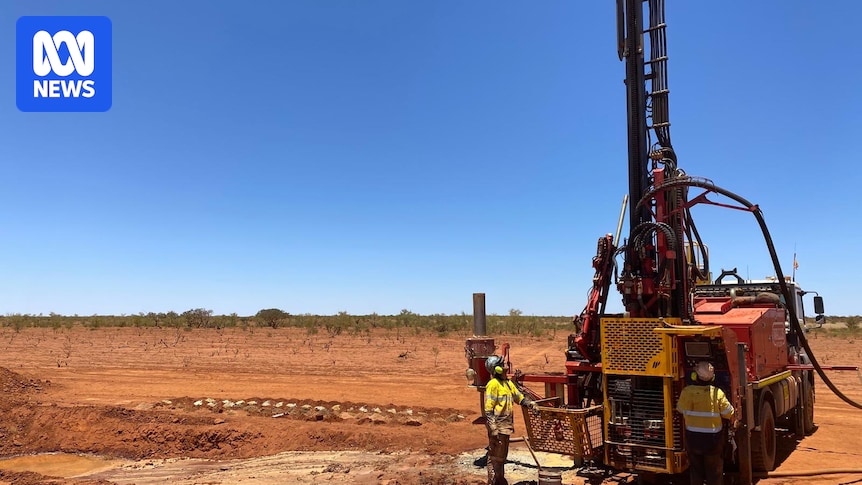
Western Australia, along with Northern Territory, are home to the nation’s largest deposits of unused uranium.
WA uranium explorers have permission to search, but off the back of the landmark deal between the Albanese and Modi governments this week, they want permission to dig too.
One mid-tier miner says there are billions of dollars to be made year on year if the government adopts a friendlier stance to uranium mining.
Jonathan Fisher’s company holds uranium exploration licences in WA. (Supplied: Monish Nand )
“The uranium industry is just one of the things that can help make sure that we continue to enjoy the world’s highest standards of living in Western Australia,” said Jonathan Fisher, the CEO of Cauldron Energy Ltd.
His company holds 12 uranium exploration licences across a total area of hundreds of square kilometres in the state’s north.
“WA could be a similar-sized producer to South Australia,” he said.
The state’s Chamber of Commerce and Industry said WA was well positioned with the infrastructure and skills needed to safely mine and export uranium.
“If other states can do it, there’s no reason why WA can’t,” the group’s chief executive Will Golsby said.
Nationals leader Shane Love said he would overturn the ban should his opposition alliance win government in 2029.
“Why on earth are we, as one of the great mining provinces, not providing uranium across the world?”
he said.
But not everyone thinks that would be a good thing.
The end game
The Conservation Council of WA wants people to think about the end game rather than the quick spoils.
“I mean it was Australian uranium that was powering the Fukishima power plant when that disaster happened,” its executive director Matt Roberts said.
“And we’re however long after that disaster and people are still living the consequences of that.”
Conservation Council WA executive director Matt Roberts says people need to think about the end game. (ABC News: Keane Bourke)
Mr Roberts said the India deal should be the trigger to reignite the debate.
“WA might identify as a mining state, but we draw a line at uranium,”
he said.
“The sector has a history of leaks, spills, accidents, expensive and failed attempts to rehabilitate, and long-term risks to the environment and workers.
“Uranium mining is radioactive, requires huge volumes of water and leaves behind radioactive mine waste.”
Mr Roberts said money should be instead spent on renewable and “clean” energy projects — a view shared by the premier.
“There are companies in Western Australia who have a permit to mine uranium [under historical approvals], and they still haven’t found the commercial circumstances for that to happen,” WA premier Roger Cook said this week.
“Our focus at the moment is the clean energy transition to the grid that we know, and that is wind, solar, backed up by battery and gas.”
The India deal
Australia’s uranium export policy precludes the sale of uranium to countries that have not signed the Treaty on the Non-Proliferation of Nuclear Weapons — the longstanding arms treaty which underpins the global system.
Loading…
India is not a signatory — but the government considers the country a “top-tier security partner” and is confident India’s civilian nuclear program is adequately separated from its weapons program.
It paves the way for Australia to help India meet its target of 100 gigawatts of nuclear energy capacity by 2047.
In return, the two countries would develop “a critical minerals corridor” and possibly collaborate on mutually beneficial “low-carbon aluminium projects.”
Western Australia, along with Northern Territory, are home to the nation’s largest deposits of unused uranium.
(Supplied: Cauldron Energy)
But Mr Roberts is among those who thinks Australia’s efforts are better spent elsewhere.
“We actually 1783816015 have so many options when it comes to renewable energy, we’re seeing that being cheaper, more efficient, and it doesn’t have the consequences of nuclear,” he said.
The world needed to decarbonise quickly, he said, and Australia’s role ought to be investing in renewable technology.
He also questioned whether expanding another resource industry would truly benefit the whole country, citing reluctance by state and federal governments to increase royalties and sales taxes on resource companies.
“They want us to take seriously that a private company, that’s going to benefit commercially from [uranium mining] has our interests at heart.”