







As Christmas approached in 2022, Brett Redman must have struggled to feel particularly merry.
He had barely been in the boss of New South Wales transmission company Transgrid for a year and problems were mounting.
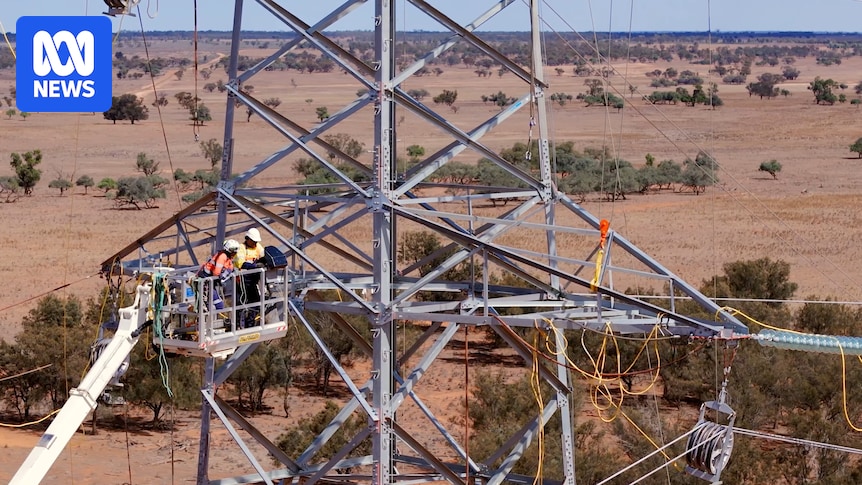
Chief among them was the company’s flagship Project EnergyConnect, a 900-kilometre high-voltage powerline linking Wagga Wagga to Robertstown in South Australia.
Transgrid was responsible for building 700km of the line but things had not been going well for a while.
And they were about to get much worse.
Clough, the Australian junior partner in an engineering joint venture that was building the line for Transgrid, was teetering.
It would collapse on December 5.
Project EnergyProblems
It was a major blow in a series of setbacks that have blighted a project, which is only just being completed, years behind schedule and at almost double the planned cost.
Those setbacks and Transgrid’s handling of them are the subject of intense scrutiny as the Australian Energy Regulator weighs an extraordinary proposal.
Transgrid wants consumers, rather than its own shareholders, to pay for $1.14 billion of the blowouts for its part of the project, which is now expected to cost $3.6 billion.
Brett Redman has been running Transgrid for four and a half years. (AAP: Dan Himbrechts)
In its push, the company has thrust into the spotlight difficult questions about who should bear the risks — and pick up the tab — in the energy transition.
Justice and Equity Centre energy consumer advocate Craig Memery says “two things are really on the line here” and “they both have far-reaching impacts”.
“The first of those is there’s a billion-odd dollars at stake here which would be, if it’s approved, recovered from households,” he says.
“The bigger thing that is at stake is what signal this sends Transgrid and, potentially, other regulated businesses.
“If the regulator sees fit to bend the rules enough to allow this proposal to be approved, that opens the door for a very, very broad interpretation of the rules that are intended to provide … cost certainty for consumers.”
To understand the hullabaloo, it’s necessary to know how the rules governing poles-and-wires companies such as Transgrid work.
Importantly, they work very differently to the normal rules of a free market because they are what economists call natural monopolies.
Many large-scale renewable energy projects are reliant on transmission network upgrades. (ABC News: Michael Franchi)
Poles-and-wires companies do not have to compete with rivals on price in order to make money, unlike the generators producing the power and the retailers that sell it.
Networks, as they’re known, are guaranteed the revenue they can make from customers and the profits they can earn.
The providers of that guarantee are regulators such as the Australian Energy Regulator (AER), which in turn are required to vet the spending plans of networks to ensure they are reasonable and efficient.
Projects that pass the regulatory test earn guaranteed revenues for decades.
What’s in a bargain?
Acclaimed energy writer Daniel Yergin says this is all part of a “bargain” aimed at balancing the needs of the networks with the interests of consumers.
It is the safety of this bargain that appeals so much to long-term investors, such as superannuation and sovereign wealth funds, which own Transgrid and other companies like it.
But it is this bargain which Transgrid is now seeking to reopen.
Earlier this year, Transgrid formally asked the AER to scrap its existing five-year spending plan and replace it with a new one that included much more generous allowances for Project EnergyConnect.
When the spending plan was first approved by the regulator, the project was expected to cost about $2.3 billion.
Of this, Transgrid’s share amounted to almost $1.9 billion, with its South Australian counterpart ElectraNet given $457 million.
South Australia finished its part on time and on budget, but it’s a different story in NSW. (Supplied: ElectraNet)
ElectraNet finished its part of the project in December 2023, on time and on budget.
In its application, Transgrid said it could not have foreseen the failure of its contract with Clough and Spanish engineering giant Elecnor.
Transgrid blamed a rollcall of setbacks it claimed were outside its reasonable control from flooding to COVID-19, labour shortages and extreme inflation.
The company argued the combination of these shocks meant the project could not be delivered under the fixed-price model it had agreed.
Therefore, Transgrid said the contract “could not be completed” and had to be renegotiated, meaning any new spending was also necessary.
In December 2024, Transgrid signed a new contract with Elecnor to finish the project.
“At every stage of the process Transgrid has acted to protect the interests of consumers and deliver PEC [Project EnergyConnect] at the lowest cost and with minimal delay,” Mr Redman wrote in his cover letter to the application.
For all his insistence that Transgrid has acted in consumers’ interests, it is not a view shared by many others.
Power giants at war
AGL says Transgrid is trying to shift the cost of its mistakes on to consumers. (Reuters: David Gray)
Energy behemoth AGL pulled no punches when it wrote a scathing submission to the regulator on Transgrid’s proposal.
AGL accused Transgrid of failing to act as a “prudent operator” in its management of the contract with Clough and Elecnor.
It said Transgrid’s entire claim relied on a bogus framing of the rules.
Under those rules, transmission companies can reopen their spending deal with the regulator when hit by an “event” that is unforeseeable and beyond their reasonable control.
While Transgrid was suggesting the failure of its contract was such an unforeseeable and uncontrollable event, AGL argued the claim was nonsense.
Project EnergyConnect will run 900km between South Australia and NSW. (ABC: Daniel Mercer)
The events, AGL said, were flooding, inflation and labour shortages, all of which were reasonably foreseeable to some extent.
As such, it argued Transgrid had simply failed to properly oversee and enforce its contract, particularly after Clough became insolvent.
AGL said the transmission company was seeking the pass the buck to consumers.
“Transgrid’s increased capital expenditure was not due to a contract failure beyond its reasonable control,” it wrote in its submission.
“But rather due its failure to exercise effective oversight of its contractor and its failure to act as a prudent operator in not enforcing its contract.
“These were both opportunities for Transgrid to exercise control and avoid its exposure to increased capital expenditure which it did not take.“
AGL also took exception to Transgrid’s argument that delaying Project EnergyConnect would jeopardise the security of the national electricity market itself.
It said the risk would only arise if AGL shut its Torrens Island gas plant outside Adelaide, but the company agreed with the South Australian government to keep the generator online.
Delays to Project EnergyConnect have required the Torrens Island gas plant to stay online for longer. (ABC News: Dean Faulkner)
“Any reliability risk associated with a delay was conditional and capable of mitigation, rather than inherent to [Project EnergyConnect],” the company argued.
Transgrid insists it is committed to maintaining its network, which it calls the NSW “backbone” of the national grid, as “efficiently and prudently as possible”.
The company says Project EnergyConnect will provide millions of households and businesses with “reliable, lower-cost energy” and help cut wholesale power costs.
A spokesman says that, notwithstanding the repeated blowouts on the NSW part of the line, the benefits would still outweigh the costs for consumers — a claim hotly contested by many.
The spokesman says Australia’s energy rules “are designed to manage unforeseen events” and Transgrid is merely seeking to recover a “portion” of its “additional investment”.
Transgrid ‘socialising’ losses
Nexa Advisory, which advocates for a faster energy transition, argued Transgrid should not be allowed not to “socialise” its failures.
Chief executive Stephanie Bashir said consumers deserved better, particularly given the number and scale of transmission projects on the table.
What’s more, Transgrid was the key player for many of those projects, including the $4.9 billion HumeLink transmission project linking the giant Snowy 2.0 pumped hydro plant to the national grid.
“The fact that a project remains strategically important cannot become a reason to tolerate a regulatory framework that repeatedly socialises delivery failure after the event,” Ms Bashir argued.
Craig Memery says Transgrid has failed to act prudently and responsibly. (Supplied: Public Interest Advocacy Centre)
Mr Memery is even more blunt.
He says Transgrid is misapplying the rules in an apparent attempt to absolve itself from its own problems.
He says the process of reopening five-year spending plans is there for extraordinary circumstances, when events change and networks need approval before they make major decisions.
But he notes that Transgrid has already made the decision — and already spent the money.
“This has become now a retrospective assessment of costs that Transgrid has proceeded to renegotiate itself in the absence of acting as a prudent and responsible business,” Mr Memery says.
He says any suggestion from Transgrid that denying it a bailout would imperil the broader transition is not credible.
Mr Memery says Australia is a “robust” place to invest and worthy of the confidence of big investors needed to fund projects such as wind farms and transmission lines.
The bigger problem, he says, is “these businesses and their boards and executives getting things so wrong”.
Long transmission lines transport power directly from its production source. (ABC News: Daniel Mercer)
Mr Memery says Transgrid’s bid is a litmus test for Australia’s energy regulations.
Central to those regulations is the bargain in which consumers pay for the “efficient” costs of properly managed projects.
Mr Memery says it is reasonable, therefore, for transmission companies to ask consumers to pay more when circumstances beyond their control change.
But he says that is “not what has happened in this case”, in which Transgrid mismanaged the project before allowing Elecnor to “not honour that contract”.
“For their own convenience, it seems, Transgrid sought to avoid whatever contract enforcement processes they had,” Mr Memery says.
“Maybe they didn’t want to spend six years in court in Madrid to enforce it.
“But that’s still their decision, their risk, their problem, and it should not be a consumer problem.“