






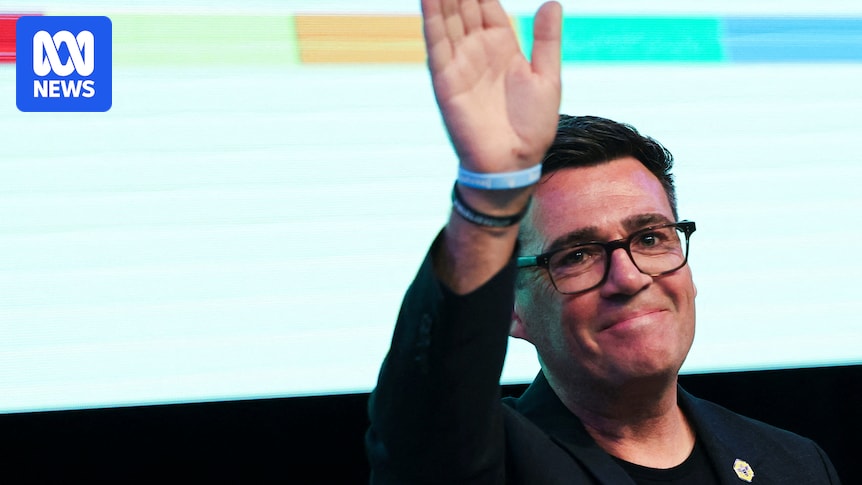
A popular mayor but a virtual unknown on the global stage, Andy Burnham looks likely to take up the UK’s top job.
It comes as deeply unpopular British Prime Minister Keir Starmer laid out a timetable for his departure, after pressure built steadily on him to go.
Sir Keir’s fall was fast-tracked by Burnham’s resounding win in a by-election in Makerfield in north-west England.
That win now has him poised as Sir Keir’s clearest successor.
But who is the so-called “King of the North” and what could his leadership entail?
A tragedy defines his early career success
The Merseyside-born Andy Burnham joined the Labour party at the age of 14, inspired by the miners’ strike.
He was special adviser to Labour’s culture secretary Chris Smith in the late 1990s, before being elected to the House of Commons in the 2001 general election.
Andy Burnham (right) was one of Gordon Brown’s youngest MPs. (Reuters: Arthur Edwards/Pool)
Just 31 when elected, he served first as a junior minister under Tony Blair before becoming culture secretary and health secretary in a new-look cabinet under PM Gordon Brown.
It was here he faced the first real challenge of his political career.
In 2009, the fresh-faced MP stood in front of Liverpool Football Club’s Anfield stadium to pay his respects on behalf of the government at the 20th anniversary of the Hillsborough disaster.
The Hillsborough disaster was defining for Liverpool. (Reuters: Action Images)
The 1989 tragedy was a fatal crowd crush at a match between Liverpool and Nottingham Forest that killed 97 fans and injured 766, making it the deadliest disaster in UK sporting history.
In the wake of the disaster, the then-Conservative government largely blamed unruly supporters, despite evidence of safety failings.
Frustrated by the years of blame, Liverpool fans heckled Burnham, chanting for justice and causing him to break off his speech.
The crowd had created a turning point, the politician later wrote.
“It was the day that changed everything,”
he said.
Burnham helped set up a subsequent enquiry by the Hillsborough Independent Panel. Released in 2012, the panel’s findings were highly critical of the emergency and police response, and established that fans had been unlawfully killed.
“It has been the privilege of my life to work with them all,” Burnham said of the survivors in a House of Commons address that saw convention bucked with a rare standing ovation.
Andy Burnham receives a standing ovation during a Hillsborough Memorial Service. (Reuters: Action Images/Carl Recine Livepic)
Failed leadership bids and Brexit
After Gordon Brown resigned following Labour’s general election defeat in 2010, Burnham took a shot at becoming the party leader.
He came fourth out of the five contenders but tried again in 2015, only to be beaten again by Jeremy Corbyn.
An opponent of the Brexit movement that was building throughout the period, Burnham now says he personally hopes Britain rejoins the European Union during his lifetime, but has walked back his previous calls for a second referendum.
“I’m not proposing that the UK considers rejoining the EU,” he said when launching his Makerfield campaign earlier this year.
“I respect the decision that was made at the referendum.”
Burnham served under Corbyn as shadow home secretary, but resigned in 2016.
He had decided to stand for the mayorship in Greater Manchester instead.
Profile rises during pandemic
Burnham proved a wildly successful mayor for the region, which has a population of around 3 million people and includes Manchester itself as well as a belt of post-industrial towns on its periphery.
He was re-elected for three terms.
Loading…
Under his leadership, Greater Manchester was the first area outside London to bring privatised bus services back under public control.
His profile also rose with his criticism of then-PM Boris Johnson’s mishandling of the COVID-19 pandemic.
He accused the government of treating the north of England with “contempt” over regional lockdown restrictions.
Andy Burnham’s integrated transport scheme came together under his Bee Network as mayor. (Reuters: Phil Noble)
Burnham later told the UK’s COVID-19 inquiry that excluding regional mayors from key meetings meant his region was “stuck” with higher infection rates for the whole of 2020.
His campaigning for northern communities during this period earned him the “King of the North” nickname from media and northerners.
Andy Burnham was dubbed “King of the North” after his criticism of the region’s treatment during the pandemic. (Reuters: Phil Noble)
The challenge of ‘two Englands’
If Burnham’s win in Makerfield propels him into Number 10 Downing Street, what happens next will likely borrow heavily from the style of his “Manchesterism” vision.
This includes moving economic power away from London and what he dubs “business-friendly socialism”.
He has repeatedly advocated bringing water “back under stronger public control”.
“We do need to bring down water bills, energy bills, rail fares, just as we brought down bus fares in Greater Manchester, to make life more affordable for people,” he said in his victory speech after winning the Makerfield seat.
Andy Burnham has propelled his regional success into another leadership bid. (Reuters: Phil Noble)
He has also flagged reforming Britain’s social care sector to ease pressure on the National Health Service, and would consider tougher measures to deter people from crossing the Channel from France.
For many, he will be seen as the UK’s “last chance” of avoiding a hard-right shift towards Nigel Farage’s Reform party, says journalist and policy analyst Anatol Lieven.
But his northern roots may also pose another hurdle, as he suggested in conversation in 2022.
“I feel all my life I’ve been struggling to relate one England to another,” he said.
“I’ve been trying to walk between the two, and often, not doing it very successfully.”