





Brisbane mountaineer Oliver Foran has completed his journey from sea level to the summit of Mount Everest for charity, despite every obstacle thrown his way.
The wind is howling, the air is thin, and every step and breath hurts.
At 8,848 metres above sea level, after 50 days battling exhaustion, avalanches and near-death experiences, 26-year-old Oliver Foran finally reaches the summit of Mount Everest.
He has just survived a journey spanning over a thousand kilometres on some of the world’s most unforgiving terrain.
The sound of his worn-in boots crunching the ice below his feet mark the moment he believes he set a new world record — the fastest human-powered journey from sea-level to the summit of Everest.
But the first person he speaks to isn’t there.
Through tears and a touch of sleep-deprivation induced delirium, he chokes out the words: “Mum, I made it.”
The woman who inspired his journey died from brain cancer over a decade ago.
But there, on the roof of the world, Oliver Foran swears she’s with him.
“I’ve always said my mum’s been climbing with me, but in that moment, I knew it,” he told ABC News weeks later.
“I just remember walking onto that summit; the wind dropped to about 10 kilometres an hour, and that was Mum.“
Setting a legacy
On mountaintops like this, there are plenty of egos, arrogance and desires for fame and fortune.
But the driving force behind Oliver’s pursuit was to raise money for charity.
He said the reason he pushed through nearly two months of muscle-shaking exhaustion, bone-chilling cold, sweat and tears was to honour his mum’s legacy.
The ABC was the first to speak with the mountaineer before he left for his big trek.
He partnered with charity YouTurn, with the ambition of raising money to build free gyms for youth across south-east Queensland; doubling as mental health support services with wrap-around, allied care.
It’s something Oliver believes would have helped him, when he found himself in a dark place seven years after his mum’s death.
When the obstacles that sought to disrupt his world-record attempt came forth at every twist and turn, he said he had to remind himself of who he was doing it for — those kids.
Obstacles like avalanches, near-fatal altitude sickness, and even hallucinations of orcs and Justin Bieber.
A busted bike and sweltering temperatures
Oliver began his journey in the Bay of Bengal, in India in early April. It was a tough start.
After a scramble to find a replacement for a screw that snapped as he assembled his bike last minute, he was on the road, full of jitters, optimism and ready to tackle cycling through the world’s most populated country.
It’s also one of the world’s hottest — he said temperatures soared to 42 degrees while he was there.
“I was not ready for the heat. That’s just something that I didn’t really train for,” he said.
“The heat was getting to me, along with the pollution, like I could hardly breathe.”
By day four, his optimism had been worn down.
There had been countless close calls with trucks on the road, the pain was overwhelming and his mental fortitude was being tested.
“By day four, I remember, I’d done 300km leading up to that, but this day was going to be the biggest day so far,” he said.
“I was about six kilometres in [that day] and I just broke down. I just started bawling my eyes out.
Loading…
“By doing that, I actually learned the best lesson of this whole expedition, and it was just to feel the emotion, let it run through you, don’t deny yourself the opportunity.
“Then just get back on that bike and keep going.”
What love he had for his bike was lost during those 16 days, amidst 1,150m and 10,000m of elevation of cycling. The moment he reached the Himalayas, he cast it aside.
“I held that bike up and then I put it down and I said, I never want to see you again,” he laughed.
“That was absolutely the appetiser, and then the real work began.”
The main course and dessert were coming, and so were some of his biggest obstacles.
Before climbers can take on Everest, they need to acclimatise to the thinner air to avoid altitude sickness.
Oliver did that by scaling two mountains, before climbing Mera Peak — a 6476m high mountain 31km from Mount Everest.
It was here it all started to go wrong.
“I felt fine, but then I went down with the sun,” he said.
A quick measure showed his blood-oxygen level was sitting at 46 per cent.
“On the mountain, anything under 80 per cent is when alarm bells go off — it’s dangerous,” he said.
“[At 46 per cent] that is fatal, if you stay there for too long.“
He said it felt like someone was standing on his head, his vision was splitting, and for the first time during his journey, he truly wondered whether he’d make it out alive.
His condition triggered a night-time evacuation off the mountain on foot, to a camp 75km away in minus 15-degree conditions.
The retreat added an additional 10 days to his trip, at a point where he couldn’t afford to lose time.
His world record attempt was in jeopardy, and he felt as though all the money he had raised, promises he had made, training and planning could be for naught.
But he wasn’t prepared to give up yet.
“After that, we were trekking for about 12 hours every single day, trying to get back on track and it was brutal,” he said.
“We did the Everest Base Camp trek in three days, instead of the eight that it normally takes.”
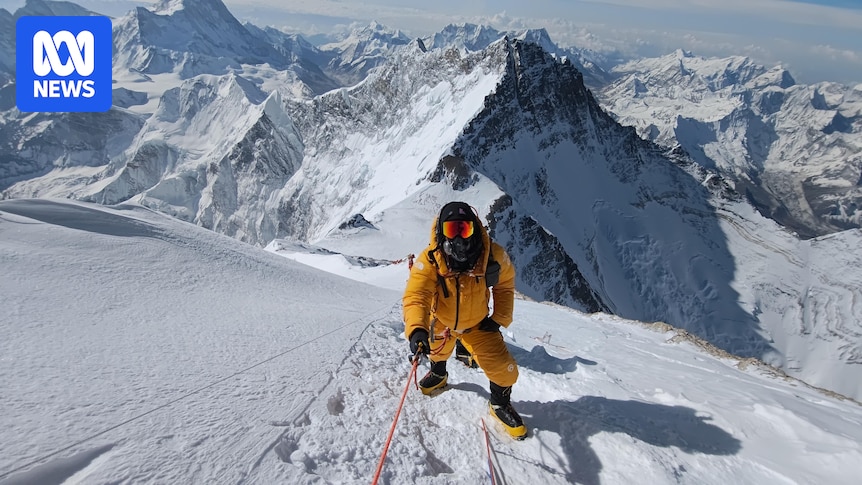
The climb to the summit of Mt Everest. (Supplied: Oliver Foran)
Ice try, Everest
On day 38, after surpassing Base Camp and en route to Camp 1, Mother Nature reminded the mountaineering team who was boss.
“You hear avalanches all night at Camp 1,” Oliver explained.
“They start out ferocious and then they fizzle out.
Loading…
“But we woke up one morning — we could hear this avalanche — and it wasn’t fizzling out.
“It was getting louder and louder.”
He said there was often debris and large shards of ice hidden in the fast-approaching snow wall.
All Oliver and his travel companion could do was hope for the best.
“It would have been 30 metres high,” he said.
“I think it was by the grace of any higher power that we kind of just walked out of that tent afterwards.”
But walk out he did, onto Camp 2, Camp 3 and finally, the hurdle he had been waiting for — the summit.
Unfortunately for Oliver, whether it be nerves, excitement or a mixture of both, he didn’t sleep in the 48 hours leading up to that moment.
He still had to scale the peak and climb back down the mountain before he could get some rest.
Record unverified — for now
The previous verified record-setting journey took 67 days from sea level to summit, and was set in 2013.
Right now, Oliver’s world record trip is unverified as having the trip officially recognised takes time, but he hopes it won’t be long until he receives certification.
When the ABC spoke with him before his journey, he said he had been playing one song on repeat, that acted as a reminder of his mum.
As he took the final steps onto the summit of Mount Everest, 50 days after starting his expedition, Madonna’s Like a Prayer was blasting.
“There were plenty of tears, just this elated feeling; sitting there and just looking out to the rest of the world,” he said.
“To be able to keep pushing through and to stand up there after everything, and set a world record, it was incredible.”
Loading…
He said the sleep deprivation-induced delirium, coupled with high altitudes and days of physical feats produced an effect that could rival psychedelics.
“There were bits of snow that were dug out for tents and [I thought they were people and] they started talking to me,” a bleary-eyed Oliver told his friend and cameraman after climbing back down the mountain.
“I remember getting to the bottom … and thinking I saw like a family of orcs making dinner.”
Pointing off-camera, he remarked: “I thought that was a teddy bear’s face with a mad Justin Bieber haircut when I walked in. What is it?”
“It’s a rubbish bin,” his cameraman replied.
A promise to keep
As Oliver faced overwhelming obstacles, trials and tests, another test of resilience was taking place thousands of kilometres away, back on home soil.
Before he set out on the expedition, he made a promise to his grandmother: “I won’t die, if you don’t.”
She had been fighting cancer for years, and her condition was worsening.
A week before he summitted, she took a turn for the worse. She wasn’t eating or drinking as much and was talking less.
“She was fighting to hold on,” Oliver said.
“When my family told her that I summitted, she said ‘I’ve done it, I did it’.
A few days after, she passed when Oliver was in Kathmandu.
“That for me was the true meaning of resilience.”