






There is something very wholesome happening at ACT events when you are eating your food truck treats from a compostable plate, with compostable cutlery and sipping from a compostable cup.
The ACT mandates reusable, recyclable and compostable packaging at all public events, but nearly all of it ends up in landfill because there is no facility to compost it.
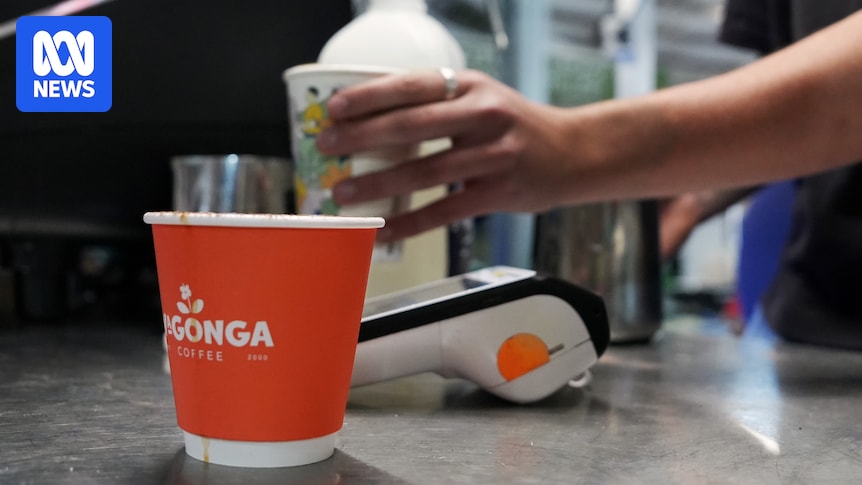
Debbie Clifford pours hundreds of coffees every Saturday morning at the Capital Region Farmers Market, and is demoralised by the lack of action.
Debbie Clifford says it’s frustrating the government is not supporting Canberrans to compost their waste at public events. (ABC News: Adam Kennedy)
“We’re being sold a lie,” Ms Clifford said.
“It says compostable, but it’s going straight to landfill.
“What I find really frustrating is that so many people are willing to do the right thing, but the government is not able to support our community to do that.”
‘What’s the point?’
The ACT government was the first in Australia to ban single-use plastics at public events, requiring organisers, vendors, and caterers to use reusable, recyclable, or compostable alternatives, but it has not built the infrastructure to actually recycle or compost the material.
While the original intent has been welcomed, many vendors and waste advocates say it is window dressing and has become a source of frustration rather than pride.
Debbie Clifford says it doesn’t make sense to pay more for compostable packaging when it will not be composted. (ABC News: Lish Fejer)
“You buy them because they’re meant to be compostable,” Ms Clifford said.
“They’re more expensive than a regular cup, and that’s because they’re meant to be better for the environment.
“What’s the point? You pay a high price and it’s all going to landfill anyway.“
Across Canberra’s event sector, small business owners, market managers and waste worriers are wrestling with a policy that mandates the front end of a circular economy without delivering it full circle.
No organics bin, only a too-hard basket
Dan Watters has spent decades working in resource recovery running events and helping events, such as the National Folk Festival, reduce their waste line.
After eating breakfast at the Capital Region Farmers Market, Mr Watters pointed to the range of cardboard and paper products it was served on as an example of the ACT’s composting issue.
Dan Watters says putting compostable packaging in the recycling bin can contaminate the entire load. (ABC News: Adam Kennedy)
“We don’t have facilities in the ACT that can handle some types of material such as this,” he said.
“Everything here is compostable, but I don’t have anywhere to put that compostable material other than a landfill bin or a recycling bin.“
Without those facilities, the mandated packaging ends up in one of two places: landfill, where organic material breaks down into methane, or in the recycling bin, where — unless it’s correctly sorted — it contaminates the entire load.
“People might think they’re doing the right thing, but I’m pretty sure a lot of it’s going to landfill,” Mr Watters said.
Market waste all goes to waste
Capital Region Farmers Market manager Sarah Power said dealing with the waste was a complicated puzzle for vendors, customers and management alike.
Sarah Power says all the vendors at the Capital Region Farmers Market are eager to figure out the market’s waste management. (ABC News: Adam Kennedy)
“Everyone here is really keen to embrace it,” Ms Power said.
“[But] we’re all really confused about what we do with all of our packaging, which is able to be composted, but isn’t being composted.“
The market has tried.
It is looking at how to manage the organic waste through a private collection and in the past has partnered with SimplyCups, a Sydney-based company that composts the BioCup, but the program is expensive and relies on shipping waste interstate, producing its own transport emissions.
“It would be fantastic if we could find a way to get that material into a compost, but we haven’t found the right person in government to have those discussions,” Ms Power said
The Capital Region Farmers Market is considering composting its waste privately through a company like SimplyCups, which composts BioCups. (ABC News: Adam Kennedy)
Good intentions, wrong bin
Mr Watters said it was clear that getting rid of single-use petroleum-based plastics was the right first step and reflected genuine environmental intent.
“Getting rid of plastic is obviously the first place you want to start, but then why aren’t we recovering organic material?”
Mr Watters said.
He pointed to what he sees as a golden, but currently untapped, opportunity to compost waste at scale in the ACT.
“You need a mix of carbon and nitrogen to successfully compost,” Mr Watters said.
“We have a great opportunity here, the FOGO [Food Organics and Garden Organics] trial will be getting a lot of nitrogen material.
The FOGO trial provides households with a kitchen caddy and liners to store their scraps, to be picked up and recycled into a nutrient-rich compost. (ABC News: Jostina Basta)
“You can combine the two and then you have a facility that can handle commercial quantities of carbon-rich material and stuff that needs to be commercially composted.
“It’s not hard. It just takes a bit of thinking and a bit of effort.”
As he left the market, Mr Watters put the compostable plates, cutlery and BioCup into the red-lidded landfill bin.
“We don’t have a compost bin so this one’s having to go in the too-hard basket. Sorry planet.“
Some packaging labelled compostable ‘cannot be composted’
In a statement, an ACT government spokesperson said major festivals and events in the ACT were focused on reducing waste and carbon emissions “by trialling new ways of reducing and processing waste at events”.
“At EPIC, several major event hirers, including Spilt Milk and the National Folk Festival, engage waste sorting contractors with the capability to process compostable materials,” they said.
Some packaging labelled as compostable contains additives to make it grease and water-resistant, meaning it cannot be composted safely. (ABC News: Adam Kennedy)
“Floriade uses more than 11 different waste streams, which are hand-sorted on site to recover as much material as possible and reduce what goes to landfill.”
The spokesperson added that while the packaging may all look compostable, not all of it is, as products with waterproof and non-stick coatings should not be composted.
“Unfortunately, some fibre-based packaging labelled as compostable can cause issues in composting facilities,”
they said.
“These products often contain additives to provide water and grease resistance in food packaging, which may cause human and environmental harm when used for compost.
“This means that compostable packaging may end up in landfill as they cannot be composted.”