





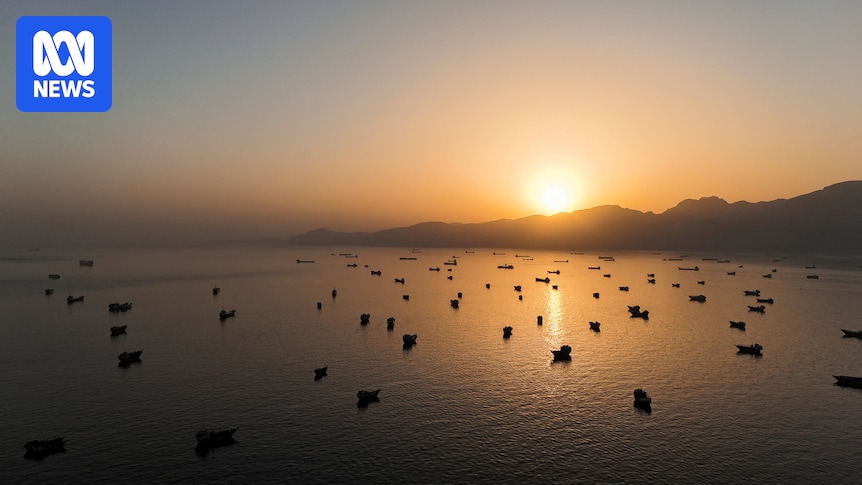
Fresh attacks on commercial vessels in the Strait of Hormuz have exposed the fragility of the 60-day ceasefire deal between the United States and Iran, which was meant to allow ships to transit through the area again.
The strait, which carries about a fifth of the world’s oil, has become one of the biggest sticking points in efforts to turn the ceasefire into lasting stability.
Last week, traffic in the critical waterway rose to its highest levels since the start of the war, according to data from marine intelligence company Kpler.
During the height of the conflict, fewer than 10 commodity ships a day were crossing the strait. But on Wednesday, 73 ships passed through, and on Thursday, 54, according to data from Kpler.
Then in two separate incidents on June 25 and June 27, two commercial ships were attacked by projectiles in the strait.
US President Donald Trump responded by describing it as a “foolish” breach of the ceasefire and carrying out strikes against Iran on Saturday.
Tehran was supposed to fully reopen the strait within 30 days as part of its Memorandum of Understanding (MOU) with Washington.
The agreement stipulates that Iran will use its “best efforts” to ensure ships can “pass safely” through the strait, and states that Iran will work with Oman on the “future administration” of the narrow waterway.
But for Iran, re-opening the strait does not appear to mean relinquishing control.
Conflicting reports have emerged about US-Iran talks supposedly planned in Qatar for Tuesday to try to resolve the dispute in the Strait of Hormuz and get the fragile ceasefire back on track.
US President Donald Trump posted on social media that Tehran had requested the meeting and that it would take place in Doha.
The White House said two of the president’s closest allies, his son-in-law Jared Kushner and Special Envoy Steve Witkoff, would fly to the Qatari capital for the “high-level meetings” as the two countries “continue to discuss the memorandum of understanding”.
But Iran’s Foreign Ministry Spokesperson Esmaeil Baghaei said no talks between Iran and the United States were scheduled in the coming days.
Iran only wants ships passing through approved route
The first strike on Thursday came hours after Tehran warned ships not to use what it described as an “unauthorised route”.
An increasing number of ships had been trying to get around Iranian control by taking the south corridor route, which hugged the Omani coast, rather than the north corridor route that sailed close to Iran.
Iran’s foreign minister warned any challenge to Tehran’s control of the strait and its approved route would delay its reopening.
“Any attempt to adopt new or separate arrangements from those currently being implemented by the Islamic Republic of Iran will only complicate the situation, delay the reopening of the Strait of Hormuz and raise the level of tension,” Foreign Minister Abbas Araqchi said on Sunday, local time.
Principal freight analyst at Kpler Matthew Wright said Tehran “will want vessels to take the Iranian route so they can exert … control”, which will make it harder for traffic to return to normal.
“There’s a fundamental limitation in getting back to normal transits that way because the navigation is trickier,” he told the ABC.
“You’ve got to go through tighter choke-points around the islands … you can’t have full vessel movement the way you can with the International Maritime Route.”
There are effectively three options for ships: the international route through the middle of the strait, the Iranian route along Iran’s coast, and a southern route shadowing Oman’s coast.
Mr Wright said very few vessels are choosing the middle route, which is the recommended path by the International Maritime Organisation because of ongoing concerns about sea mines laid by Iran.
“Some ships are going through the middle, but very few,” he said.
“If they were completely confident that they weren’t going to be attacked, and there were no mines, all vessels would take that route.”
The roadblocks to fully reopening the strait
US Central Command said it had been helping commercial ships transit the strait for the past two months and last week said it had assisted more than 500 vessels since May.
And according to shipping data Mr Wright’s firm was tracking, between 10 million and 13 million barrels a day were flowing through the strait before the Iranian attacks.
That is well below the 19 million barrels a day Mr Trump claimed was travelling through the strait.
Donald Trump has repeatedly claimed the Strait of Hormuz is open throughout the war with Iran. (Reuters: Evan Vucci)
“The pressure valve is being alleviated … you don’t need to make bombastic claims about this stuff because it is still an improvement,” Mr Wright said.
But the latest attacks have shown that reopening the waterway is as much about confidence as security.
“The situation underscores the importance of clear and unambiguous agreements between the US and Iran regarding a resumption of maritime traffic through the strait,” Jakob Larsen, chief security officer at BIMCO, the world’s largest shipping association, said.
“The attack is a setback in the plans to evacuate ships and resume transits through the Strait of Hormuz, although some transits can still be expected to take place.“
The resumption of hostilities in the strait prompted the UN shipping agency to temporarily pause plans to evacuate hundreds of stranded ships and thousands of seafarers from the Gulf.
The UK’s Maritime Trade Agency also raised its threat assessment for the strait to “substantial”.
“I think it’s a game of confidence really. It’s all about the fear factor,” Ami Daniel, co-founder of Winward Marine Intelligence, told the ABC.
“It’s like trading in the stock markets.
“Remember, it was open and was closed 13 or 14 times in the past. It feels to me right now it’s a bit more stable than what it was at the height of Project Freedom.”
Return to almost normal could take months
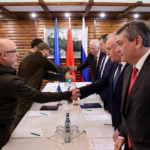
At the recent peace talks in Switzerland, US Vice-President JD Vance said Iran and the US agreed to set up a “deconfliction cell”, essentially a direct line of communication between the two countries to prevent incidents in the strait from escalating.
Mr Vance said the channel would include the Islamic Revolutionary Guard Corps (IRGC) and the US Army’s Central Command, which would sit together in Qatar to try to keep the strait open.
It’s unclear whether that line, which was meant to avoid exactly what played out over the past four days, is up and running.
Mr Wright estimates that if the attacks on vessels in the strait stop, traffic could return to 50 per cent of pre-war transits within 30 days, and it could take until September for transits to get back to almost normal.
“After 20 to 30 days, you will start to see the vessels that are in the ‘watch and wait’ … cohort, and they are the ones who are listed ship owners, the bigger players who need a few more boxes ticked before they’re going to return,” he said.
“The reason there is a slow uptake is that insurance is still exceptionally high, and there’s still a high level of distrust that the IRGC will be true to their word and say it’s open.
“We’ve had these false dawns where they think this is it, we’re safe to go.”
US Secretary of State Marco Rubio has warned against any country imposing tolls on the strait. (Reuters: stringer)
Shipping companies and insurers warn that the waterway remains highly risky, largely because of fears that sea mines were laid during the conflict.
The warnings follow threats made by Iran early in the war that it could deploy naval mines in the strait.
While Tehran said it had several types of mines at its disposal, it never confirmed whether any had actually been laid.
“The mine situation is a huge wrinkle in the recovery; we don’t know a lot about it,” Mr Wright said.
“There is a lot of scepticism about whether it is really mined.
“Over the course of the war, we have seen hundreds of vessels make transits, and there’s been no single incident with a mine, despite vessels taking all manner of routes.
“I think it’s very unlikely the area is comprehensively mined.”
Under the ceasefire agreement, Iran is required to clear any mines within 30 days, with France and the United Kingdom leading international de-mining efforts.
The long-term impact of being stuck at sea
It’s not just the immediate threat of mines that ships have to worry about, Mr Daniel said, adding there were long-term costly impacts of being stuck at sea for months.
“There are barnacles, which you need to be aware of,” he said.
“If you park a ship for a long time in the ocean, you get these small shells stuck on them.
“That affects the speed and the fuel consumption. Sometimes also the stability of the sail. So my assumption is every ship that was in the Gulf for two months needs to go to treatment.
“They won’t be able to just start trading on the high seas, so they can’t join the trading fleet anymore.”
Even if the attacks stop, uncertainty remains over what happens when the ceasefire expires.
The current agreement allows ships to move through the strait without tolls or transit fees, something Mr Trump has insisted should remain non-negotiable, given tolls are against international maritime law.
However, there is growing discussion about whether Iran and Oman could instead charge for services, such as navigation assistance, traffic management or environmental protection, introducing fees without calling them tolls.
“If they soft launch the idea of transit fees without an explicit framework, I think that would be very dangerous. They need to really iron it out themselves,” Mr Wright said.
“But the problem we’ve seen over the last three or four months is everything is being tweeted before it’s a fully formed plan, and everybody is concerned, and everybody reacts to that.”
Mr Wright believes shipping through the strait may never fully return to pre-war levels, and this conflict could change how shipping is conducted in the Middle East in the future.
Countries like Saudi Arabia have already found ways to bypass the strait, using its geography to their advantage, and are likely to continue to do so.
“Obviously in years to come every country is going to be investing in alternative routes and pipelines,” Mr Wright said.