





The new prime minister of Solomon Islands has floated the idea of a Pacific-wide security pact during a visit to Canberra, in a move that could have significant strategic implications for the region.
The ABC has been told that Matthew Wale, who is also the chair of the Pacific Islands Forum (PIF), raised the proposal with Prime Minister Anthony Albanese during his visit in early June.
Mr Wale has made a sharp pivot towards Australia since taking office, kickstarting negotiations on a new treaty and promising to “review” the China-Solomon Islands security pact, although he has backtracked on a previous commitment to publish the text of the contentious agreement.
He has been careful not to criticise Beijing, saying it is a valued economic partner for Solomon Islands and insisting he wants to maintain a policy of “friends to all, enemies to none”.
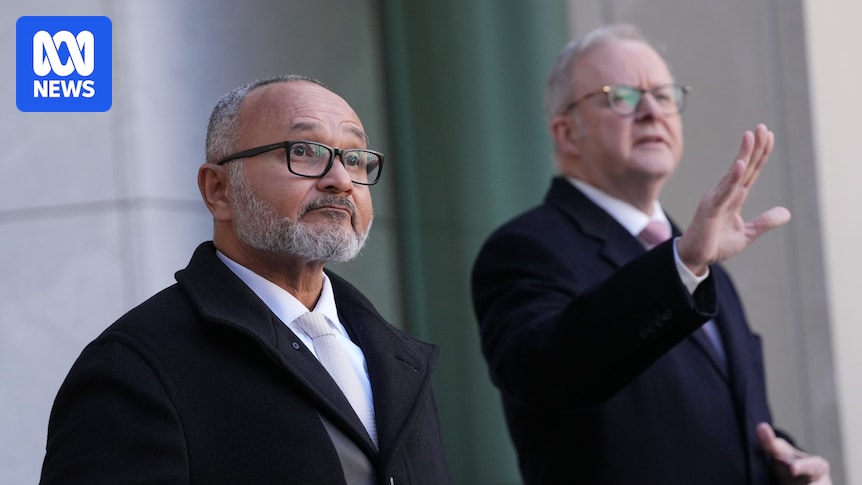
Matthew Wale was voted in as Solomon Islands’s new prime minister in May. (ABC News: Adam Kennedy)
But the ABC has been told that Mr Wale has made it clear that he shares Australia’s conviction that China should not play a major role in Pacific security and that there should be a “Pacific-led” security architecture.
The ABC has been told Mr Wale raised the idea of a Pacific-wide security treaty as a way of cementing regionalism, while adding he was in a strong position to kickstart formal discussions on the proposal as he holds the PIF chair until September this year.
Mr Wale made a veiled reference to the idea during his press conference in Canberra when he spoke about a treaty “at some stage at the regional level”, saying the “first reference point in these matters is within the region”.
But it is not yet clear whether either Australia or New Zealand are willing to throw their weight behind the idea, which analysts say would carry both significant opportunities and risks.
A spokesperson for Mr Wale declined to comment on the discussions, as did a spokesperson for Mr Albanese.
‘Uphill battle’ before regional pact
One federal government source did not criticise Mr Wale’s idea, but stressed that Australia’s main focus for now was on negotiating its new treaty with Solomon Islands.
Several senior Australian politicians are expected to visit the Pacific nation in the coming months as the federal government tries to cement the progress it made during Mr Wale’s visit.
Oliver Nobetau from the Lowy Institute said while there might be “real merit” to the idea, it could “easily backfire for Australia and New Zealand if they put their weight behind it before there’s wide buy-in from the Pacific”.
“This seems like a no-brainer, but there’s also an obvious reason why it hasn’t happened yet,” he said.
“Trying to get one cohesive approach when there’s such varied approaches to security across the region is an uphill battle, which has to be fought.”
Mr Nobetau also suggested Australia might prefer to focus on bedding down a host of bilateral agreements it is negotiating or has recently signed with a host of Pacific nations, including Fiji, Solomon Islands, Papua New Guinea, Vanuatu, Tuvalu, Tonga and Nauru.
“We have signed a lot of agreements, but the biggest question is around implementation: how do we implement and operationalise all these agreements?”
he said.
Pacific security expert Anna Powles from Massey University said Mr Wale seemed to be “acting with considerable urgency in the face of what he may fear is a short political window of opportunity”.
But she said that it would “take time to secure consensus across the region” for any new pact.
“The key political and legal questions Wale’s proposed regional security agreement raises are, for example, would it be a legal or non-binding instrument?” she said.
“How would it reflect Pacific concerns about militarisation? Where in the regional security architecture would it sit, and who would have oversight?
“And ultimately, what would its purpose be in times of regional crises, such as instability in non-sovereign states such as New Caledonia or in the case of renewed instability in Bougainville?”
The ABC understands Mr Wale is expected to discuss this idea, which is in its early stages, with several other Pacific leaders, including Fiji’s Prime Minister Sitiveni Rabuka during a visit in the coming weeks.
The ABC has contacted Mr Rabuka’s office for comment.
Opposition calls for bipartisan Pacific trips
It comes as the federal opposition presses the government to resume bipartisan trips to the Pacific, with Shadow Foreign Minister Ted O’Brien travelling to Papua New Guinea and Fiji, his first overseas trip since taking on the portfolio in February.
Mr O’Brien told the ABC he wanted to send a “clear signal that Australia is a trusted partner and will continue to be a trusted partner no matter who is in government”.
Foreign Minister Penny Wong coordinated two bipartisan trips to the Pacific in the Albanese government’s first term, but none so far in its second, and Mr O’Brien said he would like to restart them.
“I’d welcome the opportunity to be showing bipartisan force when it comes to the Pacific in particular,” he told the ABC.
“We need to restore bipartisanship wherever possible, and joint trips, as were done previously, are one way for us to demonstrate a ‘team Australia’ approach.“
The foreign minister has lashed the Coalition over its record in the Pacific, calling the 2022 China-Solomon Islands security pact a strategic disaster for Australia and pointing to fierce Pacific criticism of the Morrison government’s climate policies.
She has also criticised the Coalition for refusing to give full backing to the Pacific Engagement Visa, which offers permanent residency to 3,000 Pacific Islanders per year, because it opposes the use of a lottery to select applicants.
Senator Wong has warned the opposition’s position could undermine Australia’s reputation in the region, but Mr O’Brien said he was “disappointed” by that criticism.
“We cannot afford to have important relationships, such as those with the Pacific, undermined by our own domestic partisan debate,” he said.
Ted O’Brien visited Pacific nations on his first overseas trip as shadow foreign minister. (ABC News: Callum Flinn)
He did not rule out shifting the Coalition’s position on the Pacific Engagement Visa, but said he was not yet “convinced” by the government’s arguments.
“The Coalition supports the principle of the Pacific Engagement Visa, but continues to have concerns about the lottery-style ballot system,” he said.
“I am yet to be convinced the lottery system meets the needs of employers or aligns with the approach of other Pacific Island nation programs like the PALM scheme.”
A spokesperson for Senator Wong said the government would “consider opportunities for bipartisan engagement where appropriate”.
“Pacific leaders have made clear what matters most is support for their highest priorities, particularly meaningful action on climate change,” they said.
“A ballot ensures the Pacific Engagement Visa is allocated through a fair and transparent process.”