




Players from multiple SANFL clubs have considered collective action against the state league as negotiations over a collective bargaining agreement stall.
The ABC can reveal the SANFL Players’ Association met on the eve of the season to discuss the potential of a strike in response to a 50 per cent decline in pay over the past 20 years.
Taking inflation into account, that has seen their hourly salary drop to a third of the national minimum wage.
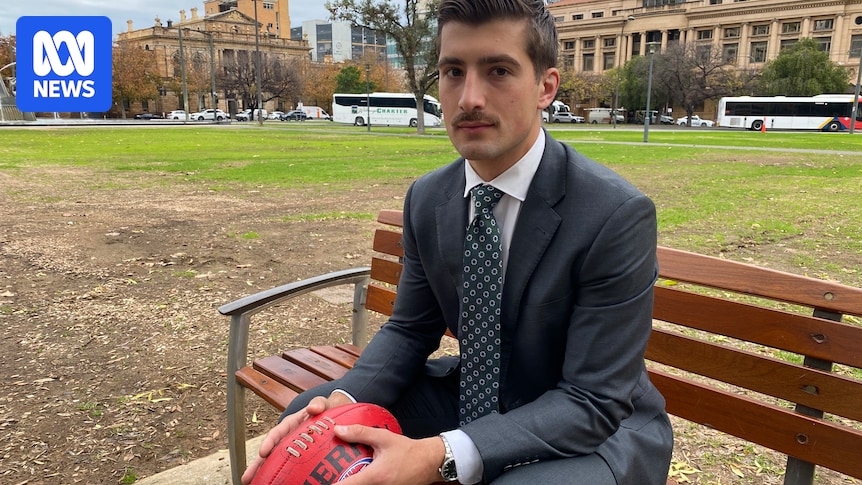
Woodville-West Torrens forward Daniel Sladojevic is one of the numerous state league players who will vote on a decision to protest when the association holds its next special general meeting on July 5.
“I love playing in the SANFL. We are the second best competition outside of the AFL in Australia,” he said.
“We want it to stay that way. The only way it does is if we get the best players wanting to play here, and the financial compensation that players receive definitely plays into that.
“A key reason players will take the opportunities elsewhere is because of the time commitment that’s involved.
“Players naturally actually ask themselves whether the current arrangements are adequately compensating them for those commitments.”
The SANFL has 10 teams, including reserves teams for the Adelaide Crows and Port Adelaide AFL clubs. (ABC Radio Adelaide: Malcolm Sutton)
Sladojevic said earlier in the year when they raised their concerns the SANFL did respond by opening dialogue and setting up meetings, which addressed some issues.
“We just want that to continue going forward,” he said.
Players earn a third of minimum wage
Since 2022 a standard SANFL playing contract stated that players were permanent part-time employees, which under Australian law entitled them to a fair wage.
But a survey of 234 players in 2025 found the average SANFL player earned about $5,000 before tax, despite committing about 16 hours per week to training and playing for 39 weeks a year.
That equates to $8 an hour, well below the national minimum wage of $24.95 per hour prescribed by the Fair Work Commission.
The national minimum wage is set to rise to $26.44 in July.
A SANFL playing contract describing the player as a permanent part-time employee. (Supplied)
Sports law academic Matt Nichol believes the players’ association could go as far as engaging federal labour law to force the league into a collective bargaining agreement.
“You’re activating the Fair Work Act by categorising players as employees, so they get [its] statutory protections,” Dr Nichol said.
“If the players don’t challenge the wages the [SANFL is] able to get under the radar of federal labour law.
“The argument that sport is unique or special doesn’t hold too well when it comes under legal review.”
Matt Nichol believes the players’ association could go as far as engaging federal labour law. (Supplied)
The players’ association estimates, on average, a SANFL player should have earned a combined $18,385 in 2024 through a minimum wage salary plus 12 per cent superannuation and annual leave benefits.
That equates to a minimum $13,000 underpayment per player and a $4 million shortfall overall.
The group’s president, Matt Crocker, feels the issue is black and white.
“When push comes to shove, SANFL players are employees,” the former Sturt player said.
“Just because they’re doing something they love we don’t think that should mean that they don’t get the same protections as other employees in Australia.“
SANFL wants ‘sustainable’ league
In a statement provided to the ABC, the SANFL said its salary cap was primarily based on the financial sustainability of the league.
“Our priority is maintaining a strong, sustainable league for all stakeholders,” it said.
“We believe the current model reflects that balance without the need for a collective bargaining agreement which exists in sports where broadcast rights are worth millions of dollars.
“SANFL has and will continue to engage with players and clubs on a range of matters and is committed to providing the best experience possible while ensuring the long-term sustainability of the competition.”
The SANFL’s salary cap has fallen over time, both before and after taking inflation into consideration. (Supplied: SANFL Players’ Association)
Sladojevic admits the players do not want to see the league financially crippled, but do want their wages to reflect the league’s profits.
“We don’t want to see our clubs or the league put under any financial pressure,” he said.
“We love the league, but what we do want is an opportunity for our voices to be heard, for our concerns to be adequately addressed.
“I think, as a player, when you look at the strong financial results which the SANFL has reported following COVID and the investment in major projects, such as the high-performance centre down at West Lakes, players have naturally begun to ask whether a corresponding level will be seen in their salary.”
The SANFL recorded a statutory profit of $19.4 million in 2025 but, after grants to state league clubs and the investment in the high-performance centre, the league ended up with cash earnings of $2.2 million.
The SANFL’s salary cap has fallen considerably compared with the AFL’s. (Supplied: SANFL Players’ Association)
SANFL Players’ Association president Matt Crocker said they were aware of the SANFL’s financial restrictions and were urging them to join forces and lobby the AFL for extra funding.
The national league generated a $67.9 million profit in 2025, while their total player payments almost tripled over the past two decades.
“We’re not naive to the fact that it is going to be a bit of a battle,” Mr Crocker said.
“We think that if we join forces with the SANFL we can make a really strong and compelling case to the AFL that for too long the funding to state-level football hasn’t been keeping up pace with what it should be.”
Other state leagues have lower caps
A collective bargaining agreement could set a precedent around the country, given WAFL and VFL teams have salary caps over $100,000 less than the SANFL.
Damon Freitag currently plays in the WAFL for East Perth after several years at South Adelaide and feels the push for a fair wage out west is not as strong.
“From my experience we spend a lot less time at the club in terms of contact hours, so there’s a lot less frustration,” Freitag said.
“I feel like a lot of it is playing to get drafted or for pride. There’s more money in country footy if you’re chasing cash.”
At its special general meeting next month the SANFL Players’ Association is set to vote on whether to accept an undisclosed memorandum of understanding from the SANFL or to continue to push ahead with negotiating a collective bargaining agreement and take collective action.