








Listen to this article
Estimated 4 minutes
The audio version of this article is generated by AI-based technology. Mispronunciations can occur. We are working with our partners to continually review and improve the results.
The Royal Newfoundland Constabulary say they’ve responded to false reports involving firearms on George Street and it’s believed to be part of the elaborate operations of a group targeting children through online platforms.
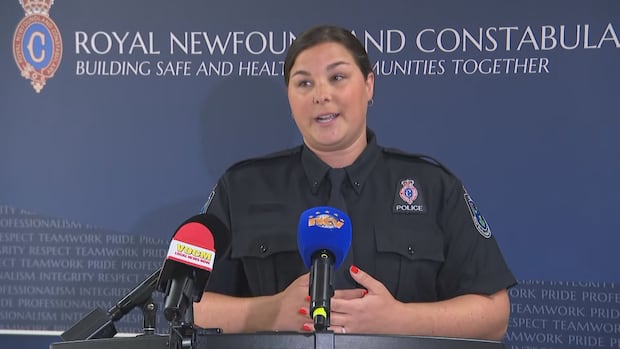
RNC Const. Stephanie Myers told reporters on Monday afternoon police believe the online group “764” has been approaching children online, including now children living in Newfoundland and Labrador, in schemes to ultimately victimize them. “764” was listed as a terrorist entity under the Criminal Code in late 2025.
The group is known to coerce youth into acts of self-harm, sharing intimate images, making threats or harming animals, according to the RNC.
She suggested the group has used false reports of guns in downtown St. John’s and the rapid police response following to try and suggest to children the group is serious, and willing to go so far as to manipulate authorities.
“Last week, we responded to George Street. We received two separate reports of firearms being used in downtown establishments,” Myers said.
There is one case of a child in this province, still under investigation, where statements point to the “764” group’s involvement, she said.
The investigation provided enough for a broader public warning.
Initial contact on gaming platform: RNC
Myers said she believes the initial approach to the child in the case in question was on the online gaming platform Roblox.
She added that in both the local case and more generally, an initial approach to children begins with friendly messages. She said parents should try to be aware if their children have new friendships online they’re being asked to keep secret or involving, for example, gifts such as “top-ups” to their platform accounts. These gifts can be a warning sign.
“Parents should certainly report to us and have those difficult conversations with their children if they’re seeing these things at home,” Myers said.

Online games and messaging are a big part of the internet. But police say youth are being extorted online — and it starts innocently enough via a chat or while playing a popular game.
Friendly exchanges can eventually lead to a request for a picture, like a school picture. Myers warned those photos can then be manipulated and used to begin extortion of the child. There may also be a direct request for explicit images.
Parents are being asked to explain pictures should only be shared with their parents’ permission, that personal information shouldn’t be shared in online chats on gaming platforms and emphasize that pictures cannot be taken back.
Police have essentially described an advancing persuasion of children. And the hoax call in St. John’s was described as part of that effort.
“We have received a number of those [calls] this week but we believe related to this event,” Myers said, adding the call numbers can be untraceable.
It’s unclear exactly what evidence has been gathered so far in the case.
Nothing was shared directly connecting “764,” or individuals tied to “764,” to the false firearms calls.
No individuals have yet been named in the investigation of attempted online exploitation of youth in the province. But Myers said the ongoing investigation involves national and international policing counterparts.
“The investigation is ongoing. We don’t have a suspect at this time,” she said.
The RNC said the group uses games such as Minecraft and Roblox to communicate with youth, but Myers also said groups targeting children will often try to move chats started on gaming platforms to online messaging platforms, naming Discord and Telegram.
If you or someone you know is struggling, here’s where to look for help:
Download our free CBC News app to sign up for push alerts for CBC Newfoundland and Labrador. Sign up for our daily headlines newsletter here. Click here to visit our landing page.