


On the first day of the epic fundraising bike ride that professor Richard Scolyer undertook just 11 weeks before he died of brain cancer, he realised one leg of the route fell short of his 100-kilometre-per-day goal.
So, he just kept riding.
Loading…
The fact the route he’d just finished was a climb from Tasmania’s Devonport to Cradle Mountain was of no consequence to Richard.
He wanted to ride at least 100km a day, so he would.
It’s a telling insight into the goal setting and determination of Richard, 59, the driven and brilliant pathologist who died last week of the terminal brain cancer that he so publicly documented.
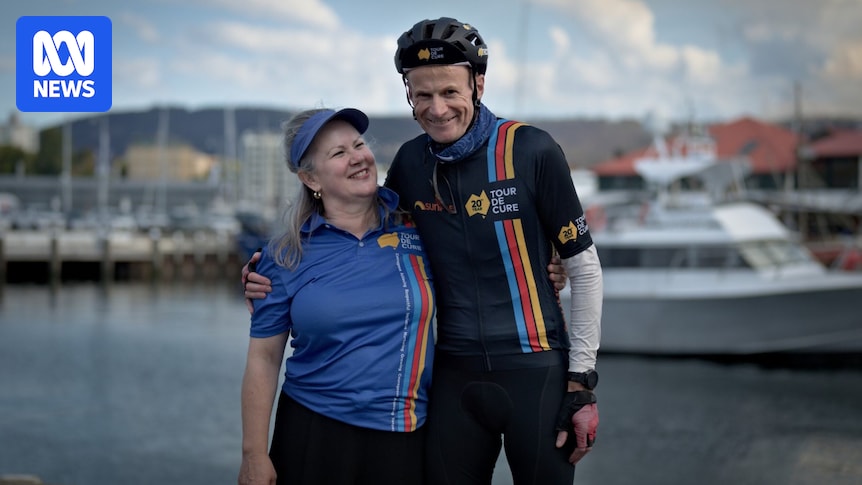
With wife Katie by his side, Richard Scolyer completed the Tasmanian leg of the 1,400km Tour de Cure bike race just 11 weeks before he died. (Australian Story: Owain Stia-James)
His wife, doctor Katie Nicoll, says he was determined to complete the four-day ride to raise money for cancer research in the Tour de Cure.
“You weren’t going to stop him, regardless of how tired or otherwise he got,” Katie said at the end of the race.
Richard brought the same unwavering attitude to his decision to become “patient zero” in a radical medical approach after being diagnosed in June 2023 with glioblastoma IDH-wildtype, the “worst of the worst” brain cancer.
Richard Scolyer with his Tour de Cure crew: brother-in-law Charlie Nicoll, brother Mark Scolyer and son Matt Scolyer. (Supplied: Instagram/ @profrscolyer)
Before his diagnosis, Richard, a world-renowned pathologist specialising in skin cancer, was part of a team led by medical oncologist Georgina Long that pioneered the use of combination immunotherapy to treat melanoma before surgically removing the cancer, not after.
The innovation has saved thousands of lives and led to the duo being named Australian of the Year in 2024.
When Georgina suggested using a similar approach to treat Richard’s brain cancer to try to increase his life expectancy — or, they hoped, even cure him — he jumped at the chance.
Helen Wheeler, a medical oncologist from Royal North Shore Hospital who also treated Richard, tells Australian Story that Richard’s willingness to be “patient zero” in pursuit of a breakthrough for brain cancer came with risk, such as brain inflammation and neurological damage. But neither Richard nor Georgina could be dissuaded.
“They were absolutely determined they weren’t going to get talked out of it in any way, shape or form,” Helen says.
“So, let’s go.”
Richard Scolyer and Georgina Long, then co-medical directors of the Melanoma Institute Australia, address the National Press Club in 2023. (AAP: Bianca De Marchi)
Georgina designed a rigorous treatment regime and Richard, an ultra-fit triathlete before his diagnosis, coped well with it for many months, continuing to run and ride.
But Helen admits it was a worrying period.
“I was absolutely terrified for the first six weeks or so of treatment he could end up with all this toxicity I’ve seen in other patients on these medications for other cancers, and we wouldn’t be able to do much at all from a conventional treatment point of view,” she says.
“So, he was remarkable in the fact that he had very little side effects where other patients can have terrible side effects. And he got through it.”
Helen Wheeler was one of Richard Scolyer’s oncologists during his cancer treatment. (Australian Story)
Throughout it all, Richard kept the public informed of his progress via social media, building a strong following of friends and strangers who were impressed by his openness.
When Richard shared in March 2025 that the cancer had returned, his followers greeted the news with sadness and an outpouring of love.
“I’m very touched by the kindness of many people,” Richard told Australian Story in his last major TV interview, with Katie by his side. “Kindness. Support. I’ve enjoyed it. I’ve loved it.”
Richard Scolyer looks at wife Katie during his final major TV interview. (Australian Story)
Richard learnt to ‘accept’ terminal brain cancer
Richard was incredibly grateful to have outlived the odds. The median length of survival for his form of brain cancer is about 12 to 14 months. Richard made it to three years. That extra time, Richard said, had helped him become more accepting of his fate.
“I’m obviously different, I’ve obviously got some problems but the fact I’m still here and can still contribute, I just can’t be happier,” he said.
“I don’t want to die at the age I am now but … I’m more accepting that it’s going to happen to me.”
On June 7, with Katie and his three children, Emily, Matthew and Lucy, by his side, Richard Scolyer died.
But the science that Richard helped generate as patient zero has a long way to run.
A few days before Richard died, Katie posted these images on his Instagram saying things were “steadily getting harder for Rich”. (Supplied: Instagram/ @profrscolyer)
Richard was ‘always pushing, always striving’
Katie grinned as Richard grabbed his phone mid-interview and searched to find out how many parkruns he’d completed.
Australian Story had just congratulated him on reaching his post-diagnosis goal of notching up 250 of the 5km, weekly runs in June last year but Richard knew he’d done quite a few since then.
Richard Scolyer crosses the finish line for his 250th parkrun, with Katie by his side, in June 2025, (Supplied: Instagram/ @profrscolyer)
Katie suggested the current tally was about 275. He thought it was more.
“There you go,” he said, holding up the phone as proof. “Two hundred and eighty I’ve done.”
“Oh,” said Katie, laughing at his competitive streak. “He’s right, of course.”
Richard smiled, saying, “Well, I don’t follow that sort of thing normally, but it’s become much more important than ever before.”
The Scolyer family: Richard, Emily, Lucy, Matt and wife Katie together on Christmas morning 2025 with their cavoodle Cha Cha. (Supplied: Instagram/@profrscolyer)
It was a great joy for Richard to be able to keep running in the social event, particularly on the occasions he was joined by Katie or the kids.
Loading…
The fact he lived long enough to see his children become adults — with all three now studying medicine or science at university — was deeply significant to Richard.
“I never thought that I’d see them all get to 18 when I’m still here,” he said. “That’s fantastic … put special memories in me and hopefully they’ll look back down the track and have good memories, too.”
His eldest child, Emily, says her father’s drive was something to behold. “Always pushing and striving for the next thing, which is such an admirable quality and something I try to take on myself,” she says.
A rainbow appeared just as Richard Scolyer finished his milestone 250th parkrun. (ABC News: Luke Royes)
That drive could be a little problematic for his doctors, who urged him to slow down his exercise regime — with little effect.
“I’d ring him and say, ‘Look, such and such is a bit up on your blood. How about you don’t ride 50km today?'” Helen recalls.
“And he’d say, ‘Oh, I’ve just done it.’ So, he wasn’t the easiest, compliant patient that I’ve come across. But he was absolutely determined to get out and do everything he possibly could with the time that he had.”
He was even more determined to advance the cause of finding a cure for brain cancer. Every time he fronted up for a procedure, all his samples and results were analysed and documented.
An MRI scan in March 2025 confirmed the brain cancer had returned. (Suppled: Instagram/ @profrscyoler)
A clinical trial based on the immunotherapy-based treatment devised by his colleague Professor Long is due to open at Melbourne’s Peter MacCallum Cancer Centre later this year and a similar trial is already underway in the US.
“I think if Richard hadn’t done this and he hadn’t been so publicised, this trial wouldn’t be going ahead,” Helen says.
Richard Scolyer returned to elite sport in August 2024 when he competed in an aquathon and duathlon at the World Multisport Championships in Townsville. (ABC North Queensland: Cameron Simmons)
Helen says it’s not possible to conclude if Richard’s three-year survival was due to the immunotherapy or other factors, such as his genes, his fitness or positive attitude.
“But it’s enthused everybody to get out there and do something and do as much as we can as quickly as possible,” she says.
The federal government has also pledged $5.9 million to establish the Richard Scolyer Chair in Brain Cancer Research at the Sydney-based Chris O’Brien Lighthouse Centre.
‘Be brave, be bold’
Seven weeks ago, when the tumour was causing cognitive issues for Richard, he pre-recorded a speech for University of Sydney medical graduates that was played at a ceremony where he was awarded an honorary doctorate.
He told of his love of pathology, of solving problems, and emphasised that graduation was not an end point but “the beginning of a lifetime of learning and curiosity”.
Loading…
He gave a sense of what it is like to go from healer to patient. “Becoming a patient changes everything,” he said. “Uncertainty increases. Every decision feels urgent.”
He told of his decision to receive experimental treatment based on his team’s melanoma research and how the questions about what contributed to his three-year survival were now being explored in clinical trials.
“That gives me hope for myself and for patients around the world,” he said.
And then, as was Richard’s style, he urged the graduates to go on to achieve great things in their field, just as he did in his brilliant career.
“I share this because what you do matters,” he said. “The questions you ask and the courage you show can change lives. Be brave, be bold and challenge the status quo. With you all, the future is in good hands.”
Richard Scolyer was remembered as a loving family man and an extraordinary pathologist. (Australian Story)
Watch the Australian Story ‘A Beautiful Mind’ tonight at 8 (AEST) on ABCTV and ABC iview.
Loading…