








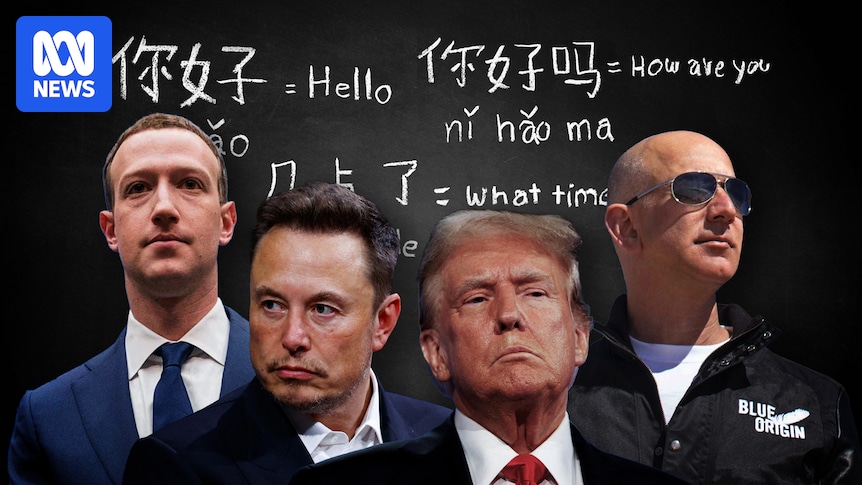
Elon Musk tweets a lot but one recent post stuck out.
“我的儿子正在学习普通话,” he wrote.
“My son is currently learning Mandarin.”
The Musks are not the only wealthy family with an interest in learning China’s official language.
Some of Donald Trump’s grandchildren are also learning it, as are the children of Amazon boss Jeff Bezos and Meta CEO Mark Zuckerberg.
Prince George, the eldest son of Prince William and Catherine, Princess of Wales, reportedly learnt some Mandarin in primary school.
The appearance of Elon Musk and his son X Æ A-Xii (left) caused a stir during Donald Trump’s recent state visit to China. (Reuters: Go Nakamura/Pool)
Kerry Brown, professor of Chinese studies and director of the Lau China Institute at King’s College London, said given China’s economy was the second-largest in the world, the rich and powerful had clear motivations to learn.
“It’s just a practical self-interest and a recognition that China is going to be a massively important technology and economic partner into the future,” he told the ABC.
“If you’re interested in business, even if you’re sceptical and not particularly friendly to China … it makes sense to learn Chinese.
“Some of these figures, I think they really do believe that engagement with China economically is the future.”
He said learning Mandarin provided diplomatic opportunities that could help grow relations with Beijing, such as the time Mr Trump’s granddaughter, Arabella Kushner, sung in Mandarin in 2017 during the Chinese president’s state visit to the US.
“When Trump has his granddaughter singing a Chinese song in front of Xi Jinping, it’s good diplomacy,” he said.
Russian President Vladimir Putin said during his recent trip to Beijing that more than 100,000 Russians were learning Chinese, and that 20,000 Russians were studying the language in China.
Russian press secretary Dmitry Peskov was reported in state media as saying his daughter spoke Chinese before Russian thanks to their live-in nanny.
Former Australian prime minister Kevin Rudd is fluent in Mandarin and hosted several Chinese government officials in-language during his time in office.
But Dr Brown said very few people were studying Chinese languages at university in Western countries such as Australia and the United Kingdom.
Arabella Kushner became a sensation on Chinese social media platform Weibo after singing in Mandarin. (Supplied: Xinhua news)
He hoped the children of these influential families might go on to become ambassadors for learning Chinese, but it was difficult to know the depth of their knowledge.
“China is more complicated, more difficult to understand than France or Germany for a European, or for someone from a European cultural background. So we do have to make that investment if we want to deal with this country at parity,” he said.
“When I’m listening to people in Chinese, when I’m speaking Chinese … it really shapes your character and your behaviour. I think that [speaking Mandarin] makes you much more sophisticated and nuanced in your approach to this very different place.”
Kensington Palace declined to comment on whether Prince George would be learning Chinese at Eton College.
A Meta spokesperson declined the ABC’s request for Mr Zuckerberg to comment. Amazon boss Jeff Bezos, Elon Musk and Mr Trump’s son-in-law Jared Kushner did not respond.
Australia’s Mandarin knowledge
About 990 million people speak Mandarin natively worldwide, according to language database Ethnologue, with the number rising to 1.18 billion when including those who speak it as a second language.
The last Australian census in 2021 found that 685,274 people spoke Mandarin at home.
Kirsty Duff grew up speaking Chinese at home and has gone on to study it at Adelaide University alongside politics, international relations and media.
Kirsty Duff says learning Chinese has boosted her professional connections. (Supplied)
She said she wanted to maintain and celebrate her cultural heritage while also bolstering her future career opportunities in Australia-China relations.
“On LinkedIn, some people have reached out to me specifically because I can speak Mandarin,” Ms Duff said.
“It’s important in the future that we have students who can speak Mandarin at a business level if we want to really take that into Australian diplomacy and international relations.
“In China, all of their high-position people, their children are all studying English. Everybody studies English, it’s a critical subject, but we don’t have everybody having to study a language here.”
The House of Representatives’ education committee last year launched a review into Australia’s education system, amid concerns about a sustained decline in Australians learning Asian languages.
A submission to the inquiry by the Australian Academy of the Humanities said its research found that “only seven Australian universities of the 14 with China studies offerings, have an honours program in Chinese studies with language.”
“An average of three, and no more than five Australians graduated with Honours (Chinese studies with language) in any one year, 2017-2021,” it said.
It added that the federal education department did not collect data on how many students were studying specific languages in East Asia, describing it as a “major challenge in tracking capability strengths and gaps” in tertiary education.
Last year, committee chair, Labor MP Tim Watts, said there had been “a 75 per cent decline in enrolments in South-East Asian languages at Australian universities” between 2004 and 2022.
Ning Zhang, senior lecturer in Chinese studies at the School of Humanities at Adelaide University, said it was “a pity” that so few people were choosing to learn languages at university and particularly Mandarin.
She said while people may be increasingly relying on artificial intelligence to translate languages, it was not the best way to understand Chinese.
“Chinese culture fundamentally is based on relationships and connections. AI is a cold machine … it’s not the human mind,”
Dr Zhang said.
“Sometimes it’s not a verbal expression, it’s a verbal message transfer. That’s why the learning of language is so important face-to-face, human-to-human, and also immersed in China, or in other Chinese-speaking communities like Hong Kong, Taiwan and Singapore.”
Elijah Barrott-Walsh says learning Mandarin is more than just a functional skill. (Supplied)
Learning the language needed to go hand-in-hand with the culture, she said, adding that it was the only way people could truly build strong cross-cultural connections in business, politics, trade or everyday life in Chinese society.
Elijah Barrott-Walsh, who is studying biomedical engineering and Chinese studies at Adelaide University, agreed.
“The language is so inseparable from culture and history and tradition. It’s such an idiomatic language. There’s so much meaning that is lost when you go from Chinese to English,” Mr Barrott-Walsh said.
He said learning the language had helped him develop professional and personal connections in China that he hoped to build on in the future.
The Australian government announced $2.5 million in funding last month to boost Asian language learning across nine organisations in Victoria, the ACT and New South Wales.
The funding supports year 7 to 12 students to learn Asian languages as part of the $25 million Community Language Schools program.
Languages supported by the program include Mandarin, Hindi, Indonesian, Japanese, Korean, Nepali, Punjabi Tamil, Thai, Vietnamese, Urdu, Bengali, Burmese, Filipino, Gujarati, Sinhalese, Telugu and Yue (Cantonese).