





There is no phone reception at Junction View, just cattle moving through paddocks and wind sweeping across sandstone cliffs that have stood for millions of years.
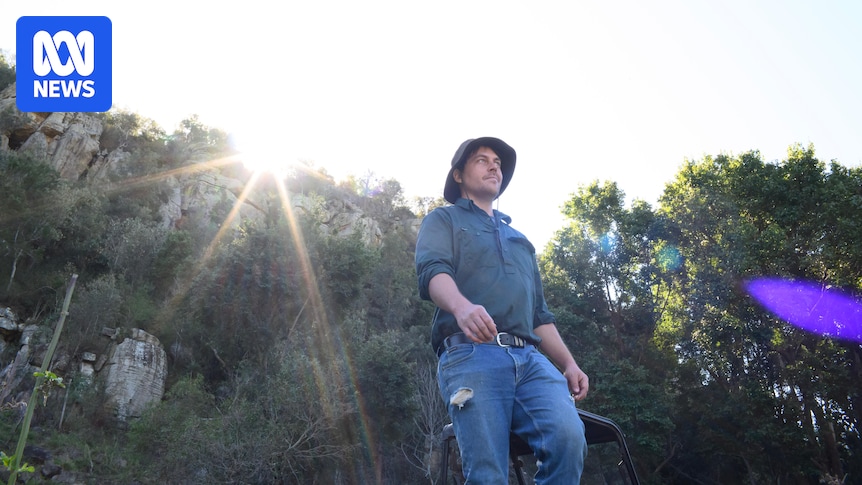
It is a landscape 29-year-old Daniel Storey has known all his life; one the fourth-generation farmer always thought he would continue to work when his parents retired.
“You often find yourself just pulling up and looking at the lovely sandstone cliffs,”
he said.
The family’s property is littered with sandstone cliffs. (ABC Rural: Brandon Long)
Now a company wants a piece of it.
That same view has caught the eye of Rosehill Sandstone, which has applied for a mining lease over 62.2 hectares to build a quarry and extract building-grade sandstone.
It includes a 21.6-hectare section of the Storey’s 100-hectare property in Queensland’s Lockyer Valley, south-west of Brisbane, first farmed by his mother’s family in the 1920s.
“They’re going to be using the back block and separating us from the back end of it [the farm],” he said.
The family runs cattle on a mixture of flat and hilly country. (ABC Rural: Brandon Long)
The company estimates the deposit contains about 1 million cubic metres of stone — enough to support an initial 15-year lease and potentially up to 50 years of mining.
But Rosehill manager John Doherty said only about one to five hectares would be actively disturbed at any given time before being progressively rehabilitated.
“You can’t just go open slather and clear the whole site and hoe into it,” he said.
Mr Storey rotates about 50 cattle across the hill paddocks, but under Queensland law, landholders cannot simply refuse mining companies access.
The state owns the minerals beneath private land, leaving affected landowners to negotiate compensation or challenge a lease in the Land Court.
He fears the disruption to his operation will be far greater.
“It would probably lower the carrying capacity of the country because we basically are using all the farm at any given time, whether it’s grazing or growing feed,” Mr Storey said.
The Storeys run cattle and grow crops for feed. (ABC Rural: Brandon Long)
The company said the quarry would create 12 to 15 jobs and inject about $3 million into the local economy through local contractors, transport operators and suppliers.
It still requires a separate environmental authority before work can begin.
Rosehill’s application for that authority described the expected impacts on groundwater and waterways as “negligible”, and air quality and noise as “minor”.
It said the mine would operate between 7am and 6pm Monday to Saturday, using up to four excavators with rock-saws and another with a hammer attachment to remove material from the exposed rock face.
“No chemicals, no blasting, no drilling,”
Mr Doherty said.
He said water for the quarry would be sourced from on-site dams or purchased externally rather than pumped from a groundwater bore, and rejected suggestions it could contaminate groundwater as “impossible”.
Some critics, he said, were seeking attention rather than raising substantiated concerns — though he remained open to meeting concerned residents.
“If somebody wanted to call me and discuss any of the issues that I might be able to help them with rather than be panicked by misconceptions that don’t exist,” he said.
“I’m happy to talk to anyone or meet with anyone.”
He pointed to Queensland’s modern rehabilitation requirements, which require companies to progressively restore disturbed land and provide financial security to cover rehabilitation costs.
Those safeguards are under scrutiny, with the Queensland government this week announcing a review of the state’s Financial Provisioning Scheme.
Environmental group Lock the Gate has warned any weakening of the scheme could leave taxpayers exposed to future rehabilitation costs if mining companies fail.
Rosehill also operates a quarry at Yangan near Warwick, and there is an existing diatomite mine operated by a different company at nearby Mount Sylvia.
Mr Storey said he was not against mining, but the sandstone cliffs were part of what he felt made Junction View special.
“Sandstone is important, but the places they currently mine are pretty well established,” he said.
“They’re not really in as scenic a place as this.”
Daniel Storey says sandstone mining is incompatible with the food producing area. (ABC Rural: Brandon Long)
His family plans to lodge an objection to the mining lease application.
Others in the 60-person community share the concerns.
Community spokesperson Lindsay Pickering described the area as part of “Queensland’s salad bowl” and said the project would permanently change the district.
“It doesn’t come back,” he said.
A public meeting is scheduled for today at the Junction View Community Hall, where State Member for Lockyer Jim McDonald is expected to attend.
Mr Storey said the future of the farm was measured less in hectares or lease boundaries than in ordinary mornings spent where generations of his family had worked before him.
“I just love waking up every morning and just doing what we do,” he said.
“I’d hate to have that changed.”