









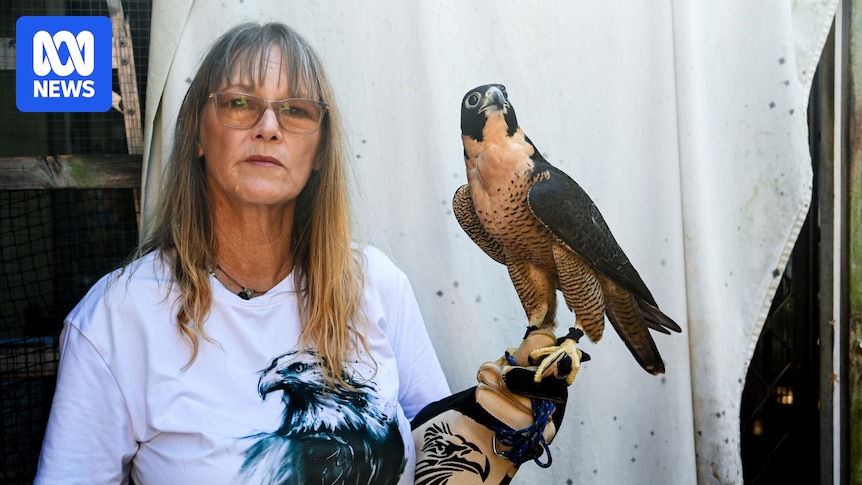
Deb Carter’s hands are covered in poo and rodent guts every morning before the sun is up.
The North Queensland wildlife carer knows looking after birds of prey is not always glamorous, despite the regal nature of her clientele.
Falcons, eagles and other birds of prey have a carnivorous diet that includes mice and rats. (ABC News: Emily Anderson)
“They’re smelly, there’s lots of poop, they’re meat-eating carnivorous birds,” Ms Carter said.
“The things that you do to feed them aren’t particularly pleasant.
“You might have to kill some rats and mice, you might have to cut them up.“
The peregrine falcon, which is powerful enough to reach speeds of up to 300 kilometres per hour and tear prey apart in moments, is also likely to be among the species most vulnerable to avian influenza.
There are only 28 people in Queensland with a permit to rehabilitate and release birds of prey. (ABC News: James Tugwell)
People like Ms Carter will be on the frontline of a potential outbreak as the H5 strain is detected across Australia.
Lifestyle of birds
The long-time Townsville resident always answers a call to help an injured bird, even if it means leaving family events.
Since she was a young child, Deb Carter has always had a fascination for birds. (Supplied: Deb Carter)
She has worked with birds of prey for two decades and has always had a deep love of the flying creatures.
“I’m not going to leave an eagle sitting on the side of the road,” she said.
“All day every day … it’s a lifestyle that I live.”
‘I apologise every time’
At any given time, the aviaries Ms Carter built in her backyard will house injured owls, wedge-tailed eagles, kestrels and peregrine falcons.
Deb Carter breeds thousands of mice and rats to feed the birds under her care. (ABC News: Emily Anderson)
She needs to breed mice and rats for them to eat.
She still dreads killing rodents, even if it is a necessity.
“I actually without fail apologise every time,” she said.
“I’m taking their little lives but it’s for a bigger cause.”
Rescuing far and wide
Ms Carter responds to emergencies from across north Queensland as one of just 28 permitted bird rehabilitators in the state.
Deb Carter uses her social media to share requests for help and updates on animals in care. (Supplied: Deb Carter)
She said using social media had become a matter of life and death for injured birds.
She said she frequently shared requests for people to help with birds in remote locations and relied on a growing community of helpers.
“Nine times out of 10, within minutes, someone will say ‘Yeah,'” she said.
Ms Carter is the only person NQ Wildlife Care can call when it needs someone to rehabilitate or release injured or sick birds of prey, due to restrictions on handling raptors.
Deb Carter has cared for thousands of birds of prey over her career. (ABC News: Emily Anderson)
“We wouldn’t have anyone else to reach out to with that level of expertise,” volunteer Colleen Avery said.
“If we didn’t have Deb, it would be the birds, the raptors, that suffer.“
Flu creeps closer
A threat Ms Carter has never encountered is creeping closer to Queensland.
The public has been advised not to touch sick birds but to report them to authorities since the arrival of H5 bird flu to Australia.
Wedge-tailed eagles and other birds of prey are vulnerable to contracting the H5 strain of bird flu. (ABC News: Emily Anderson)
Ms Carter said she treated all sick or injured birds as if they already had the virus.
“We just need to be sensible, use your normal biosecurity plans,” she said.
She is removing netting roofs and replacing them with non-porous materials so wild birds do not risk introducing the virus to water bowls.
Overhanging trees have also been cut to prevent other birdlife from entering or contaminating enclosures.
Highly vulnerable species
Experts believe the flu strain will gradually spread across the country.
There have been 13 confirmed or presumed cases detected in New South Wales, South Australia and Western Australia.
Professor Kirsty Short from the University of Queensland said birds of prey were an “indicator species” because they were so clearly affected by disease.
“These animals will prey on sick and dying birds and they can get infected that way,” she said.
Kirsty Short says raptors are highly vulnerable to contracting bird flu. (Supplied)
She said governments and authorities would need to provide support and instructions for wildlife carers who came into contact with diseased animals.
“They’re at the frontline and it’s quite difficult because the government messaging is, ‘Do not approach sick and dying birds,'” Professor Short said.
“But if you’re a wildlife carer, that’s your job, so how do you juggle the advice?”
The Queensland Department of Primary Industries said it would employ “a range of strategies” in an outbreak, including enhanced management for wild bird carcasses.
The Australian agriculture department is advising wildlife carers to have a biosecurity plan in place and to keep sick or injured animals away from pets and other animals.