







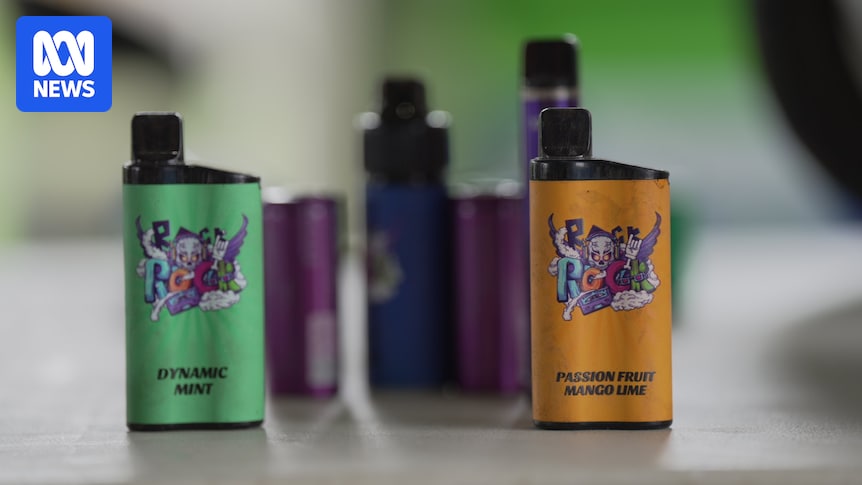
They are illegal and highly addictive, but according to a group of Northern Territory high school students, vapes are easy to find and just as easy to use, including at school.
Charlotte*, like many of her friends, was introduced to vaping at age 13.
“Vapes were kind of introduced to me in year 7,” she said.
“I think that’s the age where everyone kind of gets introduced to them.”
Now in year 10, she said vaping is commonplace and hard to avoid.
Teens in the NT say it is easy to access vapes. (AAP Image: Dean Lewins)
“In high school it became quite normalised,” she said.
Olivia*, also in year 10, said school bathrooms are a hotspot.
“Whenever I go into the bathroom and someone offers me one, I might have a little puff,” she said.
Many teens report that they only vape occasionally. (ABC News: Courtney Withers)
While most of her friends only vape occasionally, Olivia said there are some who are already highly addicted.
“I have friends who get nauseous or get headaches if they go too long without having a hit of a vape,”
she said.
“Some of my friends, the first thing they do when they wake up, even at sleepovers, is they have to take a hit of a vape because they can’t go without.”
Social media dealers and convenience stores supplying illegal vapes
Students told the ABC illegal vapes are easy to find including through social media apps, older siblings or dealers who often purchase cheap vapes overseas.
Students have told the ABC vaping culture is prominent across social media apps. (ABC News: Dane Hirst)
“It’s very easy to find them on Snapchat,” Olivia said.
“Sellers will put them on their stories like ‘swipe up if you want to buy one’ and it’s very easy.
“They’ll drive to you or you get them at school and you give them the money and they just give it to you.”
Lucy*, another student interviewed by the ABC, said convenience stores which sell illegal nicotine products regularly sell to children and teenagers.
“The only thing that you need to show is some sort of ID, it could be the worst made ID in the world, they just need to see it and then they just give it to you,” she said.
Teens say it’s easy to buy vapes at convenience stores in the Northern Territory. (ABC News: Pete Garnish)
Measures to curb vaping ‘not effective’
Of the 30,000 students across the NT, 83 were suspended in 2025 for vaping.
Acting deputy chief executive at the NT’s Department of Education, Miranda Watt, said schools have taken steps to curb vaping including altering bathroom designs and installing sensors which alert teachers to smoke or vapour.
“We would all say prevention is the best space and that’s something we’re focused on,” Ms Watt said.
Miranda Watt says school are focusing on prevention. (ABC News: Tristan Hooft)
Lauren Gardner, from the Matilda Centre for Research in Mental Health and Substance Use at the University of Sydney, worked on developing the Our Futures program, designed alongside school students to help educate them about the risks of vaping.
She said a clinical trial of the program over the last few years involving 5,000 students across 40 schools in NSW, WA and Queensland had delivered promising results.
“We found that students who did the Our Futures vaping program were 65 per cent less likely to vape in the year after the program compared to our control group who received their standard health education,” Dr Gardner said.
Lauren Gardner researches vaping among students. (Supplied: Lauren Gardner)
Dr Gardner said despite the proven efficacy of the program, many Australian schools continue to implement measures which aren’t backed by research.
“One-off guest lectures, using scare tactics … smoke detectors in bathrooms and these punitive measures like suspensions and expulsions, they’re not effective,”
she said.
“In fact, they actually can cause children to further disengage from their learning and exacerbate their vaping.”
Despite being backed by the federal government to make it free for schools to implement, only 12 of 103 schools in the NT are enrolled in the program.
Concerns around opioid poisoning in vapes
Most of the students interviewed by the ABC expressed concern about the long-term health impacts of vaping for themselves and their friends.
Charlotte said the possible risks to her fertility weighed heavily on her mind.
“I want to be able to have children and live a life without constantly feeling like my chest is really tight or I can’t run or do the sport or activities I like because I’m vaping or I’ve been addicted,” she said.
While data from the Generation Vape study has found that the rate of vaping has decreased among young people aged 14-17, falling from 18 per cent in early 2023 to 15 per cent in 2025, health professionals say the figures are still concerning.
NT Health chief pharmacist Samuel Keitaanpaa said retailers who sell illegal vapes to children are engaging in “predatory” behaviour.
Sam Keitaanpaa says vapes are designed to get people addicted. (ABC News: Pete Garnish)
“Vapes are specifically designed to get people addicted to them,” he said.
Mr Keitaanpaa said aside from nicotine, there are growing concerns about opioids and other harmful substances being added into vapes.
“One of our greatest fears is that without honest discussions, kids will try these things and end up in hospital or worse,” he said.
Sam Keitaanpaa says there are fears of harmful substances being added into vapes. (ABC News: Pete Garnish)
Mr Keitaanpaa acknowledged there had been an increase in the number of retailers selling illegal nicotine products.
“The NT is reviewing its legislation to give stronger penalties and greater powers to take action on this,” he said.
“If you are selling vapes and harmful products to children, you are going to be shut down, you are going to be investigated … we take this seriously and we’re ready to take serious action.”
*Not their real names.