





WARNING: This story contains references to suicide and addiction.
There was no knock at the door. No uniformed officer. No carefully crafted words of condolence.
Instead, the news of Neil Tracey’s death arrived on a scrap of paper.
On the morning of May 9, 1989, a man walked into a butcher shop in Lyneham in Canberra’s north and handed John Tracey a note, bearing the phone number of a Brisbane police constable.
“Your brother’s dead, ring this bloke,” the stranger said.
John dialled.
A photo of the Brisbane boarding house taken by a relative shortly after Neil’s death. (Supplied)
The officer on the other end told him his younger brother Neil, 26, had been found dead hours earlier at a boarding house in the riverside Brisbane suburb of New Farm.
Police believed he had overdosed on drugs. The death was quickly ruled non-suspicious.
For investigators, it was an open-and-shut case. For the Tracey family, it marked the start of a relentless quest for answers that has spanned decades.
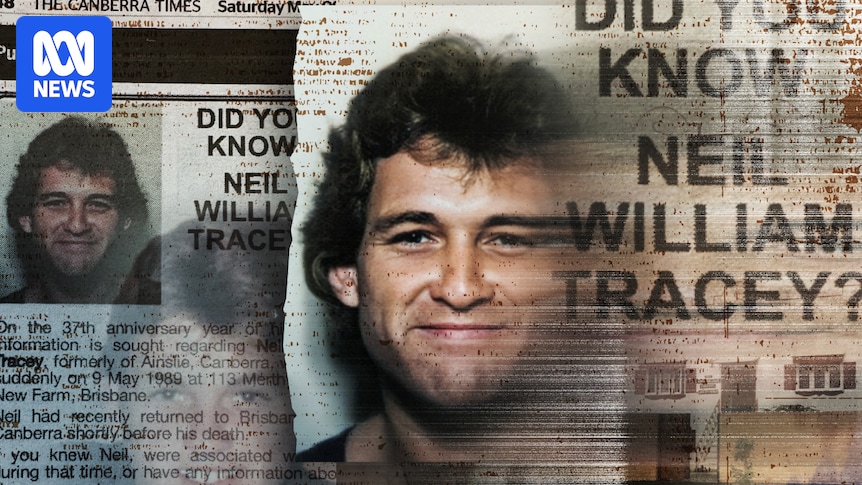
Nearly four decades on, Neil’s niece placed a notice in The Canberra Times appealing for information about his death. (Supplied)
Reports of a bounty on Neil’s head and potential ties to Canberra’s criminal underworld cast a shadow over the formal finding.
As the Traceys dug deeper, they uncovered an unusual obstacle — a police document regarding Neil’s death is sealed in the Queensland State Archives until 2054.
Neil’s parents died with lingering questions about what happened to their son.
Now, members of the Tracey family have mounted a last-ditch effort to have Neil’s death reviewed by the Queensland coroner – hoping to finally get answers after nearly four decades.
‘Mum’s little favourite’
Neil Tracey was born and raised in Ainslie, one of Canberra’s oldest suburbs – known for its leafy streets, heritage homes and parks and open spaces.
“Everyone knew everyone,” his brother John mused.
“It wasn’t a rough place by any means; it was just working-class people.”
Neil was the youngest of three siblings and his brother says he was “mum’s little favourite.” (Supplied)
John said Neil was a talented athlete with a knack for footy.
“He always was a good footballer … used to win best and fairest all the time,” John said.
“Growing up, he was a good sportsman and just a fun young fella that was a bit of a mischief maker, but other than that … he was a good kid, liked by everyone,
“He had heaps of friends … [he was] very likeable.“
Neil is remembered by family as a “fun young fella” who was “liked by everyone”. (Supplied)
Neil was the youngest of three siblings.
“The baby — mum’s little favourite,” John said.
Neil’s niece, who asked to remain anonymous, said her uncle’s death “absolutely devastated” his mother.
“She never recovered,” she said.
The theft
In late 1988, Neil Tracey was experiencing financial problems and admitted to family members that he and a friend had stolen a safe from a house in Canberra.
The Traceys believe the resident of the house was a man with links to organised crime.
In the wake of the theft, John said he was warned by acquaintances on two separate occasions that his brother’s life was in danger.
“One bloke approached me and said to me: ‘You know they’ve got a contract out … on your brother for a thousand dollars?'” John said.
“Another fella told me that the outlaw motorbike gangs were looking for him.”
The then-25-year-old moved from Canberra to Brisbane in late 1988 because he “feared for his safety”. (Supplied)
Fearing for his safety, Neil’s family said the then-25-year-old fled to Brisbane.
“He just knew he couldn’t come back,”
John said.
Less than a year later, Neil was dead.
John said the man Neil allegedly stole money from was the same person who later handed him the note in the butcher shop.
“This bloke had prior knowledge of his death before even the family knew,” John said.
Neil’s final hours
After John’s call with Fortitude Valley police, Neil’s uncle, who lived in Brisbane, went to the New Farm boarding house to try to piece together Neil’s final hours.
Two women who lived there told him a man had knocked on the door the night before Neil died and gave him a “brown drink”, according to Neil’s niece.
Around this time, the residents saw Neil appearing very intoxicated.
According to a sudden death police document seen by the ABC, Neil was heard making gurgling noises early the next morning. He was later found unconscious, his lips blue.
He was rushed to the Royal Brisbane Hospital, where he was pronounced dead.
The house where Neil died still stands today. (ABC News: Erin Byrnes)
“He had high levels of methadone and oxazepam in his system … really high levels,” Neil’s niece said.
Methadone is a potent opioid commonly prescribed to treat heroin addiction and withdrawal. Oxazepam is a benzodiazepine, similar to diazepam, — a class of drugs regularly prescribed to treat anxiety disorders and panic attacks.
Neil’s niece said the family had no knowledge of him using heroin or being prescribed powerful prescription drugs. She believes not enough questions were asked.
“Were any questions asked [by police] about whether he was a heroin user, whether he was prescribed these drugs? Did he have a script for them? Did someone else give them to him? Did he have an accidental overdose or did he [commit] suicide?,” she said.
A fresh appeal
Some of Neil’s relatives have been reluctant to speak publicly about his death, fearing retribution – but other family members are now speaking out to call for an independent review into the case.
They have also hired a forensic expert to re-examine the circumstances.
Neil’s two sons grew up without their father. (Supplied)
“I just feel like he [Neil] didn’t have that opportunity to have his death investigated properly,“ Neil’s niece said.
“It’s been this ongoing unresolved trauma for [the family] and … that has been passed down to the nieces and nephews and Neil’s children.
“If we have the findings come out that he did self-administer these drugs and die from an overdose, then that’s fine … we just want to make sure all avenues are looked at.
“That’s the ultimate outcome here, just to do as much as we can and then … everyone can be at peace with it to a degree.”
John Tracey has urged anyone with information to come forward, even anonymously.
“It’s been a long time … we just want to find out the truth, that’s all,” he said.
The Tracey family have mounted a last-ditch bid to have Neil’s death reviewed by the Queensland coroner. (Supplied)
The Queensland Police Service referred all questions to the Queensland Department of Justice.
The Coroners Court, which falls under the Department of Justice, did not respond to specific questions. A spokesperson confirmed in a statement that Neil Tracey’s death was subject to a coronial investigation in 1989.