






As governments struggle to fund regional roads and rail, an outback city’s bid to become an airship hub could offer an alternative, but experts say public backing will be critical.
French-Canadian company Flying Whales is developing cargo airships designed to provide a low-cost freight solution for remote and underdeveloped areas.
The company is awaiting certification from the European Union Aviation Safety Authority, which once approved, would allow the company to begin applications with Australia’s regulator.
Flying Whales president Sébastien Bougon said the company wanted to make Mount Isa the first of six planned Australian bases by 2029.
Sébastien Bougon wants the Queensland and federal governments to become a minority shareholder. (ABC North West Queensland: Zara Margolis)
“We’re going to transport wind turbines, blades, high voltage towers, containers in remote areas or wherever the infrastructure is congested or difficult,” Mr Bougon said.
“Mount Isa could be our very first base in Australia and the Asia-Pacific … there are a lot of projects like CopperString [transmission line], and it’s kind of halfway from Brisbane to Darwin.
“We have developed the engineering. What we would like to see from the state and federal governments is [for them] to become a [minority] shareholder alongside the French government and Canadian government.”
Representatives for the company would not reveal what specific support they are seeking from Australian backers, but in its North American operations, the company successfully sold 25 per cent of the business to the Quebec government’s investment arm.
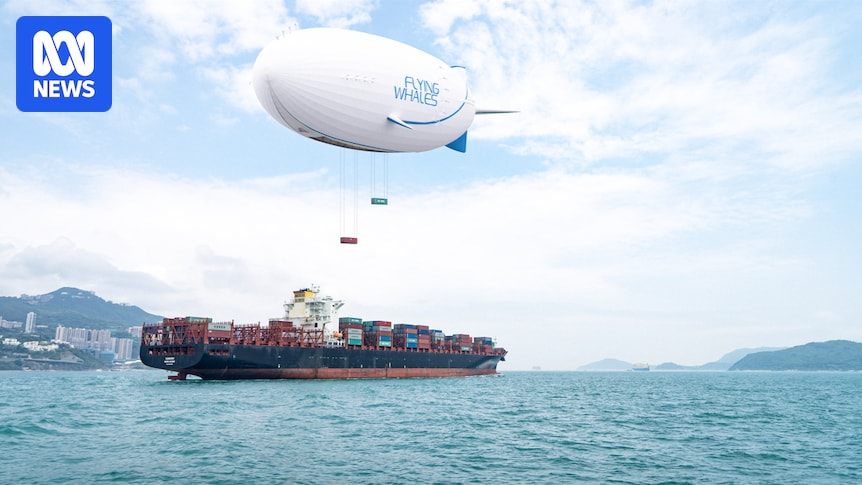
A conceptual rendering of Flying Whales’s 200-metre-long airship prototype LCA60T. (Supplied: Flying Whales)
The proposed helium airships, named LCA60T, would be carbon neutral, capable of carrying up to 60 tonnes of cargo without landing, and about 200 metres long.
While the concept may sound futuristic, former University of Sydney researcher Craig Neal said airships were a practical solution to many freight issues.
“Across regional Australia, in the freight space, options are limited and expensive,” he said.
“This provides an alternative where you don’t have to maintain infrastructure from point to point. You only need it at A and B, and even then, it’s quite limited.”
Mr Neal’s research estimated that the introduction of airships could capture about 27 per cent of the transport market.
“This could revolutionise Infrastructure projects, which use slow transportation and escorts because it can just pick up large modules and deliver to site,” he said.
“Another area would be perishable goods, stuff that’s really time sensitive or high value. This can get it to a location a lot quicker and faster.”
Deflated talks
In a bid to drive investment in Mount Isa following the closure of Glencore’s underground copper mine, the local council signed a memorandum of understanding with the aeronautical company in 2024.
Land owned by mining company Glencore is expected to be released to enable the construction of a base.
Since 2024, Flying Whales representatives have also met with Queensland and federal government officials, including Queensland’s deputy premier in Paris last September, seeking investment support.
Mr Bougon said talks had since stalled.
Sébastien Bougon and Mount Isa Mayor Peta MacRae sign a memorandum of understanding. (ABC North West Queensland: Zara Margolis)
Deputy Premier Jarrod Bleijie said the Department of State Development, Infrastructure and Planning would continue to engage with Flying Whales, but applications to the state’s investment arm were independently assessed.
“Through our landmark $180.6 million Sovereign Industry Development Fund, the Crisafulli government is prioritising the defence, biomedical and biofuels industries — proven sectors with a track record of growth, investment and job creation.
“The fund attracted a strong response from industry with applications exceeding $2.2 billion.”
Jarrod Belijie met with Flying Whale representatives during a Paris visit in 2025. (ABC News: Sarah Richards)
A spokesperson for the Northern Australian Infrastructure Facility, which finances projects that support diversification in the region, said Flying Whales did not meet essential criteria to be considered.
“NAIF’s investment team had early-stage discussions with Flying Whales in late 2024–early 2025, which did not progress,” the spokesperson said.
“NAIF has a set of mandatory criteria which projects must satisfy … this includes proponents demonstrating that the loan can be repaid or refinanced.”
Craig Neal says underinvestment in rail means governments are facing huge bills to maintain regional transport infrastructure. (ABC Western Qld: Aaron Kelly)
Mr Neal said, for decades, governments had placed increasing pressure on struggling regional road networks rather than investing in rail and shipping.
As that infrastructure faced mounting repair bills, he said, airships could be the least painful solution.
“I think it’s a much lower cost alternative,” he said.
“It’s going to take a bit of dollars to get it up and running, but we can’t rely solely on private funding.”