







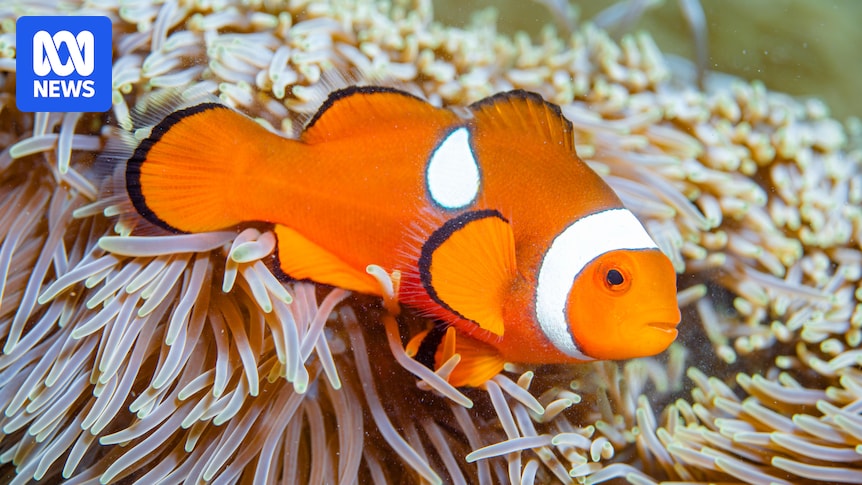
It was a flicker in the water, only 2 centimetres long, but bright and distinct, darting into the protection of a carpet anemone.
The 2003 film Finding Nemo made clownfish and the Great Barrier Reef international icons.
When the species known as a “true nemo” — Amphiprion percula — turned up in a bay on Magnetic Island, just 20 minutes off the coast of Townsville in 2022, locals were excited.
“It was called ‘Island Nemo’ because we finally have a Nemo now,” local diver and marine biologist Lawrence Scheele said.
“Island Nemo” as a baby in the reef off Magnetic Island. (Supplied: Lawrence Scheele)
Mr Scheele said it was the first recorded sighting of a true Nemo on Magnetic Island because the fish were typically found further north or off the coastline.
“It was really special for the island,”
he said.
“Locals have been enjoying it.”
Lawrence Scheele regularly saw Island Nemo while diving off Magnetic Island. (Supplied: Jack Breedon)
For four years, Mr Scheele would regularly dive at Geoffrey Bay, watching through his snorkelling mask as his fish friend grew up.
Then one day, Island Nemo disappeared.
Finding Nemo
Just two weeks earlier, unbeknown to Mr Scheele at the time, two snorkellers had pinpointed the fish’s location when they uploaded a photo to the citizen scientist app iNaturalist.
Island Nemo has not been seen since.
Locals fear their special little fish has been poached.
Locals have not seen Island Nemo at Geoffrey Bay since shortly after two online data entries shared its location. (Supplied: Lawrence Scheele)
“The timing is the most suspicious thing,” Mr Scheele said.
“This Nemo has survived major flooding events, multiple cyclones, multiple heatwaves and bleaching events. When he was taken, there was no disturbance event that would have taken him out.
“Because there were two instances of him being online at the time he disappeared, the community thinks it’s too coincidental.”
‘The go-to fish’
James Cook University’s Morgan Pratchett said the commercial harvest of clownfish was low because the fish could be bred in captivity, adding that Island Nemo was in fact “worth very, very little” in economic terms.
Morgan Prachett says Island Nemo is not worth much economically, but has symbolic value. (ABC News: James Tugwell)
But Dr Pratchett said Island Nemo had symbolic value.
“It’s a big issue for local residents because it detracts from their link to the coral reef environments,”
he said.
He said clownfish were not likely to relocate, so “if it wasn’t poached, it succumbed to natural mortality … but the rates of natural predation are quite low.”
“There’s every possibility a recreational person with a home aquarium may have taken it,” he said.
“The go-to fish is absolutely a true Nemo.”
Scale of the problem
Morgan Pratchett says most people are unaware that the poaching of fish or coral is an issue on the Great Barrier Reef. (Supplied: Citizens of the Great Barrier Reef)
Dr Pratchett said more work needed to be done to understand the extent of the illegal poaching of fish and coral.
“We don’t know the extent to which they may be driving very specific species to functional extinction.“
He said the threat to coral was “far more serious” because it was easier for poachers to access and take more valuable corals.
And while European countries have banned specific corals being exported from Australia, Dr Pratchett said some coral species that turned up overseas could only have come from Queensland.
A useful tool
Marine scientist Adam Smith has made more than 20,000 observations on iNaturalist and leads an annual citizen scientist push encouraging people to log species on the Great Barrier Reef.
Professor Smith said iNaturalist had an in-built failsafe that blurred the geolocation to around the nearest kilometre for species listed as endangered, vulnerable and threatened by the International Union for Conservation of Nature.
Adam Smith is a big proponent of citizen science on the Great Barrier Reef. (ABC News: James Tugwell)
“That’s to stop people taking advantage of those rare sightings and harvesting,” he said.
That list does not include Amphiprion percula, so the geolocation block was not activated automatically on Magnetic Island.
“Every tool has its advantages and disadvantages,” Professor Smith said.
“There’s only a limited number of scientists, so if you can tap into millions, if not billions, of people to collect data on a whole range of different things, it’s extremely powerful.“
Fears for the future
Mr Scheele loves iNaturalist’s citizen-sourced data sets but wants people to know the power of the information they share.
Lawrence Scheele is worried about the future of the reefs and wildlife off the coast of his island home. (ABC News: Baz Ruddick)
When he reached out to the people who posted Island Nemo’s location, they were distraught.
“They said: ‘I had no idea anyone would even do that’, but it was too late. It had been up for weeks,” Mr Scheele said.
“We’re very worried for the future. What other local species here will be targeted?
“If someone posts the coordinates for sensitive or vulnerable species, what else is going to go missing?”