








At 11pm on a humid Jakarta night in March, human rights activist Andrie Yunus was getting ready to head home after finishing a recording for a podcast.
Warning: This story contains details of an assault.
The episode, which had been taped at a legal aid office in central Jakarta, was on the increasing influence of the military across Indonesia’s civilian institutions, an issue the 27-year-old had been very vocal about.
Andrie walked to the car park and got on his motorcycle before joining the steady throng of traffic on Central Jakarta’s streets.
He did not know it, but he was being followed.
Four officers from Indonesia’s military intelligence unit (BAIS) were tailing him on two separate motorcycles, and one of them was concealing a tumbler filled with sulphuric acid.
Andrie continued driving for 15 minutes before they launched their attack.
One of the motorcycles broke ahead, circling back to intercept Andrie.
CCTV captured the moment the men threw the acid over Andrie.
Loading…
He did not immediately react, instead travelling a few seconds before he pulled over to the side of the road and dropped his bike.
In the video, he can be heard screaming in agony and is seen clawing at his clothes.
Concerned bystanders raced over to help, and a crowd formed as Andrie screamed in pain.
He was later diagnosed with second, and third degree burns across one-quarter of his body, including his face, neck and torso.
Several months after the attack, Andrie is still too weak to give interviews. He has been permanently disfigured, lost vision in his right eye and is undergoing repeated treatment and surgery in a Jakarta hospital.
The attack has now become a flashpoint for Indonesia’s civil society, with local human rights organisations calling the incident an assault on democracy and human rights defenders.
Four military intelligence officers have since been charged and are now on trial by a military court.
Prosecutors are seeking a sentence of two and a half years in prison, but Andrie’s legal team has already described the case as a “sham” and a “charade”.
Acid burns on Andrie’s face and body
Since graduating law school in 2022, Andrie worked as the deputy head of human rights NGO, KontraS — the Commission for Missing Persons and Victims of Violence.
The organisation’s coordinator, Dimas Bagus Arya, said Andrie was deeply interested in reform of Indonesia’s military.
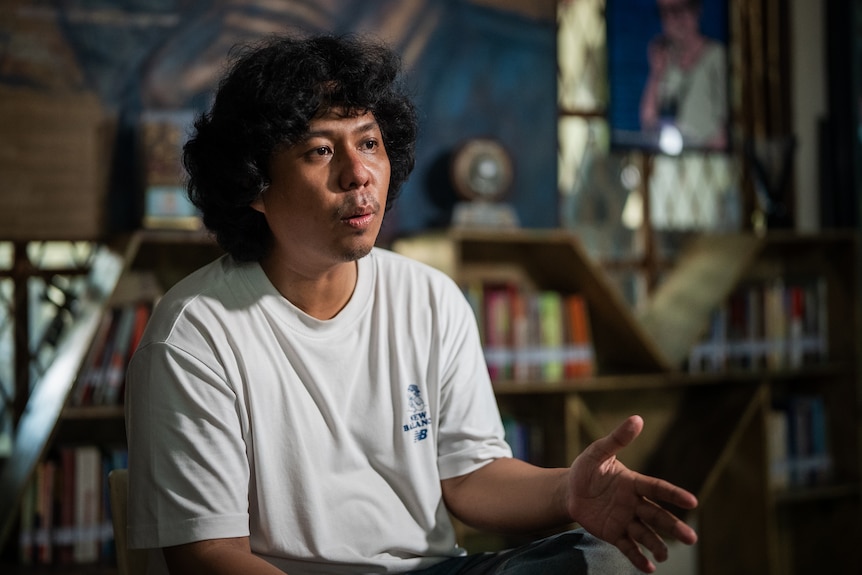
Dimas Bagus Arya was shocked by the attack on Andrie. (ABC News: Tim Swanston)
“He chose to focus on issues of security sector reform, torture, the death penalty, and resolving cases of gross human rights violations from the New Order era,” Dimas said.
“He truly enjoyed and poured his heart into the desire to be an advocate for these issues.
“Andrie became a victim of violence from the very institution that he — and we at KontraS — wanted to improve, wanted to strive for, and wanted to push toward becoming a more professional institution.”
On the night of the attack, Dimas said that Andrie’s roommate called him to tell him what happened. After he ended the phone call, he raced to the hospital.
“I saw that he was covered in acid burns, from the right side of his face and body, down to his waist and right hand,” he said.
“I felt a combination of sadness, anger, hopelessness and fear.
“We never imagined that in the modern world, in modern democratic Indonesia, archaic methods of intimidation or barbaric tactics would still be used by a state institution.”
Military officers accused of performing attack out of ‘spite’
About a week after the attack, Indonesian military authorities announced they had arrested four intelligence officers.
Prosecutors then brought three charges against them, ranging from the most serious offence of premeditated severe assault, through to premeditated assault resulting in severe injury.
After they were indicted, prosecutors alleged the officers were motivated to attack Andrie over a “personal vendetta” they held against him.
This dated back to when the young activist had played a role in crashing a closed-door meeting of politicians in Jakarta in March 2025.
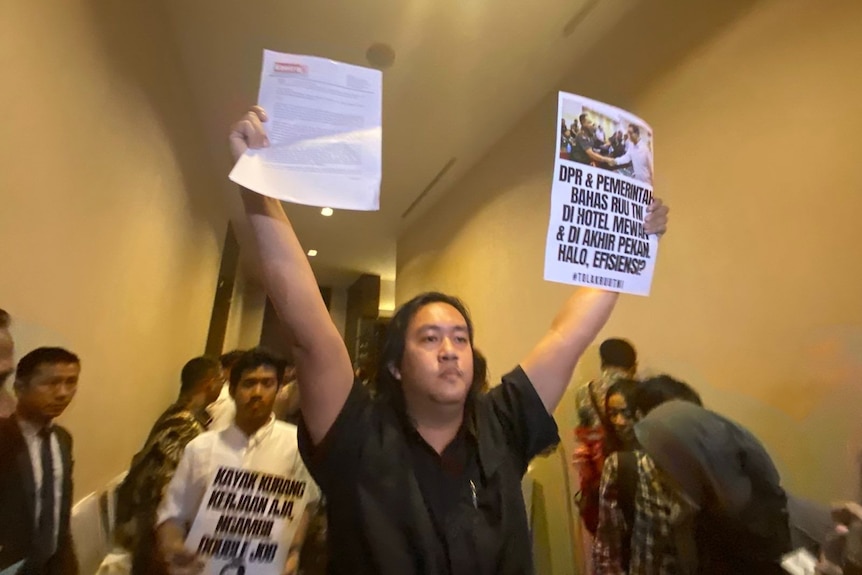
Mr Yunus was among a group of activists who forced their way into a closed-door meeting at Jakarta’s Fairmont Hotel last year. (Supplied)
The parliamentarians were discussing a law that would expand the roles that military officers could hold in government.
That law had sparked major protests across the country at the time. Many civil society organisations had raised fears it was a call back to authoritarian President Suharto’s time in power with his dwifungsi doctrine, which allowed the military to work extensively across civilian affairs.
The court heard the men who carried out the acid attack had confessed after two of them skipped a compulsory military roll call, in a bid to conceal the burns they received when the acid splashed back at them during the incident.
“They told us they did it out of spite,” Lieutenant Colonel Alwi Hakim Nasution told the court, recalling their initial “confession”.
“They saw how Andrie Yunus pushed his way into a private meeting and it just didn’t sit right with them [because] they felt personally insulted.”
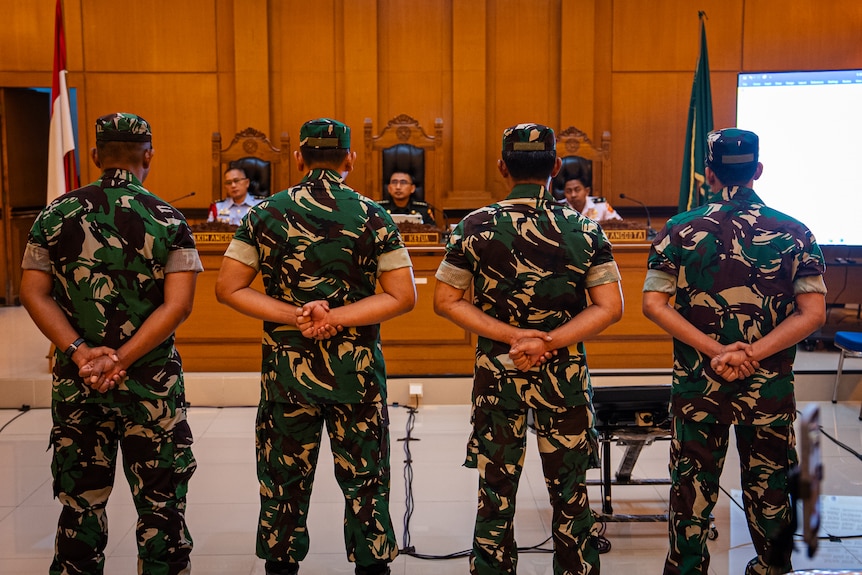
Indonesian military authorities arrested four intelligence officers over the attack. (ABC News: Tim Swanston)
One of the judges at the military court said he found it “strange” the defendants did not know Andrie, but carried out the attack anyway.
The judge asked if the defendants were operating under orders to attack Andrie.
“To our knowledge, from our investigation, no. These defendants just felt insulted and hurt by Andrie Yunus,” Lieutenant Colonel Alwi Hakim Nasution responded.
The explanation has been rejected by Andrie’s legal team and KontraS. They believe Andrie had been under surveillance for months prior to the attack.
Trial of attackers is a ‘sham’, lawyer says
At the conclusion of the trial on Wednesday, military prosecutors said they had felt they only proved the least serious of the three charges against the four officers.
They requested a two-and-a-half-year sentence out of a maximum penalty of seven years.
While the judges do have the discretion to convict the officers of the most serious offence, which attracts a maximum sentence of 12 years, Andrie’s legal team felt that was highly unlikely.
“This trial is a sham, constructed to ensure there is a formality of law enforcement to be resolved … to ensure there is a perpetrator and a penalty,” said Gema Gita Persada, from Legal Aid Centre for the Press, who is acting as one of Andrie’s lawyers on behalf of a group called the “Advocacy Team for Democracy” or TAUD.
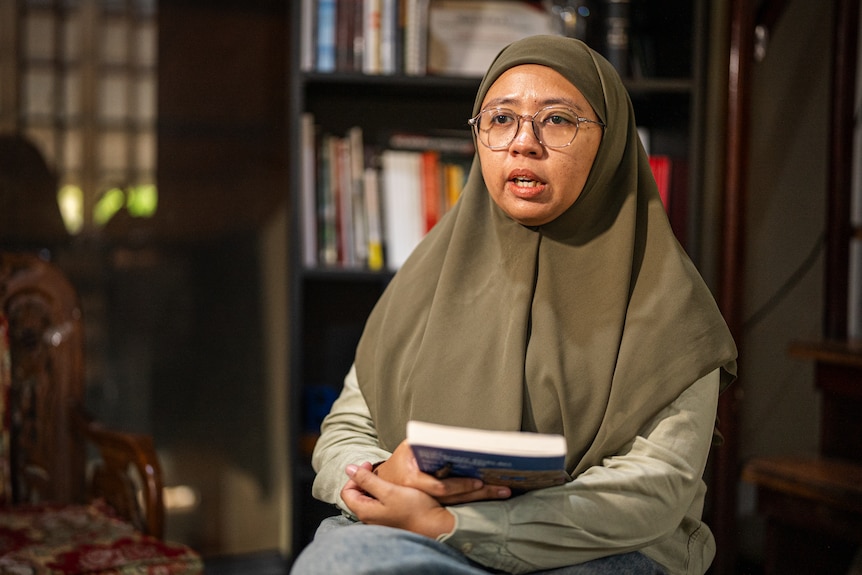
Gema Gita Persada has described the trial as a “sham”. (ABC News: Tim Swanston)
“What we’ve observed is a lack of accountability from the unit, or the institution itself, when members can so easily plan this attempted murder.”
She says Andrie’s case is not the first where the “perpetrator is a military member and the victim is a civilian, tried under the jurisdiction of a military tribunal”.
“This was a point of criticism raised by Andrie, so it is deeply ironic that Andrie himself must currently be faced with such proceedings,” she added.
Through their own investigations, including analysing CCTV, TAUD believe that 16 people, including the four officers on trial, need to be investigated by police.
Andrie’s legal team felt that a police investigation had stalled after the military announced its own trial into the four intelligence officers.
The legal team just won a victory in a civil court, which ordered police to continue an investigation into the attack.
TAUD is also effectively boycotting the military court process, although it has heavily criticised the request for a two-and-a-half year prison sentence.
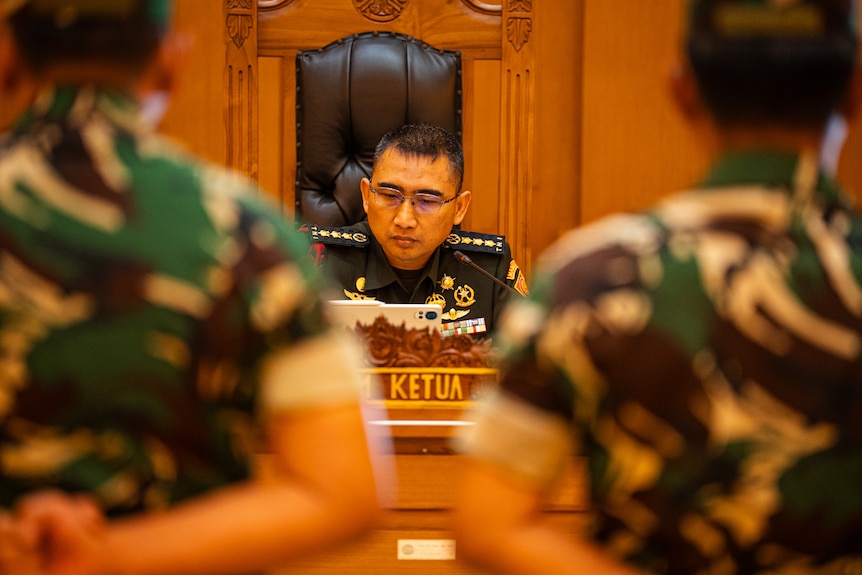
The military officers stood in front of the judges of the military court in Jakarta. (ABC News: Tim Swanston)
It described the proposed sentence for an indictment on premeditated assault resulting in severe injury as a “predictable stench of impunity”.
“Facing a mere 2.5-year sentence for a heinous, life-threatening crime that permanently disfigured the victim falls completely short of justice,” TAUD said in a statement.
The lasting impact of the brazen attack
Reaction to Andrie Yunus’s case has gone global. Last month, the European Parliament expressed “serious concern” over the attack, and a “wider pattern of violence against human rights and environmental defenders in Indonesia”.
The parliament also voiced deep concern over “government plans that risk further restricting freedom of expression, including draft laws on disinformation”.
It comes as Amnesty International Indonesia warns of what it describes as “coordinated disinformation campaigns’ that portray government critics as foreign agents”.
In a report released last month, the NGO alleged that “Indonesian authorities — including the military — deploy online disinformation to target journalists, activists, academics and protesters in retaliation for their legitimate activism and expression”.
In a statement to the ABC, Human Rights Minister Natalius Pigai said the government demanded a transparent and objective trial in Andrie’s case.
“The president has emphasised that this attack is an act of terror against civilians, particularly human rights defenders, and has urged authorities to seriously uncover the masterminds and their motives,” he said.
“The government demands a transparent, objective, and impartial trial to ensure justice for the victim.
“This is proof of the state’s presence in delivering justice for all of Indonesia.”
The ABC has contacted the Department of Defence for comment, who referred the ABC to Indonesia’s Armed Forces (TNI).
TNI did not reply by the time of publication.
Ms Persada said she and her colleagues felt even more threatened for doing their work after the attack.
“The impact on us, civil society, whether that is activists, journalists or members of the public who actively voice concerns against justice, is that we certainly feel threatened in every step we take,”
she said.
“Andrie is also a friend of mine. If this had not occurred, perhaps at this moment we might be planning to hang out together.”