







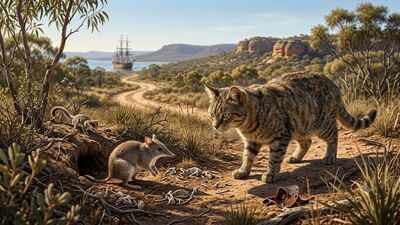
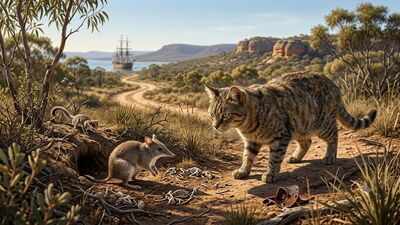
The domestic cat arrived in Australia with the First Fleet in 1788, introduced as a familiar companion and a practical way to control rodents. Within decades, many had escaped or been abandoned, gradually establishing wild populations far beyond early settlements. By the late nineteenth century, they had spread across almost the entire continent, adapting to landscapes ranging from humid forests and mountain ranges to some of the driest deserts on Earth. More than two centuries after their arrival, feral cats have become one of the country’s most persistent environmental challenges. Their success lies not in their numbers alone, but in their ability to survive almost anywhere while hunting an extraordinary range of native wildlife that evolved without such an efficient predator.
How feral cats spread across almost every corner of Australia
As reported by the WA Feral Cat Working Group, Australia now supports an estimated 1.4 to 5.6 million feral cats, although numbers fluctuate with rainfall, food availability and seasonal conditions. Unlike domestic pets, these animals survive entirely by hunting, often travelling large distances through bushland, grasslands and remote inland regions.Their diet changes depending on what is available, which partly explains why they have spread so successfully. Small mammals, reptiles, frogs, birds and large invertebrates all become prey. They are capable of taking tiny skinks weighing only a few grams, yet they have also been recorded killing wallabies close to their own body weight.Even isolated habitats provide little protection. Feral cats now occupy virtually the entire Australian mainland and more than one hundred offshore islands, reaching places where many threatened native animals make their last stand.
How millions of hunting cats are changing Australia’s ecosystems
Predation by cats has become one of the largest ongoing pressures on Australia’s native fauna. Reportedly, estimates suggest feral cats alone kill around 272 million birds, 466 million reptiles, 815 million mammals and roughly 1.1 billion invertebrates every year.When pet cats and stray cats are included, the combined figure exceeds three billion native animals annually. As reported by the Department of Climate Change, Energy, the Environment and Water, a single feral cat living in bushland may kill close to 1.5 billion native mammals, birds, reptiles and frogs, and 1.1 billion invertebrates each yearThese losses accumulate over decades rather than appearing as a single event. Small mammals that once occupied broad areas have gradually disappeared from many regions, while isolated populations continue to shrink under constant predation pressure.
A growing threat to Australia’s native fauna
Australia has experienced one of the world’s highest rates of mammal extinction since European settlement, and feral cats have been identified as an important factor in many of those losses.As reported by pestSMART and Invasive Species Council, they have contributed to the disappearance of 27 of Australia’s 34 extinct native mammals, along with two native bird species and all three reptile extinctions recorded since colonisation. Their influence extends beyond species already lost. Dozens of threatened mammals, birds, reptiles and amphibians remain exposed to cat predation across the country.Several species are regarded as especially vulnerable because their populations are already fragmented or confined to small areas. Conservation assessments indicate that animals such as the central rock rat, Gilbert’s potoroo, the western ground parrot, the nabarlek and the black-footed tree-rat face an increasing risk of extinction without sustained cat management over the coming decades.
Wildlife that never evolved with cats
Many Australian mammals evolved in environments where few predators could stalk silently at night as cats do. Species such as bandicoots, bettongs and other small marsupials often show limited behavioural responses to this style of hunting, leaving them unusually exposed.The problem extends beyond direct attacks. Cats are the only host required for the life cycle of the parasite responsible for toxoplasmosis, allowing the disease to spread through native wildlife after infectious material enters the environment.For susceptible marsupials, infection can lead to blindness, poor coordination, breathing difficulties, pregnancy loss and death. Birds and many other mammals can also become infected, adding another layer of pressure to already declining populations.
Feral cat removal is bringing lost wildlife back
Western Australia supports some of the remaining wild populations of species that have disappeared elsewhere. Animals including the numbat, mala, banded hare-wallaby and golden-backed tree-rat survive there, making cat control an increasingly important part of conservation programmes.The Western Australian Biodiversity Science Institute reported that the state is estimated to contain around 720,000 feral cats. Together they consume hundreds of millions of native birds, reptiles and mammals each year, while owned and stray cats account for hundreds of millions more.There have been examples where removing feral cats has delivered measurable results. On Dirk Hartog Island, native mammals including the banded hare-wallaby and the mala were successfully reintroduced after feral cats were eradicated, providing evidence that threatened species can recover when predation pressure is removed.
Australia is still struggling to contain feral cats
Managing feral cats remains one of Australia’s longest-running conservation problems because the animals occupy such a vast area and reproduce successfully under widely different environmental conditions.Control programmes have produced local improvements where they are sustained, particularly on islands and within fenced conservation reserves. Outside those protected areas, reducing predation across millions of square kilometres remains far more difficult.More than two centuries after cats first arrived with European settlers, their presence continues to shape Australia’s wildlife, agriculture and ecosystems in ways that extend far beyond the image of a familiar household pet.