







Under quarantine lockdown in Brisbane’s Ecosciences Precinct, an imported plant pathogen is being readied for release, its microscopic spores to be spread by the wind.
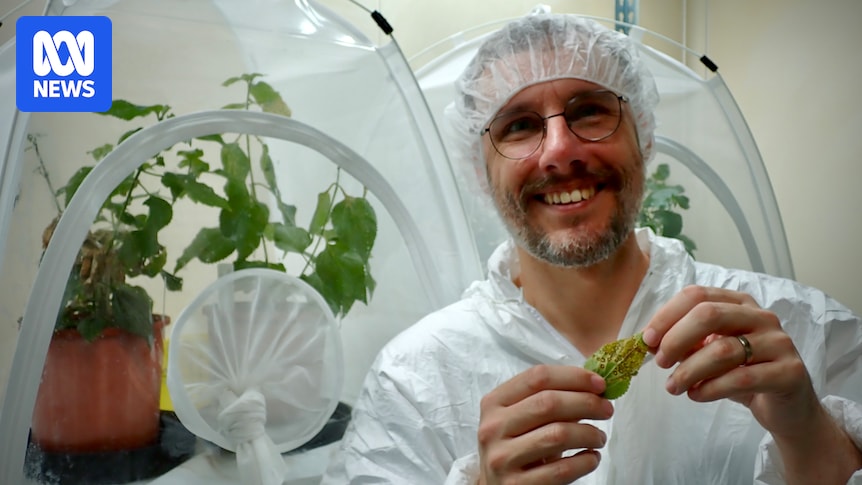
Puccinia lantanae leaf blister rust is being incubated in a laboratory with strict biosecurity measures.
Scientists shower on exiting. (Supplied: Jason Callander Biosecurity Queensland)
Scientists working with it change clothes on entry and shower in a stainless-steel decontamination room before leaving the lab.
But that is about to change.
The fungal biocontrol they have been nurturing is one last approval away from being deployed against one of Australia’s worst noxious weeds.
The lantana rust weakens the weed, damaging its leaves. (Supplied: Jason Callander Biosecurity Queensland)
A poisonous, pretty, prolifically flowering shrub, Lantana camara was introduced from the Americas in the 1840s.
But it escaped from gardens and has since invaded about 5 million hectares of pasture, bush and rainforest across New South Wales, Queensland, Victoria, Western Australia and the Northern Territory.
Banned from sale, the drought and heat-tolerant plant forms thickets that smother native habitat, kill livestock naive to its toxicity, and add dangerous fuel to bushfires.
Hardy and pretty, lantana was introduced to Australia as a garden plant. (ABC Rural: Jennifer Nichols)
A report by the National Lantana Group in 2007 estimated that lantana cost the grazing industry alone more than $100 million annually in lost productivity.
Weeds Australia warns that all parts of the hardy plant are poisonous to humans if eaten, causing vomiting, diarrhoea, muscle weakness, breathing problems, and sometimes, death.
Gloves are recommended to avoid touching it.
Weeds Australia has a lantana camara distribution map. (Supplied: Weeds Australia)
Natural enemies
In addition to herbicides and manual removal, more than 30 biological controls for lantana have been imported and released since 1914, 17 of which have become established.
But birds quickly spread lantana seeds, and bug biocontrols, sensitive to seasonal conditions, have not kept up with the weed’s relentless march.
In April, federal authorities recommended approving the Queensland Department of Primary Industries’s (DPI) application to release a South American blister-leaf rust against Lantana camara.
Jason Callander is overseeing the lantana rust program. (Supplied: Jason Callander Biosecurity Queensland)
DPI scientist Jason Callander said the Puccinia lantanae fungus infects lantana’s leaves, shoot tips, and stems, resulting in dead tissue spots (cankers) and stem dieback.
“We’re really optimistic that it’s going to get in and be very damaging to the young plants, to the regrowth, to the seedlings,”
Mr Callander said.
“We’re pretty excited about that.”
The scientists have submitted a “release from quarantine protocol” request to the federal government’s plant imports operations team, the final approval required to start the program.
They will spend the next year breeding up the rust to give to Landcare groups and local councils to help propagate and spread it.
Lantana quickly displaces plants, forming dense thickets. (ABC Rural: Jennifer Nichols)
Is it safe?
The leaf blister rust pathogen was tested on 55 non-target plants most likely to be affected at the UK’s Centre for Agriculture and Biosciences International.
A 37-page risk analysis found it was “host-specific” to Lantana camara, and the risk to other species was “negligible”.
While two native verbenas, V. africana and V. gaudichaudii, may suffer symptoms, it was “not anticipated” to cause “plant mortality”.
“Both of these plants grow in central western Queensland, outside of the range that we expect the rust to be able to persist,” Mr Callander said.
Birds and livestock can spread the seed in their manure. (ABC Rural: Jennifer Nichols)
Livestock and lantana
Adding urgency to the need for a solution is lantana’s toxicity; it can kill cattle, sheep, goats, guinea pigs and rabbits.
Joanne Connolly is a mobile cattle vet and hobby farmer at Nebo, about 100 kilometres south-west of Mackay in North Queensland.
Joanne Connolly has experienced lantana poisoning of her own stock. (Supplied: Joanne Connolly)
When one of her steers ran to find shade, with mucous streaming from its nose, she suspected lantana poisoning.
“If it’s bad enough, it can cause death,” Dr Connolly said.
A runny nose is one of the symptoms. (Supplied: Joanne Connolly)
The steer survived, but Dr Connolly said the weed’s toxins damage the liver, causing extreme sensitivity to the sun, lethargy, and yellowing around the eyes.
“It can be quite dramatic; the skin can literally just start to lift off,” she said.
Hungry cattle, newly introduced to lantana plants are most at risk. (Supplied: Lantana Removal Queensland)
Australian Cattle Veterinarians executive committee representative Lachlan Strohfeldt said livestock unfamiliar with the plant were most at risk.
“Cattle that graze areas containing lantana all the time develop an idea of what it is,” he said.
“They’ll graze around it, and they won’t browse it.“
He recommended excluding new livestock purchases from paddocks containing lantana and feeding them before they were turned out to that pasture.
Toxic lantana outcompetes native vegetation. (ABC Rural: Jennifer Nichols)
Don’t go in ‘gung-ho’
Sunshine Coast Council’s conservation partnerships officer Nick Clancy is among those on the frontline anticipating the release of the lantana rust.
“The more [tools] we have available, the better,” Mr Clancy said.
A lantana thicket killed with herbicides. (Supplied: Nick Clancy Sunshine Coast Council)
He recommended a staged approach to removing lantana, rather than going in “gung-ho”.
Mr Clancy said lantana thickets blocked koalas from moving across the ground at night.
A mur’rindum bird (black-breasted button-quail) on K’gari (Fraser Island) in 2021. (Supplied: Patrick Webster)
But some species, including the endangered black-breasted button-quail and vulnerable Richmond birdwing butterfly, had adapted to use lantana for habitat and food.
“Long-term, sure, you want to control that weed and replace it with something more desirable,” Mr Clancy said.
“But it might perform a function in the interim until you get to that point, so it’s about staging it.”
The pigs weed the paddocks for free. (ABC Rural: Jennifer Nichols)
Pig power
On their farm at Amamoor, around 150km north-west of Brisbane, Mick and Kylie Carr have used pasture-raised pigs to help tackle their lantana load and regenerate their pasture.
“It doesn’t seem to affect the pigs … and they do it for free,” Mr Carr said.
“They push it over and root around and tear the lantana out. It really saves a lot of work for ourselves.”