







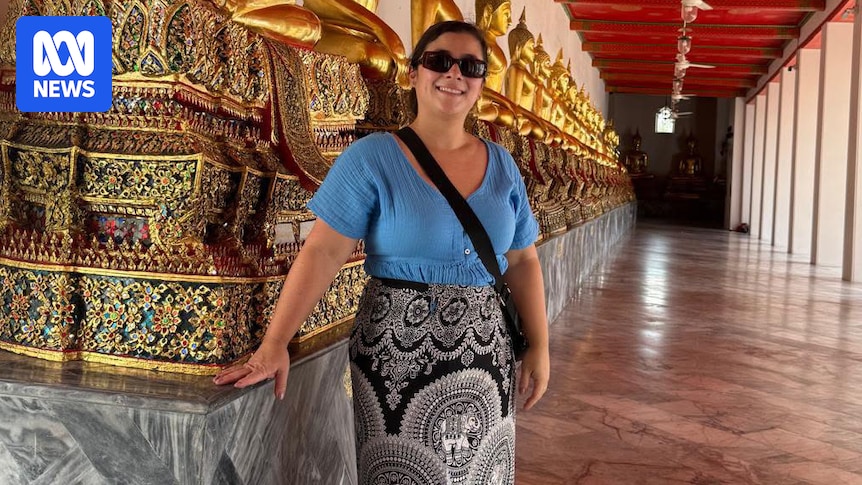
Catalina Agudelo “couldn’t wait” to escape the Melbourne winter and travel overseas.
And while she has been repeatedly checking the latest travel advice about the war in Iran, she’s confident she picked the right destination.
“All those countries around Europe and the Middle East wouldn’t be a good place to go at the moment, I would be scared about going,” she said.
“But since we are travelling to Thailand, it hasn’t changed our plans.”
Catalina was a little nervous about travelling but was happy she had chosen a country in Asia. (Supplied: Catalina Agudelo)
The strong Australian dollar combined with a reluctance to transit through the Middle East has seen some travellers ditch a European summer in favour of an Asian getaway.
Countries including Japan, South Korea, Indonesia and Vietnam have become particularly attractive, as the Australian dollar has appreciated by about 20 per cent in the past three years compared to local currencies.
At the same time, some airlines have slashed prices to lure reluctant travellers, including Qantas, which discounted more than 100,000 fares in May to destinations including Singapore, Bangkok, Japan, Manila and Jakarta.
That’s helping travellers like Ms Agudelo secure a cheap trip to Asia.
“The Australia dollar has been performing so it makes it much easier for us to travel,” she said.
Dawn of the Asian century
Japan has emerged as a top destination for Australian tourists due to a favourable exchange rate, cultural influence and cheap airfares. (Reuters: Kyodo)
Soaring jet fuel prices triggered by the war in Iran are expected to cost the airline industry an extra $US100 billion ($142 billion) this year, while annual profits will likely be cut in half to about $US23 billion, according to the International Air Transport Association (IATA).
Demand has also “softened quite significantly in some markets”, according to University of Queensland visitor behaviour expert Pierre Benckendorff.
“Airlines still need to fill those seats,”
he said.
“In some of those routes, particularly the leisure routes into Asia, there have been some really good sales.”
The disruption to international travel and fuel cost rises may begin easing, with a fragile peace deal signed between the United States and Iran this week.
Jet fuel prices have surged since February amid global supply disruptions. (ABC News: Billy Cooper)
The Australian government has also lowered its warnings for Middle East travel hubs like Qatar and the UAE from “Do Not Travel” to “Reconsider Your Need To Travel”.
And while that may see travellers return to familiar routes, Asia is expected to dominate global growth for some time.
The IATA predicts another 2.4 billion passengers will travel across the Asia Pacific in the next two decades, supported by more than $1 trillion of investment in airport infrastructure.
That means the region would be responsible for 40 per cent of global growth in passengers and half of all airport investments by 2040.
Planning, value and authenticity
Concerns about overtourism are prompting tourists to explore lesser known destinations, such as Uzbekistan. (Supplied: Kelvin Trautman)
Australian travel company Intrepid has been taking tourists to Asia since it was established in 1989 but demand has boomed since the outbreak of the war.
Since March, it said bookings from Australian customers had jumped 131 per cent for trips to China, 71 per cent to South Korea and 36 per cent to Malaysia.
Chief executive James Thornton said global travel demand “remains resilient” but customers were “booking further ahead, looking for stronger value and choosing experiences that feel more meaningful”.
“Australians are a little more cautious at the moment, particularly around airspace restrictions through the Middle East, but the appetite to travel is still very much there,”
he said.
“There’s also been a noticeable shift towards regional and closer-to-home travel in some markets.”
Mr Thornton said Asia offered “exceptional value and great connectivity” but tourists were increasingly seeking “destinations beyond the hotspots, like Sabah in Borneo, the Stans or lesser-visited parts of Vietnam and Japan”.
James Thornton of Intrepid Travel says demand remains strong, even if tourists are changing behaviour. (Supplied)
To capitalise on the growing interest in Central Asia, Intrepid has opened an office in Uzbekistan.
“Despite the current volatility globally, people still want to explore the world, connect with others and have meaningful experiences. That fundamental demand for travel remains very strong,” Mr Thornton said.
“I also believe that travel is important at this time when we’re seeing growing division in our politics and society.”
The latest ABS data on April travel showed Australian residents embarking on short-term overseas trips increased by more than 4 per cent on a year earlier.
What will the future hold?
Vietnam has been investing heavily in infrastructure to support its tourism boom. (Reuters: Yen Duong)
Travel into the Asia Pacific may be further boosted by the long-awaited opening this year of Sydney’s second airport, which will not be subject to the 11pm curfew in place at the main airport.
That will give international carriers greater scheduling flexibility, with Singapore Airlines launching a new daily service that will depart just after midnight.
But despite the US-Iran peace deal, the war is expected to impact the travel industry for years to come.
Damage to oil production facilities remains a factor, while travellers may struggle to shake their concerns about flying through former conflict zones.
Travel intelligence company Tourism Economics expects visits to the Asia Pacific to grow this year, even if the war softens demand in some markets.
Speaking before the peace deal was announced, APAC tourism analysis head Michael Shoory said the near-term outlook for the Asia Pacific was “relatively strong compared to other regions” thanks to intra-regional travel and the recovery of outbound Chinese travel.
“Destinations more reliant on short- and medium-haul travel, we expect will be less impacted, especially if they are able to effectively capture the rebounding Chinese outbound market,” he said.
“Whether that leads to higher growth than expected before the war — as opposed to merely a smaller negative impact than some others — remains to be seen.”
University of Queensland travel researcher Pierre Benckendorff says stability ultimately encourages Australians to travel. (ABC News: Alice Pavlovic)
The full impact of the conflict on travel behaviour is yet to be fully understood, as official tourism data is usually published some time after the relevant period.
But Professor Benckendorff said ultimately, “stability tends to encourage people to travel”.
“People tend to travel when they’ve got disposable income and tend to shut their wallets when they perceive that money is going to be tight,” he said.
“And in Australia, there’s some uncertainty about cost of living and interest rates going up.”