






An 11th-hour intervention from US President Donald Trump stopped a planned Israeli assault on Beirut in its tracks — but only for about a week.
Despite the US brokering a renewed ceasefire agreement between Israel and Lebanon, without Hezbollah at the table, fighting between the militant group and the Israel Defense Forces continued.
It prompted the first direct attack by Iran on Israel since April, and threatened to plunge the entire region back into all-out war.
That was until they both declared they would stop firing upon each other, for the time being.
While all of this has been happening, Israeli forces have continued to press north into Lebanon, bombs have kept falling, and Hezbollah drones have continued to cross into Israeli territory.
Mr Trump’s intervention, stopping Beirut’s southern suburbs from being hit, was only partly successful, with Israel launching strikes last Sunday.
The so-called ceasefire since April, which Hezbollah is not a party to, has done little to halt the death and destruction in southern Lebanon, and the scale of the Israeli operation called “Eternal Darkness” continues to expand.
Life on the Israel-Lebanon border
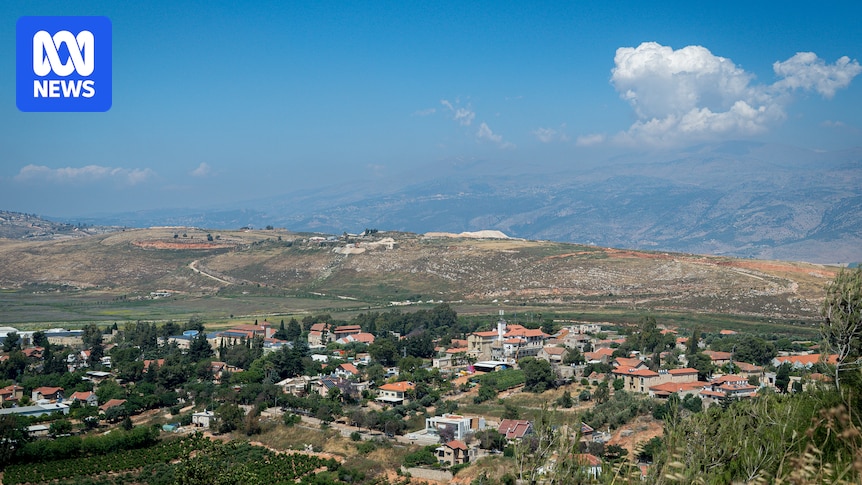
High up on the ridge line, where the border between Israel and Lebanon runs, there were constant reminders of the war being waged just a few kilometres away.
The rumble of explosions and the pops of gunfire in Lebanese territory could be heard in the distance, and locals living in the Israeli communities, which hug the high security boundary, were constantly vigilant.
The view from a damaged house in Misgav Am. (ABC News: Hamish Harty)
When warning sirens rang out, signalling Hezbollah rockets or explosive drones, it was only a matter of seconds before a potentially deadly impact.
“There’s an added level of stress being a young mum, having to answer really difficult questions [from] a three-year-old,” Alysha Morduch, a resident of the Misgav Am kibbutz in northern Israel, told the ABC.
“[They’re] wondering what’s going on, and why he’s not going to school, and why he is not meeting his friends.”
Alysha Morduch is a resident of the Misgav Am kibbutz. (ABC News: Hamish Harty)
She said she has had to be creative about how she explained the threat to her child.
”I don’t believe in lying, but I do believe in white lies to make it digestible for a three-year-old,” Alysha said.
”So I say that we’re not able to go to preschool right now because — the term is ‘chalaliot lo nechmadot’ —[which translates to] ‘mean rocket ships’ are in the sky right now.
She said she also tells her children, “We’re very lucky.”
“I tell them that the army takes care of them for us, they ask us to go underground so that nothing falls on our heads, while they’re taking things down,” she said.
“[I’m] trying to use language to make it understandable, without adding unnecessary trauma.”
In the middle of the kibbutz, there was a reminder of how febrile the situation is — a home, all but destroyed as a result of “friendly fire” when an Israeli interceptor hit the building.
Hezbollah drones, laden with explosives, have hit other buildings in communities like Misgav Am in recent weeks.
A house damaged by friendly fire in Misgav Am. (ABC News: Hamish Harty)
Israel and Lebanon announced they had agreed to a ceasefire in April, amid US negotiations about ending the war with Iran. But Hezbollah criticised the talks being held in the first place, and has repeatedly rejected the deal as a forced surrender.
Discussion about ceasefires being in force was jarring for Alysha, given the ongoing threat to her community.
“I think I feel forgotten and lied to a little bit because life is completely normal in Tel Aviv, but life is not normal for us here,” she said.
“I feel like they are using the term resilience. You’re going to hear the residents of the North being told that we have extreme resilience and that they’re proud of us.
“It’s being used as an excuse to delay providing real tangible security solutions for the residents here.”
When asked if she felt for the Lebanese civilians caught up in the Israeli attacks, Alysha said she was “an empathetic person and my heart goes out to anyone innocent struggling anywhere”.
“I’m also a young mum, and I cannot underestimate the change in your brain chemistry when you welcome life into your hands and you know that you’re responsible for keeping them alive and safe,” she said. “That is currently occupying all of my attention.”
Analyst says entire villages ‘systematically dynamited’
The security solution, at least from the Israeli government and military perspective, has focused on driving deeper into Lebanese territory and expanding its ground invasion, in conjunction with air strikes across the area.
That is despite a ceasefire announced by US President Donald Trump on April 17, and a renewal of the agreement, which was agreed to on June 10.
When the original truce was imposed, Israel said it would maintain a “security buffer” in southern Lebanon, occupying territory it had seized during its invasion weeks prior.
Israel and Lebanon announced they had agreed to a ceasefire in April, amid US negotiations about ending the war with Iran. (ABC News: Hamish Harty)
Its “buffer zone” covered hundreds of square kilometres of Lebanese territory south of the Litani River, traditionally seen as the border of Hezbollah’s heartland, and included dozens of Lebanese villages and towns.
Many of those villages had already been partially destroyed in previous conflicts by Israel, and Israel’s Defense Minister Israel Katz ordered the demolition of more homes.
“We’re seeing entire villages being systematically dynamited when the bombing from the air has not done the job of totally eradicating these places,” said Maha Yahya, director of the Beirut-based Malcolm H Kerr Carnegie Middle East Center, which provides Middle East and Africa analysis and held a webinar about Israel’s expanding borders and territory in the days after the renewed ceasefire was announced.
“We are seeing literally a vaporisation of entire residential and urban areas across South Lebanon.”
A view of destroyed buildings in southern Lebanon from Metula. (ABC News: Hamish Harty)
She said recent data suggested at least 63 towns and villages were in the Israeli-occupied area.
“At least half a million people will not be able to go back home … not only because Israel continues to occupy their areas, but even if Israel was to withdraw … their homes simply no longer exist,”
she said.
“There’s genuine concern, and it’s a very serious one, that this occupation will turn into a long-term occupation similar to the one we saw before [and] after the 1982 invasion and which obviously gave life to the resistance narrative.
“I mean, Hezbollah was born out of the rubble of the 1982 Israeli invasion of Lebanon.”
The latest renewed ceasefire deal outlined a proposal for so-called pilot zones where the Lebanese Armed Forces (LAF) would move in and take control, but it did not specify exactly how that would work.
Israel’s approach to ‘buffer zones’
Since October 7, Israel has operated on numerous fronts, including in Gaza, Syria, the West Bank and Lebanon.
In each instance, it claims it is seeking to eliminate terrorist threats and protect Israeli territory.
Its tactics have included the creation of “buffer zones” or “security zones”, where it has moved in and occupied territory outside of Israel’s own borders.
United Nations vehicles spotted lining up waiting to enter southern Lebanon. (ABC News: Hamish Harty)
”These buffer zones [they] are not new to Israeli methods, but we are certainly seeing a much wider embrace of it and a heightened acceleration and [in] the scope and scale of it,” said Amjad Iraqi, senior analyst for Israel and Palestine at the International Crisis Group.
”And the fact that Israel found that it was able to advance this to such an extent in Gaza, it provided that credit with the confidence and feeling of impunity to be able to do that elsewhere.”
In Gaza, Israel effectively controls an estimated 64 per cent of the enclave, after a two-year military assault that followed the 2023 Hamas attack on southern Israel.
Daily life for Gaza’s residents is governed by the unpredictability of the essentials: power, water and food. (Reuters: Ramadan Abed)
Prime Minister Benjamin Netanyahu has recently directed Israel’s military to take more of Gaza, initially by seizing 70 per cent of the Palestinian territory, where the population is already penned into a tiny strip of land along the coast.
Meanwhile, in 2024, when the Assad regime fell and rebels led by new President Ahmed al-Sharaa swept through, Israel used the upheaval as an opportunity to drive into the south-west of the country.
A buffer zone, monitored by the United Nations, had been in force between the Israeli-occupied Golan Heights and Syria since the 1970’s, after Israel seized the plateau from Syria.
But Israeli forces seized control of it two years ago and pushed deeper into Syria again, occupying hundreds of square kilometres.
Syrian authorities have reported numerous Israeli strikes in their territory, including as recently as this week.
Now, in Lebanon, Israeli forces have pushed beyond a “buffer”, according to a Reuters review of Israeli statements, crossing the Litani River and seizing more territory — including the Crusader-era Beaufort Castle.
Smoke rises from Beaufort Castle following strikes on May 27. (Reuters: Stringer)
This has happened as Hezbollah stepped up rocket and drone attacks on Israeli soldiers and communities, according to Alma Research Center, an Israeli think tank that monitors the conflict.
It recorded Hezbollah launching 230 attack waves directed at Israeli territory since April 17.
Israeli evacuation warnings, or displacement orders as they are often called by Lebanese authorities, have continued to be issued and deadly strikes have been reported far beyond the occupied area.
The IDF demanded that the entire population of southern Lebanon to move north, beyond the Zahrani River — the waterway further north of the Litani.
In total, it’s roughly 14 per cent of Lebanon’s land mass, and covers an area where hundreds of thousands of people live.
Lebanon’s future is uncertain
At the height of the conflict in Lebanon, which began when Israel retaliated against Hezbollah after it launched strikes in solidarity with its backers in Iran, more than 1 million Lebanese were displaced.
So far, according to the country’s health authorities, more than 3,600 Lebanese have been killed in Israeli strikes since March.
Its figures do not specifically distinguish between civilians and combatants, but it does show that among the dead are hundreds of women, children and the elderly.
An Israeli air strike hit a building and damaged a hospital in the southern port city of Tyre, Lebanon, in early June. (AP Photo)
Twenty-seven Israeli soldiers have been killed since March, and another three near the Lebanese border as a result of Hezbollah strikes.
On Thursday, a United Nations peacekeeper was killed by a mortar shell near the town of Marjayoun. The IDF accused Hezbollah of firing upon the UNIFIL (United Nations Interim Force in Lebanon) position.
Hezbollah has rejected the renewed ceasefire, announced on Wednesday night between the Israeli and the Lebanese governments.
”It is a declaration of intent to sabotage and destabilise Lebanon, incite strife among the Lebanese to Israel’s advantage, and achieve through politics what Israel failed to achieve through war,” the group’s leader Naim Qassem said in a statement.
”We have not given anyone a commitment not to resist the aggression and respond to it.
”As long as the aggression continues, we will confront it with all the strength we possess, and we will strike wherever we decide and are able.”
More than a million people have been displaced in Lebanon, worsening an existing humanitarian crisis. (Reuters: Ammar Awad)
On the issue of the buffer zone, the Israeli Prime Minister’s office would not directly answer the ABC’s question on whether it would eventually withdraw if a ceasefire was struck.
“There’s nothing specific I can share with you at this time, but if Israel has learned anything after October 7, we will never allow a genocidal terrorist organisation to sit anywhere near our borders here in Israel,” spokesperson Shosh Bedrosian said.
”That includes all of our borders.”
‘After years of war, people have become numb’
The increase in the intensity and number of Hezbollah attacks, combined with a new threat of fibre-optic drones which could not be jammed by Israel’s sophisticated defence systems, had prompted demands to expand the offensive again.
Israel’s military had reportedly expressed frustration that it was not being allowed to attack claimed Hezbollah targets in the capital Beirut, and some of Benjamin Netanyahu’s political rivals had accused him of being weak on protecting the north of the country.
Even within his coalition cabinet, he faced pressure to launch attacks — including from Israel’s far-right National Security Minister, Itamar Ben-Gvir.
On Monday, Mr Netanyahu announced he had ordered strikes on the Hezbollah stronghold suburb of Dahiyeh, in Beirut’s south.
The strikes never happened, in no small part due to a fiery phone call between the Israeli prime minister and Donald Trump. The US president chastised Mr Netanyahu for the escalation, labelling him “F****** crazy”.
Regardless, thousands of people fled Dahiyeh and its surrounds, fearing what might happen.
”Is there anyone who isn’t exhausted? From one displacement to another, and then another. I’m tired. How much longer can this go on?” shopkeeper Yehya Hallak told the ABC.
He had packed his valued possessions in the back of his van. Many from the community were living in tents.
”Women and children were the most frightened. I’ve become used to these situations,” Yehya said.
”Sometimes they issue warnings before striking, and sometimes they strike without any warning at all. That’s what’s frightening; we can never feel safe.”
Shopkeeper Yehya Hallak in Lebanon says he is tired after a long conflict. (ABC News: Cherine Yazbeck)
Yehya said the trauma of ongoing conflicts had spread through the community.
”After years of war, people have become numb and exhausted. We’re all fed up,” he said.
”But we still fear for the children and the women. In the end, there’s nothing more precious than life.”
Another Dahiyeh resident, Mohamad Siblini, who owns a car hire business in the area, said he doubted peace was coming any time soon.
“These people [Israel] live for bloodshed. They do not want peace. To them, any peace agreement is a form of surrender.
”We want peace. We want to live, and we want our children to forget what war feels like.”
Mohamad Siblin owns a car hire business in the Beirut suburb of Dahiyeh and wants there to be peace. (ABC News: Cherine Yazbeck)
The IDF’s seizure of the Beaufort Castle, which it had held for almost three decades when Israel occupied southern Lebanon, had triggered painful memories.
”Some people say that if weapons are surrendered, the war will end. That’s not true.
”They want our land, our water, and our gas.
”We are people who look like everyone else and who want to live alongside everyone else.”
Residents say current situation is not stable
Back on the Israeli side of the border, the urge for peace was clear — but the blame for the situation was different.
Yael Brodie, a resident of Metula (which is surrounded to the north, east and west by Lebanon), said the Lebanese government had failed to take responsibility for curbing Hezbollah’s influence and power.
Yael Brodie is a resident of Metula. (ABC News: Hamish Harty)
”I used to live on the edge of Metula [an Israeli town right on the border] with people from Lebanon putting lasers in my eyes and shouting, and I’m like ‘it’s OK, they’re mad, let them be mad, whatever,'” she said.
”And since the 7th [of October], things have changed, and you understand that people are by your house, ready and want to kill you just because you’re a Jew or whatever.
”We don’t care how; it needs to end. We cannot continue living like this, and we cannot leave this area, because if we surrender to the people that are trying to kill us, we’re losing our country.”
In nearby Misgav Am, mother Ron Ohana said the current situation was untenable.
Ron Ohana says residents have learned “it’s not stable”. (ABC News: Hamish Harty)
”We learned a lot these past few months, it’s not stable,” she said.
”For us, there is no ceasefire. We’re in this situation for a few months. There is school, there’s no school, there is a routine, no routine.
”We just want peace and quiet, we want to be in a stable situation.
”We want to be able to be outside and not fear missiles or drones.”