







Beneath the sprawling gnarled branches of a kiawe tree in Hawaii’s pristine Kealakekua Bay, an X lies carved into an otherwise unassuming rock face.
But there’s no buried treasure to be found here.
This X marks the spot where Captain James Cook was killed by Kānaka Maoli (native Hawaiians) on Valentine’s Day in 1779.
The X in question that quite literally marks the spot. (ABC/Wooden Horse/WildBear Entertainment/Artemis Media)
Almost 250 years on, the British naval explorer is famed for his navigational and cartographic feats.
Emalani Case thinks another descriptor should be added to that list: thief.
The Kānaka Maoli lecturer in Pacific Studies smiles as she looks down at the spot where Cook met his demise, waves gently lapping against the foreshore.
“What I think most people hear is that Captain Cook was killed by a group of savage Hawaiians,” she tells ABC iview’s Stuff the British Stole.
“What people don’t know is he stole from us.
“And I think people need to see him and his crew as thieves.”
Emalani Case is “so sick” of talking about Cook. But her conscience won’t let her stop. (ABC/Wooden Horse/WildBear Entertainment/Artemis Media)
Centuries later, the debate continues over the circumstances surrounding the death of one of the world’s most famous explorers — as well as the implications the events surrounding it have for his legacy.
Case thinks it’s “essential” the story is revisited including the perspective that isn’t “tied to power”.
“[It’s a misconception] he was an innocent explorer … What we understand as Hawaiians is that he was a coloniser,” she says.
This story has its beginnings in a small English town
Cook was just 17 years old when he left behind his stable job at a general dealer’s shop in a North Yorkshire fishing village.
He moved to the neighbouring ship-building trade centre of Whitby in 1746 with a goal: to make something more of himself.
At the time, the town of Whitby was reportedly known as the “university of the sea”. (ABC/Wooden Horse/WildBear Entertainment/Artemis Media)
“He was primarily a simple man from very humble beginnings, with a real enthusiasm for science,” says historian Clair Stones, of the Captain Cook Memorial Museum.
Over the next three decades, Cook would complete two celebrated expeditions aboard the Endeavour. On the first, he mapped the Pacific Ocean, including New Zealand, Tahiti and the east coast of Australia. And on the second, Cook and his crew became the first recorded people to cross the Antarctic Circle.
Clair Stones says Cook “opened up the world”. (ABC/Wooden Horse/WildBear Entertainment/Artemis Media)
According to Stones, Cook’s expeditions differed in key ways to his predecessors such as Christopher Columbus and Sir Walter Raleigh, whose Age of Discovery voyages were driven by the desire to increase wealth.
“Cook’s voyages were to find out … What do people on the other side of the world look like? How do they live? What customs do they have?” she says.
“And of course, he was a brilliant cartographer. His maps were so accurate … the maps we use today … they were from Cook.“
In his lifetime, Cook went from working in a shop to a widely celebrated explorer. (Supplied: Dixson Galleries, SLNSW)
By 1775, this man of “humble beginnings” had become renowned for his voyages of enlightenment, and climbed his way from a lieutenant to a commander, to the higher rank of post-captain.
It made sense that Cook would turn, then, to one of the last big navigational feats left to solve.
For centuries, the British had dreamed of finding an elusive, ice-free trade route along the northwest passage connecting the Atlantic and Pacific oceans.
In July 1776, Cook set sail in the Resolution from Plymouth in southwest England in search of the coveted shortcut to Asia.
This third voyage would be his last
Cook and his crew battled through the storm-tossed waters of the Cape of Good Hope off the coast of South Africa and then rested and replenished their supplies in Aotearoa/New Zealand.
By January 1778, they had come across the Hawaiian Islands — becoming the first-known Europeans to do so — before continuing their hunt for the northwest passage.
An illustration of Cook’s third voyage by John Webber, the official artist who accompanied the cartographer and his crew. (Supplied: Wellcome Collection)
But mere months later, the Resolution’s path forward was blocked by a wall of sea ice near Alaska.
Cook was forced to admit defeat.
“You’ve got to imagine the horror of being on these tiny, tiny ships,” says Peter FitzSimons, the author of James Cook: The Story Behind the Man who Mapped the World.
“It was a cork on the ocean and you’re being swept by the waves and the wind and the frost. [Imagine] somebody shows you the brochure … Hawaii looks nice! Taxi!”
“We know [Cook is] important, but the actual man himself … what he felt about things, who the hell [knows]?” says Peter FitzSimons. (ABC/Wooden Horse/WildBear Entertainment/Artemis Media)
So, the Resolution made its way back to Hawaii — which Cook had dubbed the “Sandwich Islands” — to wait out the worst of winter.
The explorer and his crew dropped anchor at Kealakekua Bay on the Big Island. It was January 1779.
Akoni Nelsen grew up hearing stories about their arrival from his elders.
“Apparently, [Cook] stumbled over our islands … the first time,” the Kānaka Maoli leader says.
“The natives were quite inquisitive [about who these people were]. And in that excitement to welcome them, the king allowed Cook and his men to land.”
Akoni Nelsen has family lines in Hawaii that go all the way back to Cook’s arrival. (ABC/Wooden Horse/WildBear Entertainment/Artemis Media)
Once ashore, Cook was apparently treated as a highly regarded guest.
“They wrapped a red cloak around Cook and they [presented] him on the heiau [a sacred religious site], and so they treated him like a chief,” Nelsen continues.
It isn’t believed to have lasted.
“There’s records of the crew taking a little bit too much here and searching for relief, searching for women … You see a disregard of Hawaiian people from Cook and his crew,” Case says.
“Captain Cook was coming with that perspective of, ‘What is here is mine, I can steal what I want.’ So, I think he would have been a burden.”
Some accounts have reported Kānaka Maoli saw Cook as a deity. The idea is incredibly divisive, with critics arguing crucial nuance has been missed. (Supplied: J Webber, NLA)
Stones agrees, adding their requests for food and other assistance from their Hawaiian hosts were not treated in “quite the same way” as weeks passed.
“They outstayed their welcome,” she says.
About a month after arriving at Kealakekua Bay, the explorer and his crew prepared to leave and resume their search for the northwest passage.
But, before they did, the British sailors apparently entered the temple space at the heiau and took something unforgivable: sacred, irreplaceable wooden sculptures known as ki’i.
An act of ‘desecration’
Kahaka’io Ravenscraft is an expert in ancient Hawaiian practices, who specialises in storytelling and ki’i.
When he looks upon ki’i, he sees the physical embodiment of the link between the material and higher realms.
Loading…
“We transform it by putting our own reflection into it,” explains Ravenscraft, whose ‘ohana (family) trace their lineage back to the Kealakekua Bay area.
“The amount of labour that [is put into ki’i], the amount of intent … the thoughts and the focus and the purpose of why these images were carved was meant to serve something bigger than just an individual.”
To take ki’i, Nelsen explains, is “like taking your chief, it’s like taking your family member … it’s like you’re leaving a void”.
“I feel that that happened,” Ravenscraft says.
In addition to the ki’i, the British sailors are believed to have taken some of the wood that marked the boundary around the sacred, prohibited heiau. (ABC/Wooden Horse/WildBear Entertainment/Artemis Media)
Case has read the sacred carvings were then used as firewood.
“If you’re a Hawaiian, and this is a deeply spiritual, significant site, and someone is taking that, that could be seen as desecration,” she explains.
But the British admiralty had a different point of view.
According to Stones, officers wrote they received permission to enter the heiau and remove wood, which they did because they “needed to make a fire”.
Most of what was written down on the voyage was the property of the British admiralty. (ABC/Wooden Horse/WildBear Entertainment/Artemis Media)
However, these perspectives aren’t the only two in existence; there was also an American on the voyage by the name of John Ledyard.
John Ledyard, who had essentially been forced into the British Navy, wrote from the Hawaiian perspective. (Supplied: Ledyard Bank)
And it was his opinion, Stones says, that “the Hawaiians were humiliated” by these events.
“Ledyard writes that … they were made to do something that they really did not want to do.”
The end of the end
Cook and his crew eventually set sail — but their attempt to leave Hawaii behind for good was thwarted by storms and they were forced to return to Kealakekua Bay.
Few, if any, would describe the reception they received as that befitting highly regarded guests.
“They wake up to find that overnight … the Hawaiians have ‘stolen’, taken, borrowed, one of the small boats that had been tied up and Cook is of the mind to discipline them,” explains FitzSimons.
Cook’s reported attempt to take a Hawaiian chief hostage didn’t go well for him. (Supplied: John Webber, NLA)
At the time, it was an established practice among English maritime captains to take leaders hostage, and it’s reported Cook entered the residence of the ruling chief, Kalani’ōpu’u, and placed his hands on him with this intention.
It’s believed to have been the final act of provocation; from the perspective of Kānaka Maoli, chiefs are the closest to gods.
“The chiefs [put] up their spears and they [were] ready to kill because breaking the kapu — or the sacred laws — warrants your blood,” explains Nelsen.
“Eye for an eye, tooth for a tooth.“
“Hawaii is a storied place, a legendary place. It has its magics,” muses Nelsen. “But then, this is not paradise.” (Supplied: NLA)
According to FitzSimons, Cook recognised the danger facing him and his crew and ordered a return to their boats.
But they were followed from Kalani’ōpu’u’s residence to the tidal flats of Kealakekua Bay — where Cook is believed to have made his final error in judgement.
“There’s some people that said he didn’t know how to swim … I think his men were retreating and [Cook] was stranded on the shoreline,” Nelsen says.
Standing alone, Ravenscraft explains Cook offered his back to his opponents, something you “never” do in Hawaiian warfare.
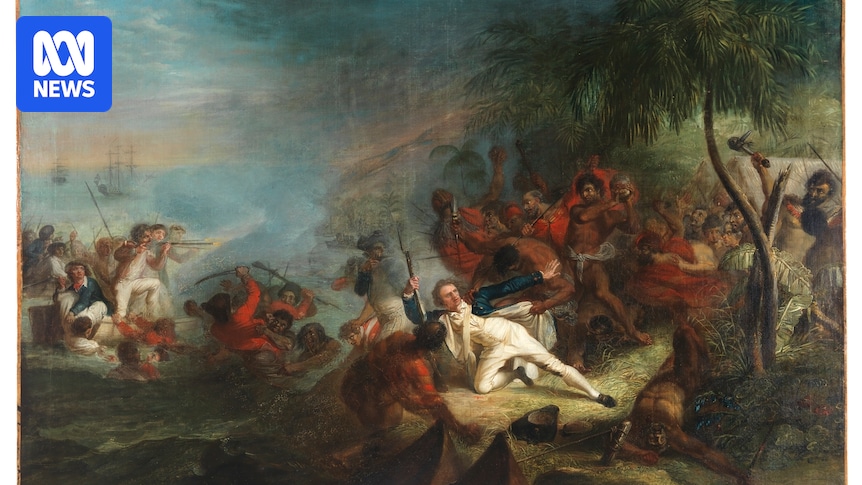
Countless artworks have romanticised Cook’s last moments. (Supplied: SLNSW)
Depending on who you ask, Captain Cook was either struck by a spear from behind that went straight through him, repeatedly clubbed, or some mix of the two.
Either way, he was slain on the foreshore that day.
A fraught legacy
Centuries on from Captain Cook’s death, many people — FitzSimons and Stones among them — see the British naval officer as a pioneer whose feats are worthy of celebration.
Stones marvels at the way Cook rose “from the very bottom up the ranks to change the world” — whether “for the good or the bad”.
She also sees the expeditions he’s famed for as inevitabilities.
“When [Cook] was sailing, the French, the Spanish, the Portuguese and the Dutch, were also looking for this doorway,” Stones says.
“So, it was going to happen. And if it hadn’t been the British, it would have been somebody else.“
A Captain Cook statue in Whitby, which is often seen with a seagull perched atop his head — hence the bird poo tracking down his shoulder. (ABC/Wooden Horse/WildBear Entertainment/Artemis Media)
Stones thinks “mistakes were made on both sides” on Cook’s last voyage in Hawaii, insisting he “wasn’t the ‘baddie’ in the whole story”.
FitzSimons echoes her.
“I am keenly aware of the devastation wrought by white colonisation. The bottom line, however — get ready to slaughter me — is I don’t think Captain Cook was a bad man,” he says.
Indeed, there’s no shortage of people who disagree, and who would instead describe the naval officer as an emblem of oppression, who embarked on voyages that were the catalyst for devastating colonisation.
To comment on Cook’s legacy at all today is to provoke intense criticism.
Wiradjuri man and former ABC journalist Stan Grant found out first-hand how polarised the debate is after he wrote a column about the accuracy of the plaque on Cook’s statue in Sydney’s Hyde Park on Gadigal land back in 2017.
A little less than 10 years ago, Stan Grant received significant backlash after suggesting Cook did not “discover” Australia. (ABC/Wooden Horse/WildBear Entertainment/Artemis Media)
And yet, Case hasn’t stopped sharing her perspective about Cook, his voyages, his death, and what we should make of it all — even though she’s admittedly “so sick” of doing so.
“You can’t talk about colonisation in the past tense when people are still living with it. We still live with it,” she says, steadfast.
“[Cook] was an agent of empire … He brought disease, he murdered people. He was not a nice guy.”
Case doesn’t think of his storied achievements as all that noteworthy, either.
“We found this place first,” she points out.
“He’s not actually that remarkable when you think about him as a discoverer and a so-called explorer; he found a place that people had happened upon generations before.”
“He may have mapped parts of the Pacific, but we had already done so … [and] evolved and developed cultures in all these places,” says Case. (ABC/Wooden Horse/WildBear Entertainment/Artemis Media)
This is why the story of Captain Cook’s death is symbolic of “a win against colonisation” to Case; why it demands retelling.
She says the X that points us to the spot where Cook met his violent demise “marks Indigenous persistence”.
“The fact I’m standing here, as a Hawaiian, means my people survived everything he brought.
“That X marks our resistance and our ongoing dedication to being Indigenous here, and forever.“
Watch Stuff the British Stole free on ABC iview and ABC TV at 8:00pm on Tuesdays.