




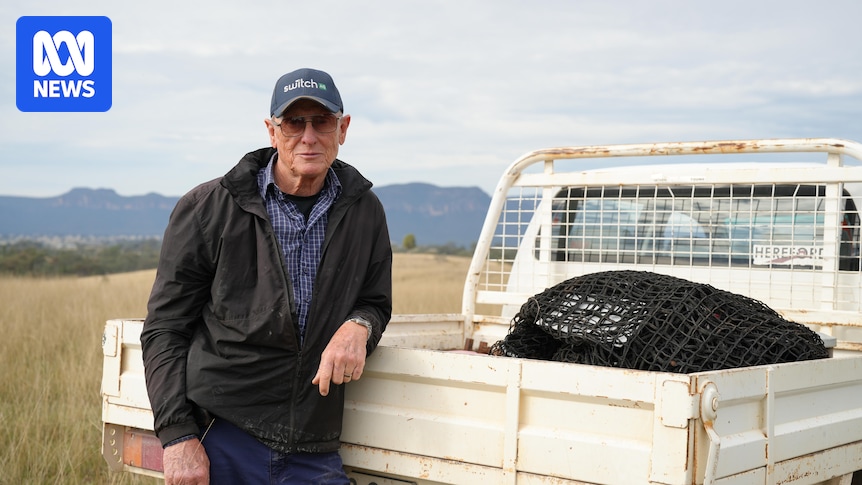
Farmer Derek Larsen will spend most of his days setting up traps, tracing diggings and devising plans to keep feral animals at bay on his property.
It is part of life on the sprawling farm at Capertee, on the New South Wales Central Tablelands.
But Mr Larsen believes some absentee landholders, who do not live on the land full-time, are not pulling their weight when it comes to feral pest management.
Pigs that were trapped and killed on Derek Larsen’s property. (Supplied: Derek Larsen)
“It becomes a more difficult process … a bigger challenge,” he said.
“They’re wonderful people, they’re great neighbours, but a lot of them have never ever heard of the NSW Biosecurity Act … there are obligations under that act.”
Many factors make determining the number of absentee landowners difficult.
A 2023 University of Wollongong research study referred to estimates that between 22 and 45 per cent of landowners in Australia were absentee.
These could be large corporations, farmers leasing their land or tree changers.
While the study focused on the south-east part of the state and weeds, it found more than 80 per cent of both residential and absentee landholders spent an average of one to five hours managing weeds.
Under the NSW Biosecurity Act, anyone who owns, occupies or manages land in the state has a general obligation to “take action to prevent the introduction and spread of pests, diseases, weeds and contaminants”.
The state’s Department of Primary Industries and Regional Development said this meant everyone had the responsibility to take part in pest animal control programs, work together with neighbours, and keep an eye out for pests and signs of disease.
By placing grain in a trap, Derek Larsen was able to capture more than 30 feral pigs in one night. (ABC Central West: Emily Middleton)
Feral pests a major problem
According to the Australian Bureau of Agricultural and Resource Economics and Sciences (ABARES), vertebrate pest animals cost farmers almost $1 billion a year.
This can be in the form of livestock deaths from foxes and wild dogs, a decrease in yields from crops damaged by pigs, as well as setting up baits, traps and cameras.
While Mr Larsen said the Local Land Services (LLS) was a huge help with the costs of feed and traps through regular feral pest management programs, the time and labour involved was the biggest toll.
There are a number of different types of traps that can be utilised on properties. (ABC Central West: Emily Middleton)
“It takes a lot of time to set up traps, feed overnight, go back and reload it, come back, then destroy and dispose of the pigs,” he said.
“[Feral pests] have a massive disease implication. If we were to get foot and mouth [disease] in this part of the world or brucellosis, all things that pigs can spread, if we get those diseases, it will wipe out our cattle herds.“
Neighbours onboard
Alongside some of his full-time farming neighbours, Mr Larsen has been able to catch upwards of 30 pigs in a night.
Capertee Valley Landcare group president Patrick Bryant said working with neighbours was critical to minimising the feral pest problem.
Patrick Bryant says neighbours need to work together to tackle pests. (ABC Central West: Emily Middleton)
“With pigs in this area, if we do not work with our neighbours, if we eliminate them from one farm and don’t remove them from our neighbours, new pigs will just come into the area,” Mr Bryant said.
“We have to have a very broad-brush approach to removing pigs.”
As he might not see his absentee landholder neighbours for a few months, Mr Bryant said it made it hard to discuss pest management plans.
“It’s very difficult to get approvals from them to go onto their land and set up pig traps,” he said.
“Unless they get involved, we’ll never get on top of the pig problem.“
Landholders’ obligations
Amber Kelly, a sheep and cattle farmer from Rugby, NSW, 30 kilometres east of Borrowa, has also been battling with feral animals with her neighbours for years.
Amber Kelly says absentee landowners give feral pests a massive area to harbour in. (ABC Central West: Emily Middleton)
“We would have probably put out close to 1,000 baits over the last three months,” Ms Kelly said.
With the amount of damage that can be caused, particularly by foxes, she said she had a responsibility to try to control them.
However, according to Ms Kelly, there were more than 10,000 hectares of land owned by absentee landholders in her area.
“The feral animals have got this massive area to harbour in, so we are never able to get ahead of management of feral animals in this part of the world,” she said.
“We are already working together, but it’s pretty hard when you’ve got a lot of land owned by people that don’t live there.”
Feral pigs are more active at night. (Supplied: Derek Larsen)
More education for weekenders
While the LLS run a number of educational programs on pest management across the state, Mr Larsen wants to see more conversations happen before people buy land.
“When you’re buying a block of agricultural land, there needs to be some form of education and documentation which is seen by the purchaser prior to buying that land,” he said.
“They never bought the land anticipating that they would need to deal with both feral pests and noxious weeds.”
Mr Larsen said people living full-time on properties were more than happy to engage in conversations and arrangements with their city-living neighbours to ensure an all-round beneficial outcome.
“I think if they understand the issues, then they would participate.”