







Energy industry voices are warning that the business case for Marinus Link appears increasingly unviable if power-hungry players such as AI data centres continue to expand across Tasmania.
Firmus Technologies, a Singapore-based company led by co-founders Oliver Curtis and Tim Rosenfield, has designs on using a significant portion of Tasmania’s energy to power three AI data centres in the state’s north.
It has already locked in more than 100 megawatts for its St Leonards precinct, which is currently under construction.
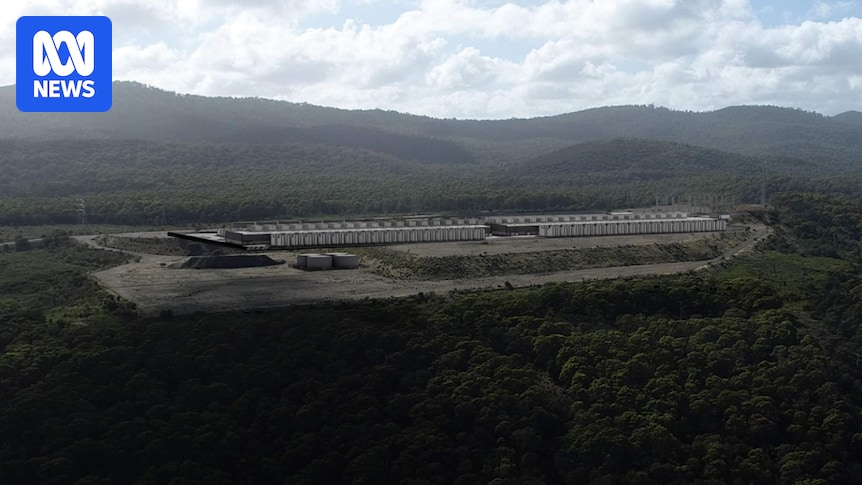
The AI data centre at St Leonards will produce “AI tokens” needed for tools such as generative AI chatbot ChatGPT. (Supplied: Tasmanian government)
Two more Firmus centres are planned: one in Bell Bay, north of Launceston; and another in Wesley Vale, in the state’s north-west. The power requirements across the three sites are estimated to be 400 megawatts, or about two-fifths of the state’s total power supplies if more generation is not added.
Those high energy needs were enough for the boss of a federal agency charged with advising the government on climate policy to express some doubt towards another energy infrastructure project — Marinus Link.
The $5 billion project will connect Tasmania and Victoria via 255 kilometres of undersea cable, enabling greater energy trading between the states. (Prysmian Group)
“Just look at Tasmania, for example,” Climate Council Authority chair Matt Kean said during a Q&A at the Morgan Stanley Australia Summit in Sydney last week.
“We have to say that the Firmus proposal and the other data centre proposals for Tasmania, if they get up, does bring into doubt the business case for the Marinus Link. That’s the reality.“
“It’s an evolving market,” Mr Kean would go on to tell the global investment bank’s summit, which is held over several days and plays host to business leaders, investors and analysts.
“Government policy needs to keep up with those rapid shifts if we’re to realise the opportunity.”
Firmus declined to provide comment for this story.
Premier Jeremy Rockliff (centre) with Firmus Technologies co-CEOs Tim Rosenfield and Oliver Curtis. (Supplied: Tasmanian government)
‘You can’t do both’, energy expert says
The $5 billion Marinus Link is a proposed 1,500-megawatt two-way undersea data cable between Heybridge in Tasmania’s north-west and the Latrobe Valley in Victoria.
Jointly funded by the state and federal governments, the development will allow energy to be sent between the states, and on into the National Electricity Market (NEM).
The project promises to allow Tasmania to import low-cost renewable energy, while it reserves and stores its hydropower, which can then be exported to the mainland when required.
In February, the Australian Economic Regulator green-lit the first stage of the project.
Loading…
Hydro Tasmania’s claim that the undersea Bass Strait cable Marinus Link will make the state an extra $450 million in profit a year was “now looking quite questionable” according to an energy analyst.
The Tasmanian government remains firmly committed to the project, but energy analyst Marc White of Goanna Energy, says he believes energy commitments made to data centres in Tasmania have weakened the project’s business case.
“We expect there is a trade-off there between supporting on-island customers and making arbitrage profits over Marinus Link,” Mr White told 936 ABC Hobart.
“Effectively you’ve got a limited capacity to trade, and if you’re making decisions to use that capacity to firm up renewables in Tassie, then that’s capacity that you don’t have to trade on the market.
“If that energy has to be allocated to local businesses, then you can’t do both.”
A stylised 3D graphic of the proposed Marinus Link project. (Supplied: TasNetworks)
A Marinus Link spokesperson said the increased investment in data centres is further proof of the necessity of the project, which will enable new investment in renewable generation and major load infrastructure.
“Importantly for Tasmania, Marinus Link will enable hydropower assets to operate more strategically — storing energy when renewable supply is abundant and dispatching it whenever it is needed most,” the spokesperson said.
Power bill hike possible, report finds
Tasmania’s cool climate and access to renewable energy has made it an attractive place for AI data centre investment, even while some of its major industrial energy users face an uncertain future.
Aside from Firmus’s proposals, Australian mining company Greenwing is also investigating the potential for data centre expansion in Tasmania.
Greenwing hopes to reopen the mothballed Que River Mine, about 75 kilometres south of Burnie in Tasmania’s north-west, but said its longer-term plan was to assess whether the site can host third-party data infrastructure, such as data centres or artificial intelligence (AI) infrastructure.
Data centres have rapidly spread across Australia, with 162 in operation and more than 90 in the pipeline, according to recent Climate Council research.
Firmus Technologies’ AI factory in St Leonards is expected to be operational early next year. (Supplied: Tasmanian government)
Grid-scale batteries across the NEM are also expanding rapidly, which, according to the Australian Energy Market Operator (AEMO), make up just under half of the total capacity in the NEM pipeline.
A new report, by the Victorian Energy Policy Centre for the Bob Brown Foundation, has found the rollout of affordable and efficient batteries has blunted Tasmania’s competitive advantage in cheaper energy storage, further eroding the business case for Marinus Link.
The report predicted an electricity bill hike for Tasmanians, in the form of increased network charges, if Marinus Link went ahead.
It also found the state only had a small exportable surplus of energy beyond its current capacity.
It said only a “catastrophic contraction of demand”, such as the closure of major industrials Liberty Bell Bay and Nyrstar, would make it viable to expand data centre development in the state.