







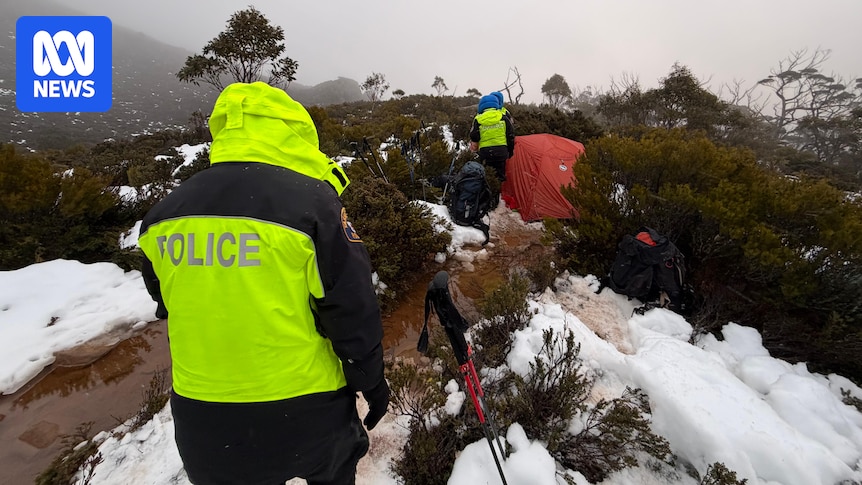
About every fourth rescue, Callum Herbert heads out to retrieve people who haven’t properly prepared for a walk in Tasmania’s wilderness.
In the 12 months to the end of June, more than 100 of the 375 emergency rescues Tasmania Police took on were due to people failing to take proper precautions.
Callum Herbert frequently has to rescue ill-prepared hikers. (ABC News: Ebony ten Broeke)
Senior Constable Herbert admits he can sometimes find himself frustrated on missions, after rescuing people who have not heeded the advice he and the Parks and Wildlife Service issue about Tasmania’s changeable weather conditions each year.
“Mainly during a rescue, you can be frustrated, thinking ‘how did these people get there?'” he said.
“But at the end of it, when you’ve saved someone or rescued them from something life-threatening, you actually see the human behind the story.
“They’re just normal people who are just cold and scared and have made some bad decisions.
“And often these are done with their family just trying to do the right thing, and it’s quite heart-warming once you rescue them, but it certainly is frustrating and time-consuming in the lead up to it.”
Members of Tasmania’s police search and rescue team walk through thick snow during a search operation in 2019. (Supplied: Tasmania Police)
Signage advises Cradle Mountain visitors of the appropriate clothing and gear. (ABC News: Hayden Smith)
The annual plea for walkers to make sure they’re ready for wintry walks in the wilderness comes despite several bushwalker deaths in recent years.
Senior Constable Herbert said Tasmania’s changeable weather, where large amounts of snow can fall rapidly, or wild winds whip up instantaneously, means a day out can quickly shift from a fantastic experience to a life-threatening situation.
And he says there are other ways bushwalkers fail to prepare for a Tasmanian adventure.
“People go out for a day walk having come from the mainland where it gets dark at six or seven at night, and suddenly it’s 4:30pm in Tasmania,” he said.
“It’s pitch black and you don’t have a torch, you might go and reach for your mobile phone in your pocket, but it doesn’t work because it’s cold.“
Brendan Moodie says it’s common for hikers to not have the right gear. (ABC News: Ebony ten Broeke)
Cradle Mountain ranger Brendan Moodie said he comes across poorly prepared walkers every day.
“People going off on walks who haven’t go the right equipment on, they haven’t got the right wet weather gear,” he said.
“A lot of the time, people just underestimate the conditions they’re going into and overestimate their abilities.“
Tasmania Police’s search and rescue team helping two interstate bushwalkers who were in distress on the Overland Track in 2025. (Supplied: DPFEM)
How a summer walk turned deadly
During a bush walk on Tasmania’s iconic Overland Track in the middle of last summer, the weather changed dramatically for one couple.
Just after the husband and wife crested Marion’s Lookout on the first day of the usually six-day hike, piercing hail “started smashing” into their faces and winds of more than 50 kilometres per hour made the two-kilometre trudge to Kitchen Hut unbearably difficult.
“The winds were so strong it was blowing us over for what seemed every second step, and the next 2 hours were nothing more than a fight for our lives,” the man said in a post to social media.
“There were numerous times where I was given physical and mental support from my wife to keep moving, as the extreme conditions were causing me to slow down.“
Kitchen Hut, an Overland Track shelter that has likely saved many walkers from bad weather. (Facebook: Mountain Huts Preservation Society Tasmania)
The pair took shelter in Kitchen Hut overnight, but the next day the situation got scarier when he and his wife got trapped in waist-deep snow.
“No matter how hard I tried to compact the snow to take steps, it just did not work, I just kept sinking deeper into the snow,” he said.
“I was quickly running out of options, this is the point where you cannot panic, you must remain calm and think.“
After 30 minutes of assessing his options, the man crawled on his stomach for 30 metres, until he was able to reach safe ground, the man wrote in his social media post.
In the post, he warned others to never underestimate Tasmanian conditions, and to turn around and abort the mission when things get hairy.
A State Emergency Service staffer in snowy conditions during a rescue operation in the Walls of Jerusalem National Park in 2024. (Facebook: TAS SES Northern Search and Rescue)
The story is exactly the kind that authorities want bushwalkers to be thinking about when they plan their trip.
“We ask people when they’re planning a walk to plan one that’s in their physical capabilities and to keep a really good eye on the weather as well,” Mr Moodie said.
“And if things start to get a bit uncertain, it’s a good time to turn around and come back out.“
A Tasmanian search and rescue team reached a stranded family at Mount Field in July 2025. (Supplied: Tasmania Police)
Don’t make plans based on social media
In another post on the same Facebook page, one man sought advice about completing the Overland Track over two days in August, saying that the track “seems quite easy walking” based on what he’d read and the videos he’d watched.
A number of repliers warned against the plan, with one calling it “ludicrous”, and another walker saying it had taken them eight hours to walk 12 kilometres in April due to a large snowfall that made following the track difficult.
People walking the Overland Track are urged to equip themselves with a personal locator beacon. (Supplied: Les Whittle)
While walking the Overland Track in one or two days is possible if walkers are experienced and properly prepared, Mr Moodie said the iconic track was “not easy at any time, particularly in the middle of winter”.
He said walkers should read official sources of information about hikes, and talk to rangers at national parks before heading off.
A Tasmania Police officer navigates treacherous conditions to rescue walkers on Kunanyi/Mt Wellington in Hobart in 2022. (ABC News)
Senior Constable Herbert also warned about the perils of following the itineraries of social media influencers, who often complete ambitious walks.
“Social media sees some incredibly fit and very well prepared people doing some amazing things, the Overland Track in two days in the middle of winter, for example.
“These people behind the scenes might well be athletes; they may have done a lot of research on it, they may have just got lucky,” he said.
“Treat anyone you see on social media that is not from a reputable organisation with caution.“