





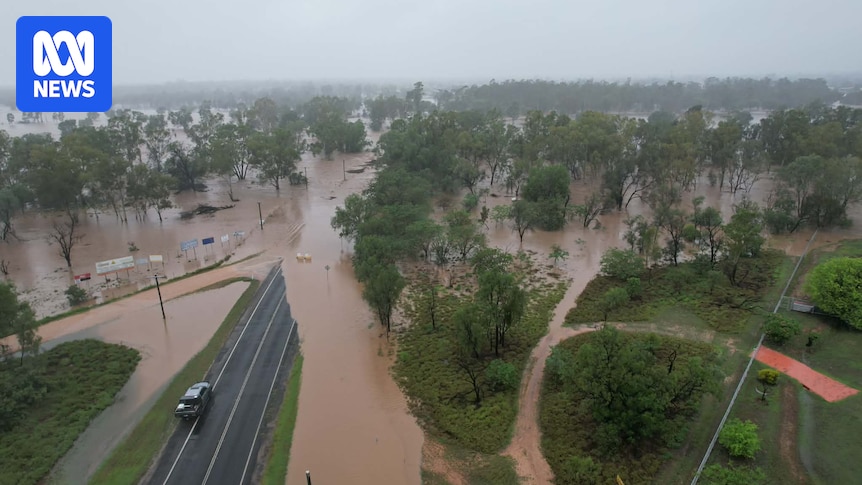
Allan Kelly had driven on the flooded Gregory Highway before, but when he felt his ute start to move sideways, he knew he and his daughter were in trouble.
“Not my greatest moment as a father,” the Clermont-based property owner and church pastor said.
The ute eventually became stuck in a table drain, and Mr Kelly and his daughter were forced to sit on the top of the vehicle until 2am.
“I got out and I tested the water and I got up onto the road, it was just above my knees,” he said.
Both eventually pulled themselves up onto the road and walked 4 kilometres back to town.
Allan Kelly says he wanted to return home as quickly as possible to check on his horses. (ABC Capricornia: Vanessa Jarrett)
The memory of threatening storm clouds sticks with Mr Kelly.
“I was worried because it was still raining,” he said.
“It could have come up. We could have got washed away.“
In the small Central Queensland town, similar stories are still told six months on from the worst flood in more than 100 years.
As the remnants of Ex-Tropical Cyclone Koji barrelled west, it spread consistent heavy rain across broad swathes of the Isaac and Central Highlands regions.
At the convergence of several creeks, more than 140 homes in and around Clermont were impacted on Monday, January 12.
Local helicopter pilots scrambled to rescue stranded families as waters rose rapidly.
Liz Slattery says her group was not given any warnings the waters were rising quickly in Clermont. (ABC Tropical North: Liam O’Connell)
State Emergency Service (SES) Clermont group leader Liz Slattery said there were two volunteers, including herself, in town that day.
“There wasn’t any preparations here; we were given no warning whatsoever,” she said.
Ms Slattery said despite filling sandbags quickly, it was too late to help some people.
“We had an urgent job come in that there was an elderly couple trapped in floodwater,” she said.
Dozens of homes across Clermont and other low-lying areas were impacted. (Supplied: Bush Heli Services)
“We borrowed a neighbour’s tinny and went and picked them up, and they had water up to their waist in their house.”
Private helicopters spent the day rescuing people isolated by rising water, and more volunteers from across Central and North Queensland arrived in the following days.
Ms Slattery said it was “very lucky” no-one died in the floods.
“We could have been looking at a few fatalities because it just happened so quickly,” she said.
State, federal funding stoush
As residents ask how to better prepare the town for future floods, the Queensland government is disputing commonwealth plans to change disaster-funding arrangements.
In the days after the emergency, the state and federal governments allocated more than $66 million to direct disaster support to communities across Central and Western Queensland.
Further bridge and drainage upgrades in Clermont have also been announced in the months since.
Private helicopters spent days ferrying people, food and essential supplies to isolated farms. (Supplied: Bush Heli Services)
The commonwealth has now proposed splitting state and federal funding 50/50, instead of the current 64/36.
Queensland Disaster Recovery Minister Ann Leahy said if the proposal went ahead, it would “seriously impact on the ability of councils and the state government to continue that recovery”.
“We can work with councils to make sure that we get that trunk infrastructure into those newer states, which are flood-free,” Ms Leahy said.
“But we want to make sure that there’s no daylight between response and recovery.”
Recurring nightmare
A bright-yellow excavator sits next to a freshly dug pile of dirt at Justin Lawrence’s property, about 15km outside town.
Justin Lawrence is building a levy bank well above the 1916 flood level. (ABC Capricornia: Vanessa Jarrett)
He said he bought the digger this year and intended to build a levy bank around his property after being caught by surprise by the fast-rising water in January.
“It washed through the backyard hard, which took the pool fence, and that’s when it started getting fairly real,” Mr Lawrence said.
While water did not enter the home, he said the chaos of ensuring his children, his horses and valuable machinery were safe had stayed with him.
Justin Lawrence says his property sits downstream of Clermont township, and he had more warning water was coming. (ABC Capricornia: Vanessa Jarrett)
“Afterwards, you’d be asleep in bed and wake up thinking that water was coming through the window and that you were going to get wet in bed.”
Homes, farms rebuilt
At Mr Kelly’s home, the force of the water slammed kilometres of fencing and twisted them into metal balls.
The past six months have involved waking up before sunrise to spend two to three hours rebuilding the fences before work, as well as on days off.
Allan Kelly says he has been able to retrieve and reuse fence posts which were not as badly damaged. (ABC Capricornia: Vanessa Jarrett)
“We’ve probably got 4.5km done and we’ve got another five to do,” he said.
He said neighbours had been sharing everything from Rosewood fence posts to mechanical post-drivers.
“All different people have come out just to help with fencing and pushing and lending a shoulder and pushing in, that’s been so encouraging.”