




Businesses around the world are clawing back tens of billions of dollars paid to United States customs after Donald Trump’s “liberation day” tariffs were deemed unlawful.
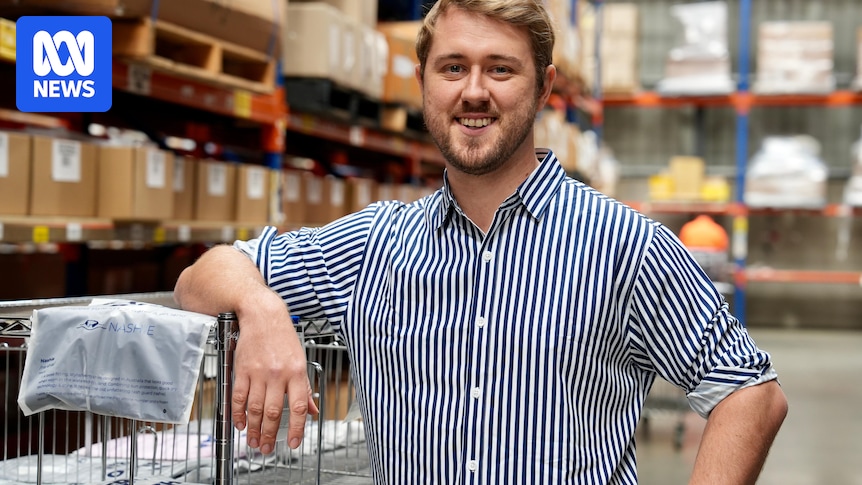
Australian brand Nashie has received a tariff refund, with the six-figure payout including interest on the money illegally deprived.
“I’ve got my very own Trump account,” Nashie’s co-founder Tom Wilson said.
“I can’t believe my eyes.“
Overall, $US80 billion ($115 billion) in tariffs has been refunded by the US since May, plus interest at a rate of up to 7 per cent, analysis by Oxford Economics has found.
Over the next year, the same amount is expected to be refunded to businesses globally.
“This is the largest refund issuance that’s ever been paid off by the Department of Homeland Security,” Oxford Economics’s Grace Zwemmer said.
Why are tariff refunds happening?
Armed with a gigantic board, the US president sent global markets and importers into a tailspin in April 2025 with his self-deemed “liberation day” tariffs.
Donald Trump shocked global markets in 2025.
Australian exporters got a flat tax of 10 per cent slapped onto any goods going into the US, but many faced far higher rates due to making goods in China.
Online start-up Nashie was in this predicament, with its Chinese-manufactured swim garments battling a patchwork of higher tariffs as they sold to buyers in the US.
The fashion brand had only just set up a local distribution hub to sell into the US when Mr Trump introduced the worldwide tariffs.
Nashie already had cargo on the water and needed to suddenly pay extra cash to get its products into the US.
“It is stomach-curdling, the stress that you get from it,” Mr Wilson recalled.
From the outset, Mr Wilson was aware of a legal challenge against the April 2025 tariffs brought by an American not-for-profit law firm, the Liberty Justice Centre.
Its chief executive, Sara Albrecht, had personally voted for Mr Trump three times, but believed passionately that his tariffs needed to be shut down.
“We’re known as a conservative firm,” she told ABC News.
“Taking on a conservative president is not something we decided to do lightly.
“Finding plaintiffs was the hardest thing to do, because President Trump has [been] known to take things very personally.
“There was always a threat of retaliation.”
Sara Albrecht with the Liberty Justice Centre’s co-counsel, Neal Katyal, on the day the Supreme Court ruled in their case’s favour. (Supplied: Liberty Justice Centre)
After a string of rulings and appeals, the law firm eventually won its case earlier this year.
The Supreme Court panel, while split 6–3, ultimately ruled that the president did not have the power to impose sweeping global tariffs under the decades-old law enacted, known as the International Emergency Economic Powers Act (IEEPA).
“It was about the presidency and the separation of powers,” Ms Albrecht said.
The victory turned the president’s signature economic and trade policy into a liability, with billions of dollars to be refunded to businesses across the globe.
How businesses claw back tariffs
Despite the court ruling, getting a tariff refund is not a straightforward process for many exporters globally.
Nashie has been navigating the process through a Californian-based customs broker, Ray Lopez.
“‘Liberation day’ was definitely unprecedented,” Mr Lopez told ABC News.
“It was a very chaotic time for everyone involved.“
Unscrambling the egg has been a huge task for US authorities, with customs receiving tens of millions of claims after the Supreme Court ruling.
“Dealing with that volume of entries on a very short timetable [is] a gargantuan task, unquestionably,” Mr Lopez said.
Nashie’s refund took about two months to clear.
Tariff refunds unavailable for postal shipped goods
As Mr Lopez explained, the Australian brand was lucky it had US-linked import operations and an American bank account.
Importers without this set-up were often in a holding pattern, especially if they went through traditional mail networks to get goods into the US.
Australian small businesses are caught up in US tariff changes. (ABC: Charlotte Wilkes)
This included brands that shipped via Australia Post, including Victorian-based online retailer Emma Jean Jansen.
“I still haven’t had any communication from either Australia Post or [its tariff import platform] Zonos about receiving any refunds,” she said.
Australia Post said it was advocating on behalf of its customers to US authorities.
“We are continuing to seek information on refund arrangements for items sent through the postal network,” a spokesperson for Australia Post told ABC News.
ABC News did not receive a reply from US customs authorities by deadline.
As Mr Lopez explained, it was more complicated to trace individual taxes that were paid on items that went into the US through mail networks.
He said products that entered the US that way might never get their IEEPA tariffs refunded.
“I have a lot of sympathy for those in that situation that paid [tariffs] the Supreme Court found ultimately to be unconstitutional,” he said.
“They paid in duties that were basically illegal, but they are kind of stuck with it.“
He said the ultimate losers were American consumers, who often shouldered the higher tariffs when companies passed them on with higher prices.
Trump’s tariffs threw online retail logistics into chaos. (ABC News: Billy Draper)
“I think often about consumers. The buck got passed to them,” Mr Lopez said.
“And now major companies are going to claim back those duties, but I highly doubt they’re going to pass that on to other consumers.”
Loading…
Will Nashie pay back customers?
Nashie got its six-figure refund with 6 per cent interest this month.
Mr Wilson still cannot believe the cash cleared, with him thanking the Liberty Justice Centre for “sticking up for the little guys”.
“There was a lot of small businesses represented in that court case and a lot of people hanging on around the world,” he said.
“Probably the people fighting that case didn’t realise just all the people who were backing them, including myself.“
Nashie mostly passed on the higher tariffs to customers in the US.
Mr Wilson said refunding that cash and figuring out which order paid what was not a simple process and customers could not get refunded.
“We’ve decided that the best thing we can do is just put [our tariff refund] into making a better product,” he said.
And for all the court victory, the brand was still paying many duties to get goods into America.
Plus Trump is still wielding other tariffs post-“liberation day” using different laws.
Only this month, Australia lodged a formal objection to Trump’s latest round of tariffs and the Liberty Justice Centre is challenging them too.
QUT trade expert Felicity Deane said: “There could be entitlements to refunds there as well.”
“We just have to wait and see what happens,” Dr Deane said.
“It’s just fascinating everything that’s gone on. And what is probably interesting, if Trump was the sort of person to go and ask permission of Congress, and they may very well have given him permission to do all these things, but of course he’s not that sort of personality.”
With his stake in the States growing, Nashie’s Tom Wilson was careful about his message for the president.
“I think he’s just got to relax,” he said.